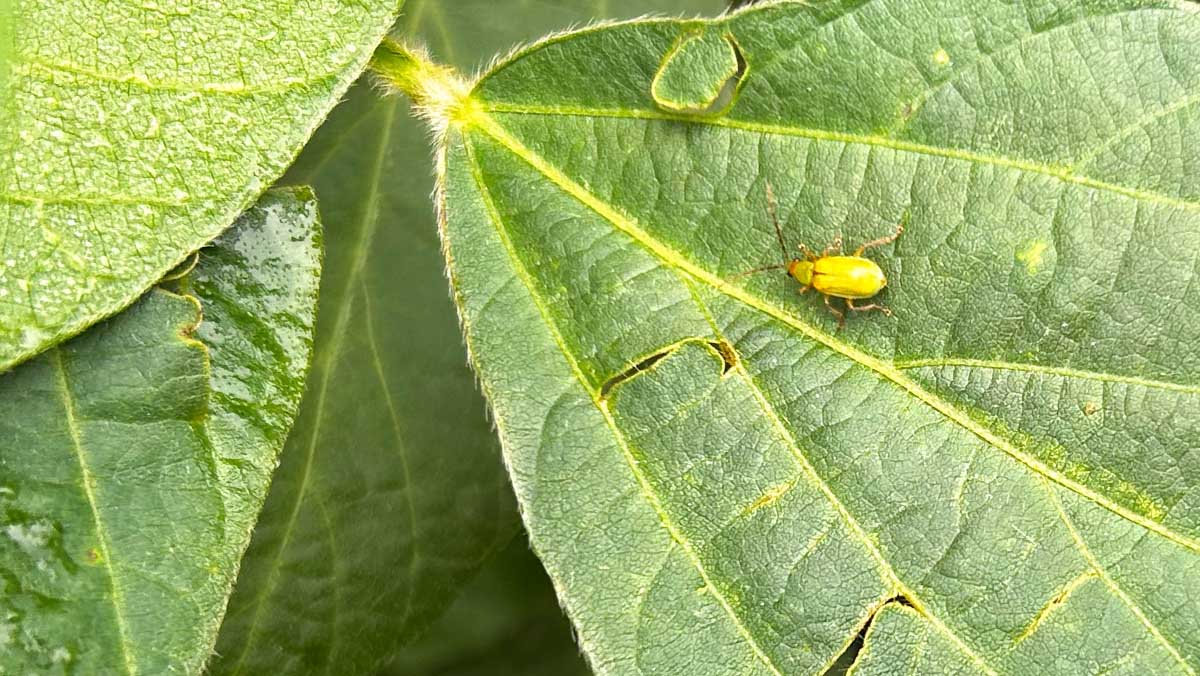
Northern corn rootworm beetle in soybean canopy. Adult beetles may feed on soybean foliage, causing minor feed injury but are generally not considered a significant pest. (Photo: Iowa Soybean Association / Avreeanna Tweedy)
Walking Rows: Late-season scouting pays
August 13, 2026
With much of Iowa's corn and soybean crop entering the final stages of development, the focus is shifting from in-season management to evaluation. Across the state, Iowa Soybean Association research agronomists are encouraging farmers to get back into their fields, assess disease and insect pressure, evaluate management decisions and begin preparing for harvest.
Alex Schaffer – Central Iowa
We have reached the point in the growing season where just about every card has been played to maximize yield on this crop.
The canopy has closed, plants are well into reproductive stages, fungicide applications are wrapped up, and many of you are already prepping combines for harvest. For most of the district, moisture looks sufficient to finish out the season, leaving harvest weather as the main remaining wildcard.

With results of the growing season on full display, walking the field this time of year is well worth the effort for the following reasons:
Evaluate season-long decisions
This is the time to review choices made at planting and throughout the season to see what paid off. Walk fields to estimate yield, check kernel depth, count pods and evaluate treatment effects. If you applied fungicide, hopefully you left check strips to measure true ROI. It's also time to start looking for late-season stalk or ear quality issues that may be brewing.
Identify late-season soybean diseases
Keep an eye out for diseases like sudden death syndrome and brown stem rot. Both show similar foliar symptoms, but splitting the lower stem will tell the story: a brown pith indicates BSR, while a clean white pith points to SDS.
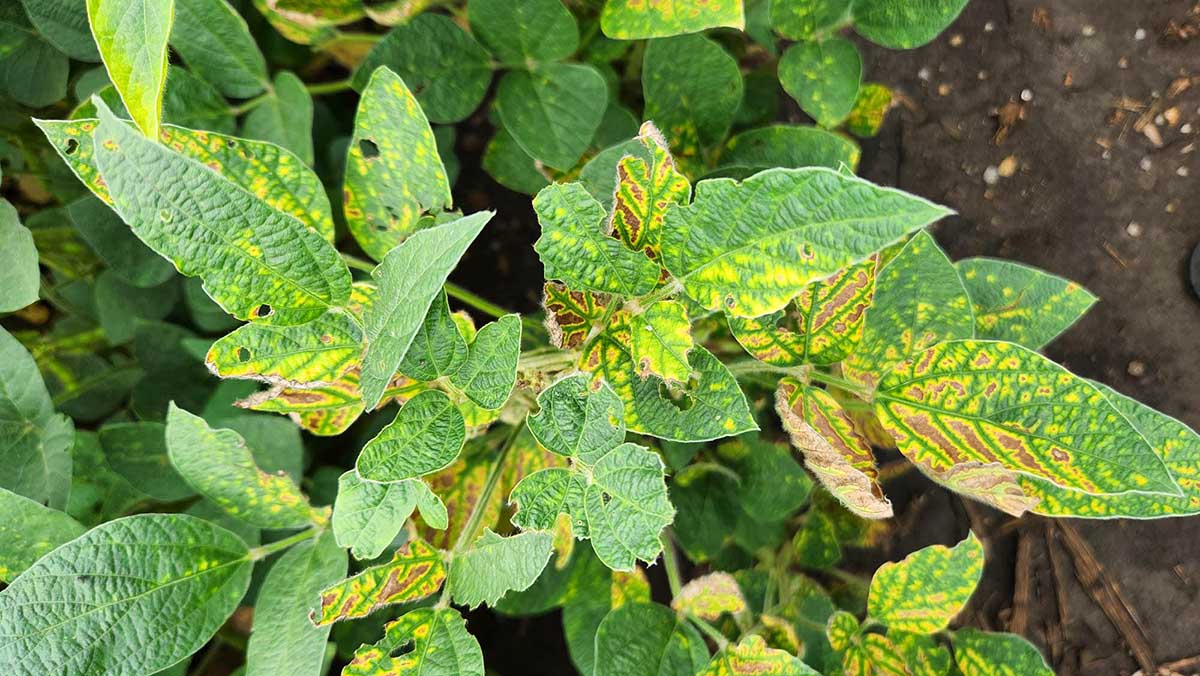
Sudden death syndrome symptoms (Photo: Iowa Soybean Association / Alex Schaffer)
Another disease to keep on your radar is red crown rot. While it hasn't been identified in Iowa yet, it exhibits foliar symptoms similar to SDS.
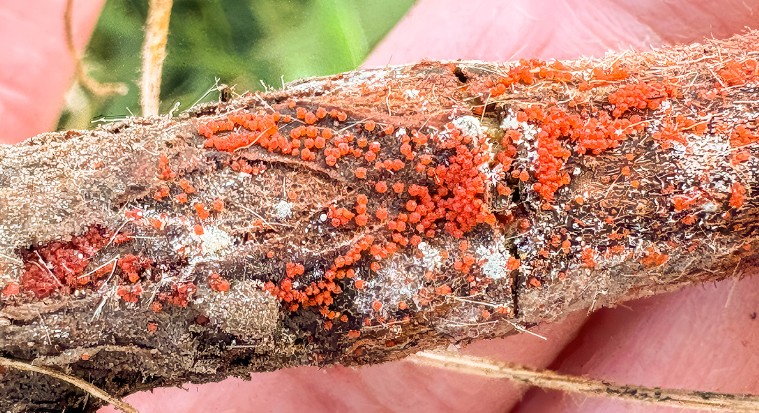
Red crown rot (Photo submitted by Beck's)
The key difference is small red fruiting bodies (perithecia) near the soil surface on the stem base. If you see this, reach out to ISA—we are happy to help you submit a sample for an official diagnosis.
Audit your herbicide program
Weed escapes are pushing above the soybean canopy now. Use this opportunity to evaluate how well your soybean program held up and start planning next year's corn weed control around the seedbank you expect to see.
Set your harvest order
Walking fields now lets you spot hybrids showing early stalk degradation or lodging risk so you can prioritize them on the harvest list. Harvest always comes faster than expected, and having a baseline plan to adapt from is always helpful.
Shane Beck – Northeast/Northern Iowa
Strong storms have once again hit some fields hard, with some even resulting in a complete loss.
The storms on Tuesday and at the end of the previous week left some corn and soybeans completely lost, with the leaves completely stripped in Delaware and Jones counties. Some other fields with less damage will still see significant yield loss from the hail and green snap, but not a complete loss.

Last week, I had the opportunity to tour our phosphorus and strip-till plot in north-central Iowa.
In this trial, we are comparing RhizoSorb, a highly available phosphorus fertilizer from Phospholutions Inc., with conventional phosphate fertilizers, either monoammonium phosphate or diammonium phosphate.
Since RhizoSorb does not tie up in the soil, it can be applied at a half rate of DAP or MAP.
So, in this trial, we have RhizoSorb applied at half the rate of DAP or MAP, with a full rate of DAP or MAP in strips, and the crops planted directly over the fertilizer strips.
After looking at three plots (two soybean and one corn), we didn’t see much difference between the two fertilizer types.
This is what the hope was for RhizoSorb: that it would perform similarly to DAP or MAP at a half rate. We will analyze the yield of these trials this fall to see if there is a difference in yield between the two types of fertilizers, so stay tuned for yield results.
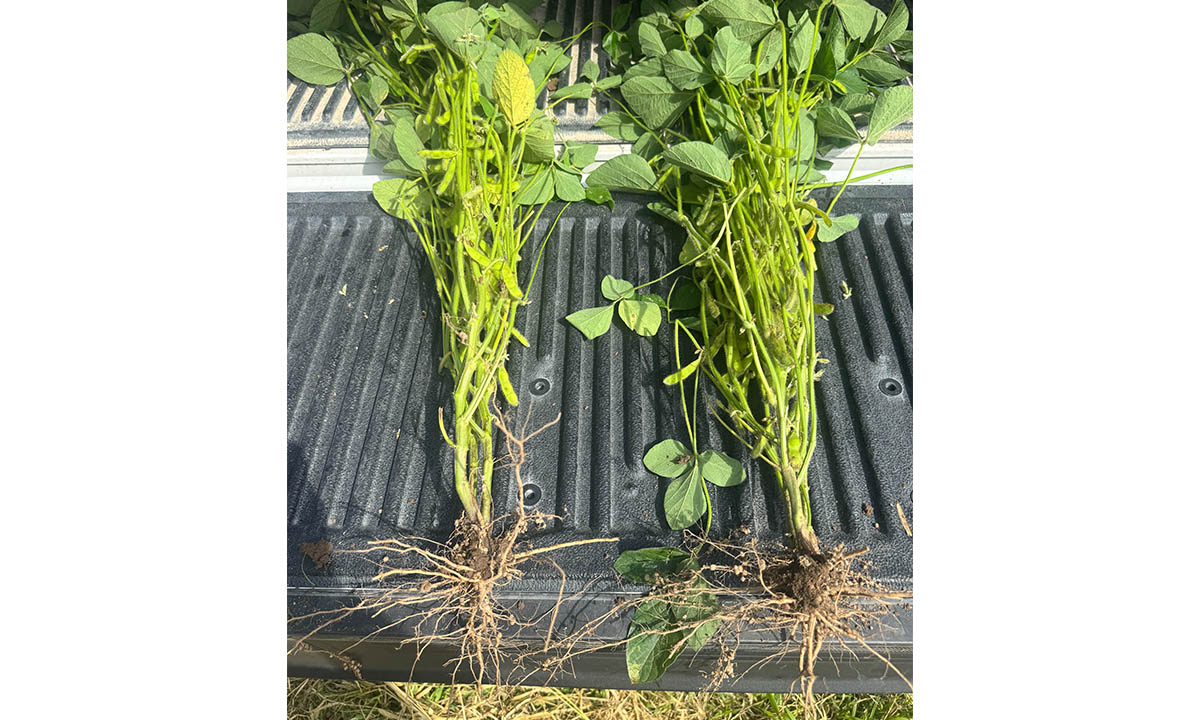
A side-by-side comparison from an ISA RhizoSorb trial shows plots treated with diammonium phosphate (DAP) on the left and RhizoSorb on the right. (Photo: Iowa Soybean Association / Shane Beck)
Craig Woods – Northwest/West Central Iowa
Soybeans in my area are at the R4 to R6 reproductive stages, while corn is at R3 to R4. Recent rains have helped the crops continue progressing through grain fill and pod fill, easing concerns about drought stress.
Even so, moisture remains a concern. Rainfall over the past week has been spotty, with some areas receiving more than an inch while others saw much less. Additional showers in the coming days would benefit pod fill and help sustain yield potential.
While out scouting this week, I saw stink bugs, southern and western corn rootworm beetles, soybean gall midge and some bean leaf beetles.
While pressure from these pests remains fairly low, it will be important to continue scouting, as populations can grow or the insect could introduce a new pathogen, such as bean pod mottle virus, from the bean leaf beetle.
While scouting, I also came across some sudden death syndrome. While not much can be done, choices for future seasons can help mitigate yield losses. Fungicide seed treatments and varieties with some resistance have proven successful in mitigating yield loss to SDS.
Evan Brehm – Southeast/Eastern Iowa
Soybeans range from early R3 to early R4 in the reproductive stage. Although that staging doesn’t seem significant, it surely is. R3 is the “sweet spot” for fungicide applications in soybeans, with R4 still economically viable but not as effective as R3. Walking fields during water monitoring and the occasional scout session, I have seen pods developing in the upper canopy, and now is the time to apply fungicide if warranted.
Corn is all fully tasseled, and fungicide appears to be in high demand this season. With the moisture and temperature fluctuations, diseases of all sorts seem to set in on the corn depending on resistance ratings. I have not heard of any kernel counts yet. Talking with area agronomists, corn is R1-R2. It’s always fun, even in the early reproductive stages, to take yield estimates.

Ground along the rivers and creeks has washed out areas. It’s too late to plant any row crops, but if you want to combat future weed pressure, consider cleaning it up with herbicide or even trying a cover crop.
Corn rootworm has been a huge problem on the eastern side of the state over the past decade. Continuous corn acres are No.1 in attracting CRW. Ongoing research has shown that CRW can exhibit extended diapause when soybeans are in the rotation. Crop rotation used to be the way to curb CRW populations along with resistance. Despite added genetic benefits, CRW still exists in Iowa and can at times be a huge yield robber. I have seen less of CRW in fields that posed issues years prior, but reports and visual scouting continue.
Fungicide applications on corn are in high demand, with acres still being treated. I have seen or heard of almost every corn leaf disease out there this season, but they are being stopped or slowed by fungicide applications. The rain quit for a bit but has recently returned. Although welcomed, diseases could flare up again, unfortunately. At this corn-staging stage, a second application most likely won’t pay for itself but will add bushels. Consider the form of application and if you have your own equipment or not.
Cover crop acres will be increased this fall. That is due mostly to cost-share programs and state support. Row-crop acres that have had cover crops for three or more years continue to demonstrate the ability to suppress weeds.
Genetics in our soybeans, especially, have allowed for better weed control with chemistry. However, it could only be a matter of time before weeds evolve and become resistant to new technologies. Cover crops will help prolong herbicide efficacy by hindering weed germination or suppressing weed growth, allowing better control with herbicides.
Cost-share programs are filling up, if not full already, for cover crops. If you haven’t tried a cover crop before, I’d advise finding a program to help offset the cost and then choosing to plant either oats or cereal rye.
Oats this fall will need to be planted by the last week in September, depending on your location in eastern Iowa. District 6 needs to be planted by September 27 with district 9 in the far south by September 30. Oats winter-kill and do not cause anxiety for first-time cover croppers.
I personally like cereal rye over oats due to the longer planting window per NRCS recommendations, which ranges from November 6-November 10 in districts 6 and 9, and it provides a cover crop next spring with “more bang for your buck”.
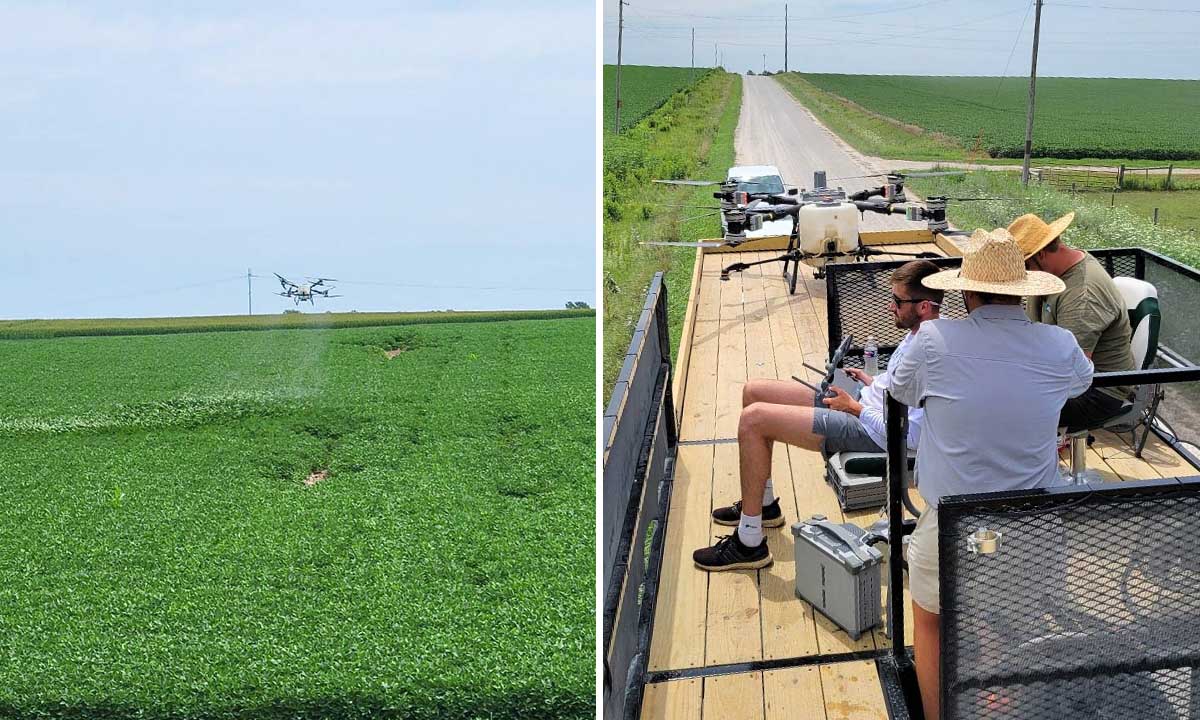
Cover crop applications tend to be heavy by mid-October, with cereal rye as the “go-to” species. However, I have some farmers applying cover crops as early as August 8 with drones. I expect this to increase by late August. Drones have changed the way cover crops are applied, and this trend seems likely to continue as more farmers own drones or have a local ag retailer with those capabilities.
Below are two pictures courtesy of ISA and a local ag retail partner in the Middle Cedar RCPP, Linn Cooperative. This is a drone trial conducted through ISA on soybeans, evaluating drone applications with replicated trials of fungicide, insecticide, fungicide and insecticide, and no application.
(Photo: Iowa Soybean Association / Evan Brehm)
We lined up three of these in district 6 with three ISA farmer members. ISA built the prescriptions, and Linn Cooperative applied them. Two were done on July 31, and the last one was applied on August 10. Soybeans ranged from late R2 to mid R3 in these trials. We are excited to see the results after the harvest season.
Avreeanna Tweedy – Southwest/South Central Iowa
Crops across southwest and south-central Iowa continue to move through grain and seed fill, with much of the corn and soybeans now around the R4 to R5 growth stages. Recent rainfall has provided some much-needed moisture during an important part of the growing season, and overall, crops continue to look good across the area.

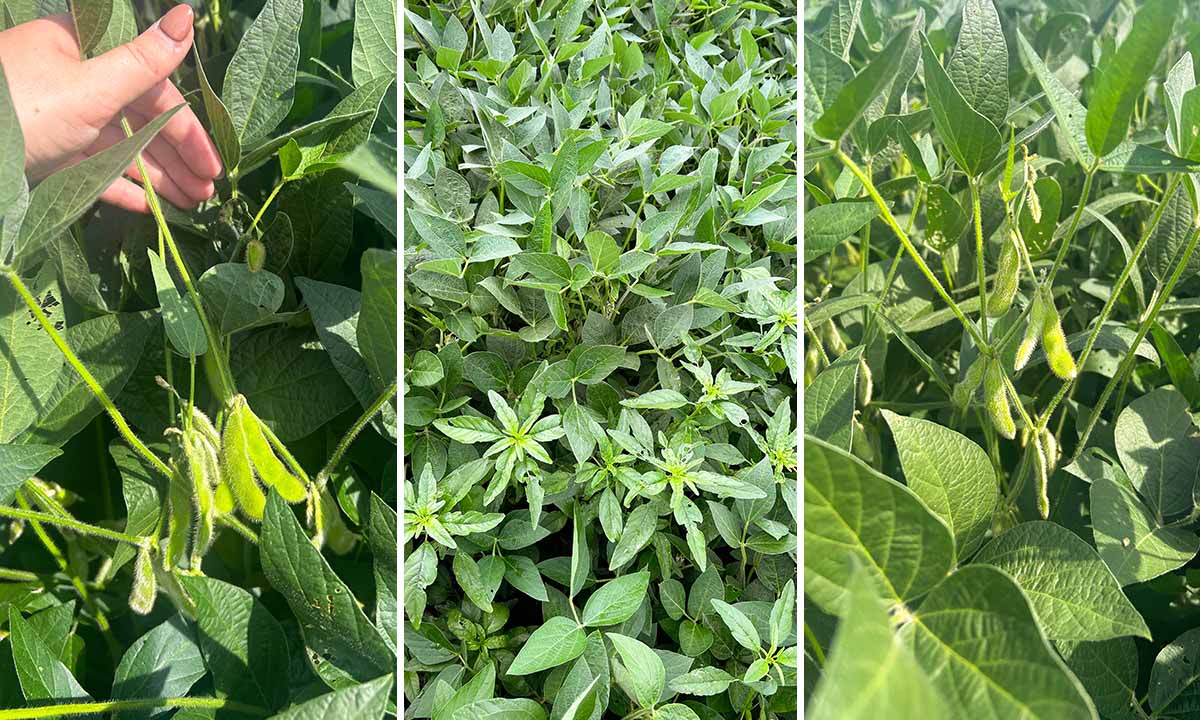
Soybean fields are especially lush this year, with tall, dense canopies and pods continuing to fill. As soybeans move through R4 and R5, now is a good time to look beyond the upper canopy.
Watch for patches of premature yellowing or discoloration that could indicate issues such as sudden death syndrome, red crown rot or other root and stem diseases. White mold and foliar diseases are also worth watching, especially with recent rainfall, humidity and dense canopies. If something looks unusual from the road, get into the field and look at the entire plant, including stems and roots, to help determine what may be causing the symptoms.
Weed escapes are also becoming much easier to spot as they begin peeking above soybean canopies. Take note of where escapes occur and which species are present. Even when there may not be an in-season management option, identifying those problem areas now can help guide weed management decisions for next season.
(Photo: Iowa Soybean Association / Avreeanna Tweedy)
In corn, grain fill continues as fields move through the dough and dent stages. Now is a good time to pull back husks and evaluate ear and kernel development. Look for kernel abortion or tip back, which may provide clues about stress experienced during pollination or early grain fill.
Continue watching the upper canopy for disease progression and pay attention to overall plant and stalk health. As the plant allocates more resources to filling kernels, fields that experienced earlier-season stress may begin showing stalk quality concerns that will be important to monitor as harvest approaches.
Many growers have already made fungicide and insecticide applications this season, which raises another question: did those applications pay off?
Scouting doesn't have to stop after an application. Going back into treated fields can help evaluate current disease and insect pressure and how well the crop is maintaining healthy leaf area as it finishes the season.
That's a question we're also looking at through ISA on-farm research this year. In one of our soybean trials, we're comparing an untreated check, fungicide, insecticide, and a fungicide + insecticide combination.
Treatments were applied at R3, followed by scouting at R5 to evaluate disease and insect pressure across the different treatments. The final piece will come at harvest, when we will compare yield and return on investment to determine whether those applications provided an economic benefit.
As August continues, keep walking fields and watching how crops finish. Pod and kernel development, disease and insect pressure, weed escapes and overall plant health can all provide clues about what we may see when combines begin to roll.
Compiled by Kriss Nelson.
Back