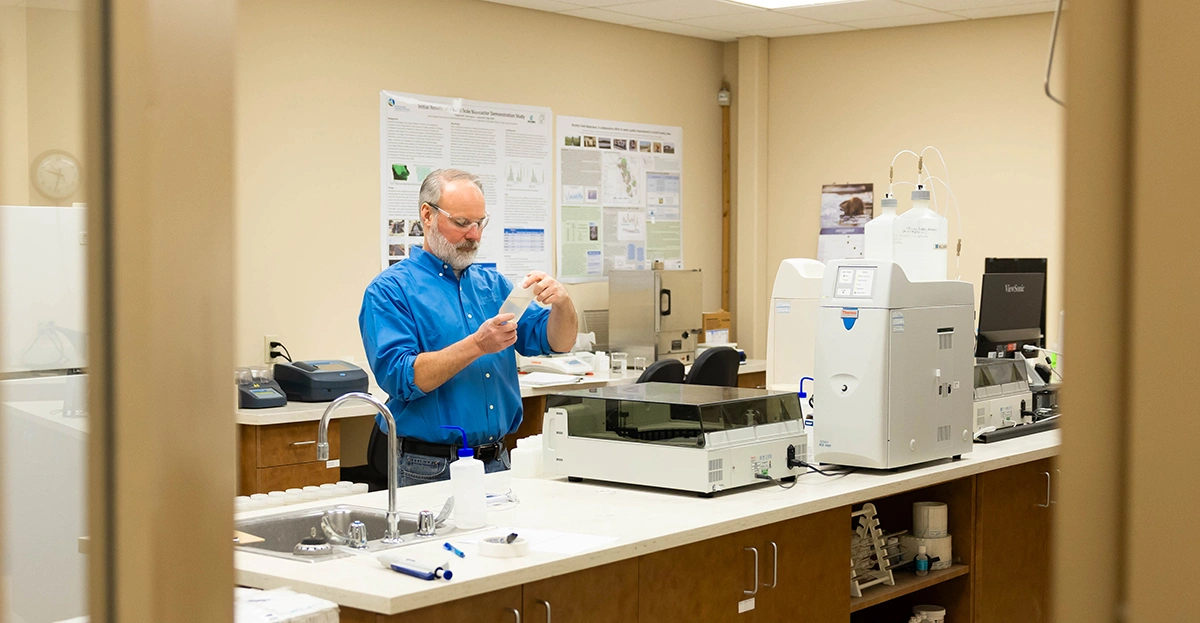
(Photo: Iowa Soybean Association / Joclyn Kuboushek)
What the water tells us
November 12, 2026 | Kriss Nelson
September rainfall brought more than harvest delays to Iowa. It also sent river levels and nitrate concentrations climbing, giving the Iowa Soybean Association Water Lab another chance to examine how weather and seasonal conditions influence water quality.
Tony Seeman, ISA water lab services manager, says the late-season increase was among the most notable findings from another busy year of monitoring streams and tile drainage.
The lab analyzed more than 2,700 samples in 2026, a volume consistent with recent years. Nitrate concentrations were also elevated early in the year.
Warm, moist soil conditions may have increased natural nitrogen mineralization throughout the growing season, releasing nitrogen that remained available after crops had stopped taking it up.
What remains uncertain is whether the late-season increase reflects nitrogen already present in the soil being flushed into waterways or nitrogen released more recently through mineralization. It is also unclear what those conditions could mean for next spring.
Seeman plans to examine tile drainage data more closely this winter to better understand the increase.
What the numbers mean
Beyond tracking water quality trends, testing provides farmers with information they can use to evaluate nutrient management practices.
“It's an ongoing evaluation of how things are working,” Seeman says.
A single sample doesn't tell the whole story. Weather, soil conditions and the timing of nutrient applications can all influence results. Monitoring over multiple seasons helps farmers identify patterns and determine whether adjustments could make a difference.
Those long-term observations provide insight into how different nutrient management approaches perform.
For example, Seeman has observed that farmers who use sidedress nitrogen applications and adjust rates based on growing-season conditions generally have consistent, relatively low nitrate concentrations in their tile water. Rather than applying all their nitrogen in the fall or early spring, these farmers evaluate crop needs as the season progresses.
“They're really trying to fine-tune exactly what they need, and only what they need,” Seeman says.
Water testing helps farmers assess conservation practices, including cover crops that take up nutrients when cash crops aren’t growing. Those practices can help limit nutrient losses during the offseason.
Expanding monitoring efforts
The ISA Water Lab continued working with Agriculture's Clean Water Alliance, Soil and Water Conservation Districts and projects supported by the Iowa Department of Agriculture and Land Stewardship’s Water Quality Initiative in 2026.
Monitoring efforts included renewed work in Taylor County and continued sampling in the South Skunk River watershed in Mahaska County.
In northwest Iowa, Sioux and Plymouth counties joined Lyon and Osceola counties in countywide stream monitoring efforts.
The lab expanded tile water monitoring through partnerships with conservation agronomists.
Those relationships allow ISA to reach more farmers while connecting them with trusted advisers who can help interpret results and consider potential management changes. Agronomists can coordinate sampling across multiple farms, making monitoring more efficient.
“It gives them someone to work with to make changes if they do see something,” Seeman says. “They have a trusted adviser to help them with the next steps.”
The lab increased its phosphorus testing in 2026, primarily analyzing total phosphorus in stream samples. As more information becomes available, ISA may consider expanding phosphorus monitoring at the edge of fields in selected areas.
A resource for Iowa farmers
Operating since 2011, the ISA Water Lab provides water quality testing to support conservation research and better understand nutrient movement.
The lab has been accredited and certified through the Iowa Department of Natural Resources under the federal Safe Drinking Water Act to analyze E. coli bacteria, nitrates, nitrites and fluoride.
Seeman says more farmers and landowners contacted the lab directly in 2026 amid increased water quality awareness.
Farmers interested in participating in 2027 can work through existing monitoring projects or collect samples themselves, depending on their location. For individual monitoring, ISA can provide sample bottles for monthly collection. Farmers generally freeze the samples and return them together at the end of the growing season for analysis.
The lab is also interested in working with groups of farmers in areas where coordinated sampling could expand monitoring efforts.
To learn more about water testing or participate in 2027, contact Seeman at aseeman@iasoybeans.com.
Written by Kriss Nelson.
Back