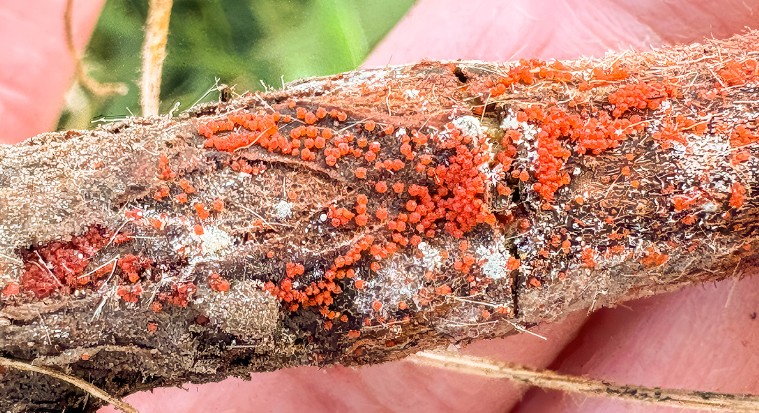
(Photo: Submitted by Beck's)
Red crown rot emerges as a disease to watch in soybeans
July 1, 2026 | Kriss Nelson
A relatively new soybean disease is starting to get more attention across the Corn Belt, and agronomists say it’s one that farmers need to understand but not panic over.
Red crown rot, caused by soilborne fungus, has been confirmed in several Midwestern states in recent years. While it has long been present in the southern U.S., its movement north has raised questions about identification, yield impact and management. It has not yet been confirmed in Iowa.
“Respect the disease, but don’t panic,” says Matt Montgomery, an agronomist with Beck’s.
Disease origins
Red crown rot was first identified decades ago in peanuts before moving into soybeans in southern regions. It wasn’t officially confirmed in the Midwest until 2018, but has since spread into multiple states, including Illinois and Indiana.
The disease survives in the soil as microscopic structures that can persist for years, even in the absence of a soybean crop. It can also survive on a wide range of host plants, making it difficult to eliminate once it’s established.
“This is new enough that there’s still a lot we don’t know,” Montgomery says. “We’re still learning how it behaves in our environment.”
What to look for
One of the biggest challenges with red crown rot is that it can easily be mistaken for sudden death syndrome, especially early in the season.
Initial symptoms often include yellowing between leaf veins, similar to SDS. But the disease progresses differently and can move quickly.
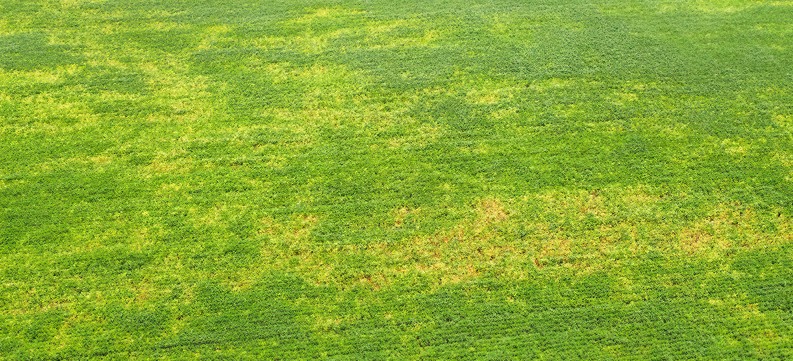
“You can go from plants that look like SDS to plants that are completely dead in just a few days,” Montgomery says.
Infected fields often show a mix of healthy, yellowing and dead plants scattered together, rather than uniform patches. Another key difference is that the leaves in plants affected by red crown rot tend to stay attached to the plant even after it dies, unlike SDS, where leaves drop off.
The most definitive sign is found at the base of the plant.
To confirm red crown rot, farmers need to dig plants and look about an inch above and below the soil line for small, red, pinhead-sized structures.
“Nothing else does that in the Midwest,” Montgomery says. “If you find those, you’ve got red crown rot.”
Yield impact and timing
While not every field will experience significant losses, yield loss can range from 40% to as much as 60% under the right conditions.
“It’s one of the few threats we’ve encountered that can take yields down that much,” he says.
The timing of infection is part of what makes the disease so damaging. Red crown rot infects plants early in the season but may not show symptoms until mid- to late summer. By then, plants can decline rapidly before they’ve fully set yield.
Moisture appears to play a role in the disease's aggressiveness, Montgomery says.
“In wetter years, it seems like the disease really takes off. In drier conditions, you may still see it, but not the same level of yield loss,” he says.
Confirm the diagnosis
Consistent scouting can help detect red crown rot early. Farmers participating in on-farm trials through Iowa Soybean Association’s Research Center for Farming Innovation have that built-in advantage.
“A tangible benefit for farmers participating in on-farm trials is access to qualified agronomists to help scout fields,” says Alex Schaffer, ISA research agronomy lead. “We’re already in those fields and are always on the lookout for pests and diseases, including red crown rot.”
For now, scouting and accurate identification are the best line of defense.
“If you see something that looks like sudden death, get out of the cab and check,” Montgomery says.
He encourages farmers to dig plants and look for those telltale red structures before making assumptions.
If a farmer suspects they have red crown rot, they should contact Daren Mueller, professor and extension plant pathologist at Iowa State University.
ISA research agronomists can assist farmers in collecting samples, logging the necessary information, and delivering it to the ISU Plant and Insect Diagnostic Clinic in Ames for final identification.
No silver bullet
Management options are still evolving, but Montgomery says early research points to a layered approach, including variety selection, seed treatments and minimizing plant stress.
“There’s no silver bullet,” he says. “It’s going to take a systems approach.”
As research continues, the focus remains on understanding how red crown rot spreads, what conditions trigger the disease, and how farmers can stay ahead of it.
Although red crown rot has not been detected in Iowa, RCFI is trialing Syngenta’s new Victrato seed treatment as a proactive step.
“We want to be ahead of the curve with data on management options for this disease in case it shows up in Iowa,” Schaffer says. “These trials will help us better understand how the product performs, including on pests already present in Iowa, such as soybean cyst nematode and sudden death syndrome.”
In the meantime, Montgomery’s advice remains steady.
“Take it seriously,” he says. “Just don’t panic.”
Suspect red crown rot in your fields?
Contact ISA Research Agronomy Lead Alex Schaffer at aschaffer@iasoybeans.com or 815-274-2998. Or contact Daren Mueller, professor and extension plant pathologist at Iowa State University, at dsmuelle@iastate.edu.
Samples may also be dropped off or mailed to the ISU Plant & Insect Diagnostic Clinic in Ames. A completed submission form must accompany the sample. Avoid mailing samples on Thursdays or Fridays to prevent delays over the weekend that may affect sample quality. Photos to accompany plant samples are encouraged and may be emailed to pidc@iastate.edu. Samples can be delivered between 8 a.m. and 4 p.m., Monday through Friday, excluding university holidays.
Written by Kriss Nelson.
Back