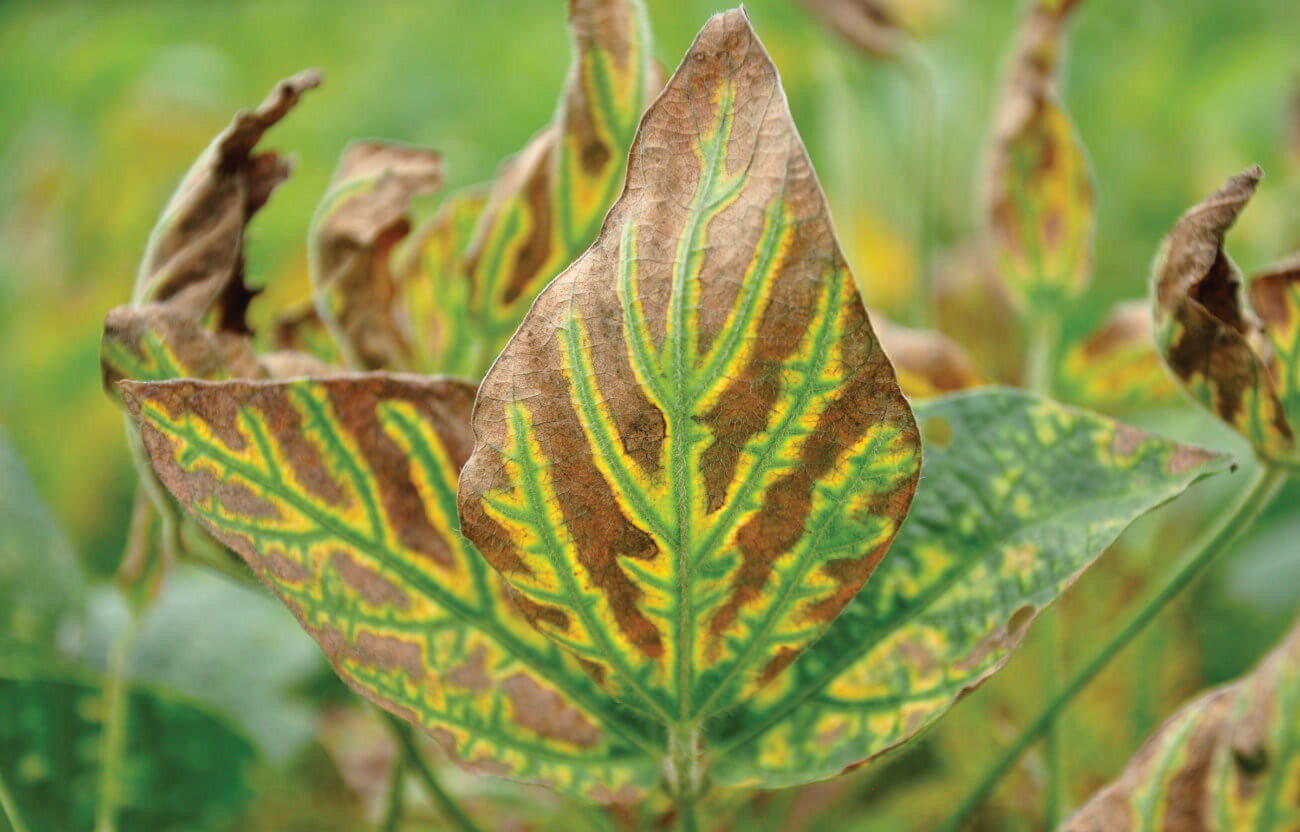
Sudden death syndrome is showing up in some Iowa soybean fields. Because foliar symptoms can resemble other diseases, farmers should inspect symptomatic plants rather than diagnose SDS from the road. (Image from Soybean Research & Information Network)
Walking Rows: Harvest comes into view
August 27, 2026 | Kriss Nelson
Iowa farmers are shifting their focus from managing the crop to preparing for harvest. Iowa Soybean Association research agronomists say it’s time to scout for late-season disease, assess standability and weed escapes, and note what worked, or didn’t, before harvest begins.
Alex Schaffer – Central Iowa
The feeling in district 5 is that we have shifted from managing the growing crop, to preparing for harvest and the 2027 growing season. One soybean field is beginning to show signs of maturity, while some yellow is starting to creep into the corn crop.

Instances of Sudden death syndrome and brown stem rot seem down this year, but if you do see those telltale foliar symptoms, continue to be on the lookout for red crown rot, distinguished by the red fruiting bodies near the soil.
Most of the rest of the district remains green and continues to fill pods. This late-August moisture should support nice bean yields.
As we begin preparing for the 2027 growing season in the research agronomy department, we’re organizing fall soil sampling and coordinating cover crop applications. As soybean fields begin to turn yellow, we’ll apply some of our cover crop plots by drone, targeting seed to be on the ground just before leaf drop.
We are recruiting for fall trials looking at cover crop implementation and optimizing fertilizer inputs. If you are interested reach out to me at aschaffer@iasoybeans.com.
Shane Beck – Northeast/Northern Iowa
Harvest is quickly approaching for much of the area, with probably less than a few weeks until combines start rolling. A little bit of seed corn has been picked so far, and the rest of the fields appear to be drying down nicely.
Across my travels the last couple of weeks, I have noticed a couple of diseases showing up in both corn and soybean fields. One is sudden death syndrome in soybeans, which has become more obvious over the last couple of weeks in some fields around the Highway 20 corridor.
SDS cannot be combated with foliar fungicides, so there isn’t much that could have been done about it in-season. Two things that can help protect soybeans are resistant varieties and a good seed treatment. If you are noticing SDS in your fields, check what variety was planted and whether it had a seed treatment. That could play a part in deciding what varieties to plant next year.
Anthracnose in cornfields has also become more prevalent over the last couple of weeks. It is causing leaf blight in the upper canopy and slowly killing the top of the plant. It can also lead to stalk rot. It is important to watch stalk integrity in these fields and consider harvesting them a little earlier than desired to help prevent lodging.
The Pro Farmer Crop Tour concluded last week, with yield estimates coming in slightly lower than USDA had predicted. With the weather conditions across the Midwest and extreme storms, this is not overly surprising.
I have talked with several farmers who were a little disappointed with overall ear size this year and the amount of tip-back they were seeing in their fields. One thing to look at, though, is the number of viable kernels in each row of the ear. I was surprised by some of the numbers we were getting at a field day last week, even with 1 to 2 inches of tip-back.
As that agronomist said, don’t put too much stock in yield estimates. He stressed that unless you know the genetics you are growing and the kernel weight, it can be difficult to accurately estimate yield because kernel size can vary significantly from hybrid to hybrid.
Craig Woods – Northwest/West Central Iowa
With scattered rains bringing relief to moisture-stressed soybeans and corn, farmers in northwest and west-central Iowa are preparing for harvest and evaluating how well management practices performed this year.
Disease and insect pressure have been relatively low. However, scouting has produced reports of western bean cutworm, corn rootworm beetles and southern rust. With most corn at the R5 stage, the benefit of applying a foliar fungicide for southern corn rust is unlikely, according to the Crop Protection Network.

There have also been scattered cases of SDS.
While there isn't much that can be done at this point to manage SDS or corn rootworm damage, farmers can begin making harvest plans. Prioritizing fields based on standability and other risk factors can help ensure the best possible harvest.
In addition to making harvest plans, some farmers are preparing to seed cover crops through interseeding or getting equipment ready for planting. With plenty of options for species and seeding methods, having a plan in place will be important. Taking advantage of available heat units and moisture can help ensure good establishment and biomass accumulation, setting the cover crop up for success.
Find ISA recommendations for cover crop species, seeding, termination and cash crop management in the Cover Crop Management Guide
Lucas DeBruin – Southeast/Eastern Iowa
“August rain makes a soybean crop.” This August has brought plenty of moisture, enough in some areas to swim, drown, but hopefully, still yield. Not a lot is happening in the fields right now. Weeds are beginning to pop through the canopy in some areas, and I’ve received reports of southern rust appearing in untreated corn. There has also been some chatter about stalk rots, which could indicate root rots are present as well.

Remember to check fields that were hit by hail this season, and determine whether harvest plans should prioritize thinner stands and weaker plants.
Soybeans have put on some good height, so let’s hope they don’t start to lodge. I have also seen a few soybean fields beginning to turn. Harvest is right around the corner, so now is the time to make a harvest plan if you haven’t already.
Reach out to your local ISA research agronomist about fall trial opportunities that may fit your operation.
Avreeanna Tweedy – Southwest/South Central Iowa
Consistent rainfall over the past few weeks has kept soil moisture around, and soybeans across southwest and south-central Iowa are generally in the R5 to R6 stages. Overall, farmers I've visited with are feeling good about the crop and are excited to see what is actually out there once the combines start rolling.
As we begin preparing for harvest, it’s a good time to make another pass through fields and evaluate how the crop is finishing. Look for lodging, weed escapes, disease pressure and differences in soybean maturity.

In corn, start checking stalk quality and standability to identify fields that may need to be prioritized at harvest.
These late-season field walks can also tell us a lot about how our management decisions performed this year. Did certain varieties handle disease or stress better? Are there patterns that could point to drainage or compaction concerns? These observations can easily disappear once the combine rolls through, so documenting them now can help guide decisions for next season.
One issue that has become much easier to spot recently is SDS. I've seen SDS symptoms coming on strong in some soybean fields. Look for yellowing and browning between the leaf veins while the veins remain green. Because several diseases can produce similar foliar symptoms, don't diagnose SDS from the road. Pull a few symptomatic plants and split the stems lengthwise. With SDS, the pith typically remains white, while brown stem rot can cause similar foliar symptoms but typically causes browning within the pith. Identifying affected areas now can help guide management the next time that field rotates to soybeans.
Harvest will also be the final test for many of our on-farm research trials. Even when there isn't an obvious visual difference between treatments throughout the season, yield data can tell a different story. I'm looking forward to seeing what we learn as we also begin recruiting for fall research opportunities, particularly those focused on nitrogen management. As you evaluate this year's crop, think about the questions you still have about your management system and how on-farm research could help answer them.
Compiled by Kriss Nelson.
Back