(Photo: Iowa Soybean Association / Joclyn Kuboushek)
Biological trial results: Test before you invest
November 2, 2026 | Josh McDanel
Key Insights
1. Fundamentals
Basic field management practices, including balanced fertility, proper soil pH and an effective herbicide program, are in place before investing in a biological product. Biologicals should complement sound agronomic practices, not replace them.
2. Mixed results
Internal ISA biological trials showed a mixed yield response to biological products. Soybean trials resulted in a higher potential for yield gain compared to corn.
3. No sure thing
Science for Success found that soybean yield was not consistently improved compared to the untreated control, regardless of what product was tested.
Biological product availability is expanding as companies develop new products to assist plants in crop growth outside traditional management strategies. Products range from microbes applied to the soil that improve nutrient efficiency and uptake to residue decomposers that accelerate breakdown to help with crop emergence and nutrient cycling.
If you are confident that your management fundamentals are sound in terms of balanced fertility, pH and an effective herbicide program, it may be time to consider a biological. Covering the fundamentals first is the key to maximizing the potential of a biological product.
External research
Initial research for new products takes place in a lab setting where factors like weather and soil are easier to control. While helpful for early testing, field trials show that products perform differently in the field than in the lab. Science for Success evaluated biologicals in soybean trials across 22 states in 2022 (including Iowa) and 2023. Researchers tested several biological seed treatments marketed to help with some, but not all, of the following categories: disease and pest suppression, enhanced nitrogen fixation, better nutrient uptake, and improved plant growth and vigor.
In both years, researchers observed no statistically significant difference between the biological and untreated controls. Overall, they found that some products worked in specific situations and environments, but no product worked everywhere, and observed yield differences were marginal.
Additional work from the University of Wisconsin and The Ohio State University reviewed the number of trials needed to detect yield differences of 1.5 bushels per acre and concluded that it would likely take 50 to 80 locations. Given this high number, we strongly encourage farmers testing biologicals to replicate across multiple fields and years before making a large investment.
Internal ISA trials
At the Iowa Soybean Association, we have compared multiple biological products side-by-side with untreated strips over the last few years. The products tested performed similarly to those in external research trials.
The yield difference between biological strips and untreated strips was variable for both corn and soybeans. The accompanying graph shows a good example of these results from biological trials conducted in 2021 and 2022 using Sound Agriculture’s Source SC (soybean) and Source DC (corn). (Source is applied in-season to the crop canopy, often with a herbicide pass. It translocates through the plant into the root zone, stimulating microbes in the rhizosphere.)
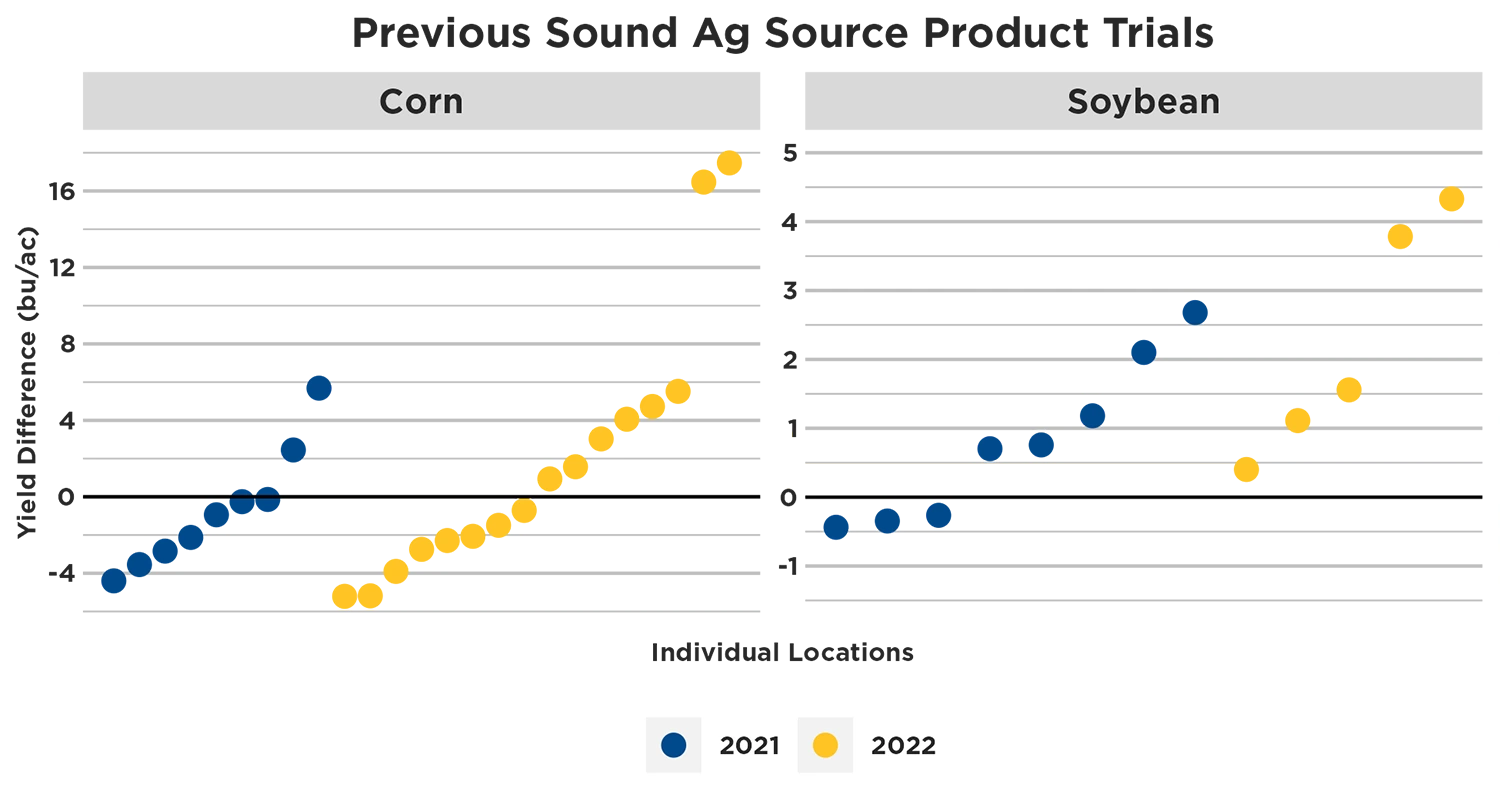
Yield difference by year between strips treated with Source biological versus untreated strips. A positive value indicates the biological yielded higher than the untreated strips. Yield difference in corn was more variable than that observed in soybeans.
Corn in our Source trials showed higher variability in yield difference than soybeans. Soybeans had a higher occurrence of Source outperforming untreated strips. However, that yield difference was not substantially positive, as the average yield response was 1.4 bushels per acre.
An important aspect to note for these trials was that both 2021 and 2022 were seasonably below average for rainfall. That lack of moisture likely caused increased stress and limited the potential effects of the product.
Another biological product ISA trialed at seven corn sites in 2023 was AMVAC’s iNvigorate. Applied from planting to the mid-vegetative stage, iNvigorate can be applied in-furrow, at planting with starter fertilizers, side-dressed, top-dressed, broadcast, or applied via drip or pivot irrigation. Results were similar to those observed in external trials and previous Source trials: A 1.6-bushel-per-acre yield advantage was observed in the iNvigorate strips compared to untreated strips.
Test your fields
A wide array of biological products is available to purchase and apply. New products are constantly being developed, making in-field testing challenging. At ISA, we routinely assist growers with trials they set up in their own fields, performing detailed analyses on product performance. If you are interested in using biologicals, reach out to us and we can help you conduct a trial.
Have a trial or a project you’re interested in?
We can consider it as a topic in a future issue. Better yet, we’ll connect you with your local expert so you can implement a trial on your farm.
Email us at agronomy@iasoybeans.com
Written by Josh McDanel.
Back