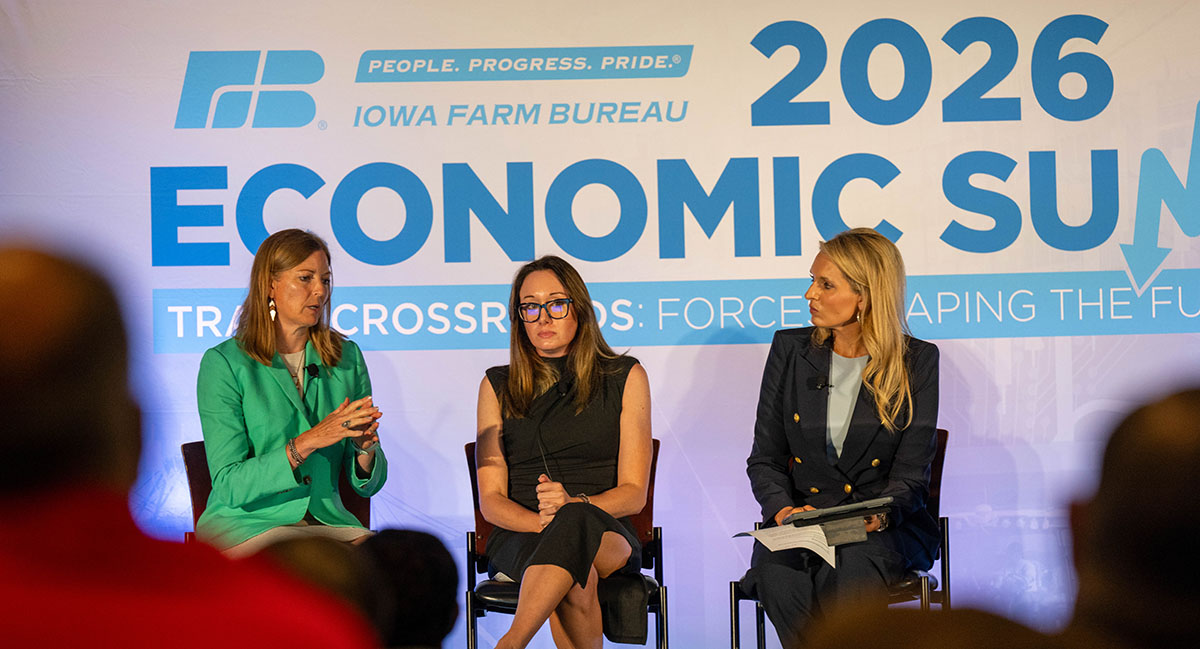
No Bull Agriculture founder Susan Stroud (center) listens in as Erin Borror (left), U.S. Meat Export Federation president of economic analysis, highlights the benefits to U.S. farmers of growing global protein demand. The discussion was facilitated by Tyne Morgan, host and executive producer of U.S. Farm Report. (Photo: Iowa Farm Bureau / Conrad Schmidt)
Trade turbulence creates mix of uncertainty, optimism for U.S. farmers
July 23, 2026 | Aaron Putze, APR
Trade is a driver of both profitability and uncertainty for U.S. soybean farmers.
It’s reassuring to know some things never change.
The theme of profitability and uncertainty driven by changes in U.S. trade policy echoed throughout multiple presentations at an Iowa Farm Bureau Federation economic summit held July 17 at the FFA Enrichment Center in Ankeny.
The agenda included an all-star lineup of speakers with deep knowledge and involvement in trade policy and a divergence of opinion.
U.S. a free trader
Sam Gregg, president and Friedrich Hayek Chair in Economics History for the American Institute for Economic Research, argued free trade is the optimal policy for the United States.
“America has always been a trading nation, and we always will be a trading nation,” he said.
“Even before our founding as a country, we were trading throughout the rest of the world. The Empress of China docked before we even had a western coastline.”
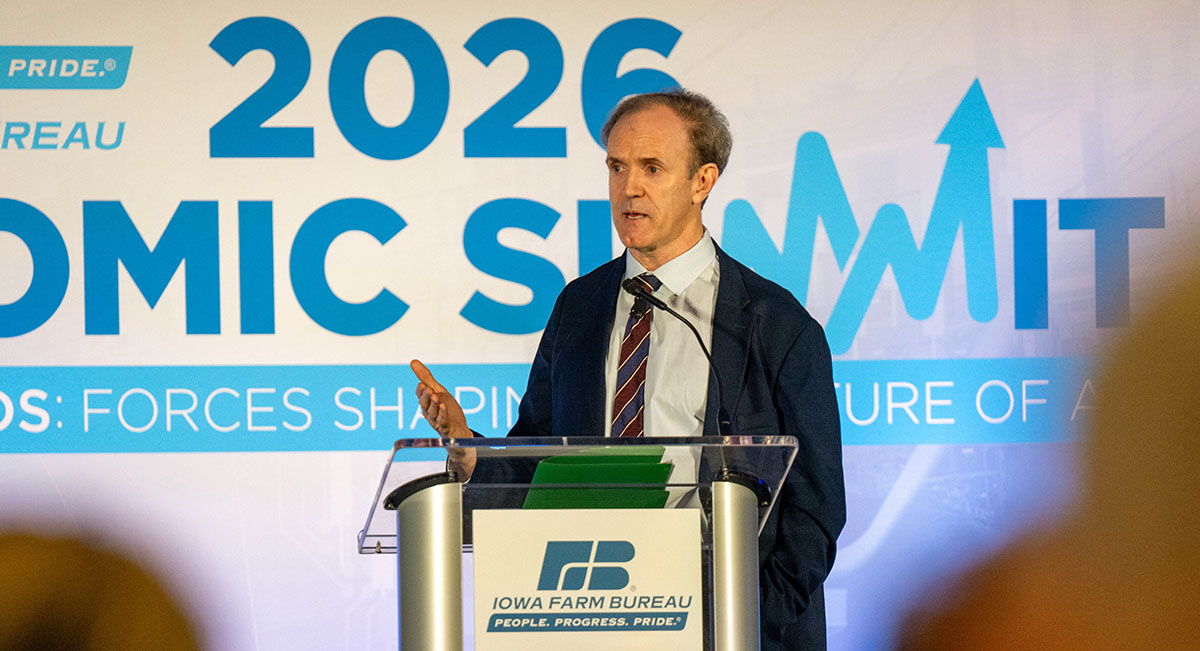
Sam Gregg, president and Friedrich Hayek chair in economics history for the American Institute for Economic Research, speaking at the July 17 Iowa Farm Bureau Federation's Economic Summit. (Photo: Iowa Farm Bureau / Conrad Schmidt)
Trade has been central to economic and political debates since 2016 and along with it, a point of contention, he added.
“Not long ago, many trade issues had been solved. But we got a big surprise in 2016 when, for the first time in many decades, America has a convinced protectionist in the White House,” he added. “This has had big implications on the U.S. and the rest of the world.”
Protectionism - including the use of tariffs - undermines the competitiveness of U.S. companies. When they’re not exposed to international competition, Gregg said companies get lazy and complacent.
A protectionist approach to trade also raises costs for American businesses and consumers because tariffs are essentially a tax and facilitates cronyism.
“It gives rise to special interests wanting their own policy and trade favors,” said Gregg. “Even if you’re in favor of tariffs, you cannot deny that special interest groups are highly influential. They are hyper focused on what benefits them and less on what benefits the United States.”
Former U.S. Trade Representative Robert Lighthizer disagreed with Gregg’s assessment that free trade benefits U.S. families.

Former U.S. Trade Representative Robert Lighthizer (left) converses with Iowa Farm Bureau Federation President Brent Johnson at an economic summit held July 17 in Ankeny. More than 300 attended the meeting sponsored by IFBF. (Photo: Iowa Farm Bureau / Conrad Schmidt)
“There’s never been free trade,” Lighthizer retorted. “The current system is broken, and it has harmed America dramatically and it’s hurting ag substantially.”
Known for his “America First” approach, Lighthizer led negotiations for the North American Free Trade Agreement and U.S.-Mexico-Canada Agreement. He contends trade is a matter of economic security and life quality.
Trade and dignity
“Trade is not to optimize the price of your can of soup or TV,” he said. “Its purpose is for people who live in community to have a good, substantial life – that you derive dignity from your work and that you make your community great and in turn that makes our country great.”
Free trade, he said, transfers wealth, slows economic growth, stifles innovation and negatively impacts the working class.
“We’ve had trade deficits for decades – trillion-plus deficits. We’re transferring our wealth overseas not because of basic economics but because of industrial policies like in China that has to run a trade surplus.”
Over the past 25 years, free trade policy has drained $27 trillion in economic net worth out of America and trillions more in lost wealth and economic growth.
“Economic growth is also slowing,” Lighthizer said. “Over the past 25 years, the U.S. economy has grown 3% or more annually just three times. This lack of growth impacts every aspect of life.”
This is especially true for America’s working class.
“We’ve lost 5 million jobs, wages are stagnant and health outcomes are worsening,” said Lighthizer. “Death and despair come from growth in economic disparity. There’s more wealth in the top 1% than the middle 66%.
“In the year 2000, for the first time in history, a child could not expect to be richer or live longer than their parents. All of that is because we want really cheap TVs.”
No sector of the U.S. economy is more competitive and more discriminated against than agriculture, Lighthizer said.
“We think of the U.S. being the most efficient producer in the world, yet our country is running gigantic trade deficits in ag.
“Trump says he’s not buying all of the philosophy stuff,” Lighthizer said. “Instead, he’s taking away a country’s access to U.S. markets if they don’t buy our agriculture products.”
Expanding access
Soybeans continue to sit at the heart of U.S. trade discussions, particularly with China, America's largest soybean customer.
While Chinese demand has shown signs of stabilizing, Susan Stroud, executive vice president of global market intelligence at No Bull Ag, said Brazil has dramatically strengthened its position since the first U.S.-China trade dispute.
Brazilian soybean production has increased roughly 40% over the past 10 years, steadily eroding the U.S. share of global soybean exports. Meanwhile, China has expanded investments in Brazil to strengthen its own food security and diversify supply.
“China is looking out for number one,” Stroud said. “They're looking for ways to secure their supply chain, and there's no better way to do that than increasing their presence in Brazil.”
While the pace of Brazil’s growth in soybean production is slowing, Stroud emphasized it’s far from ending. Continued infrastructure improvements, multiple-crop production systems and expanding livestock sectors position Brazil to remain a formidable competitor for years to come.
Despite export headwinds, she pointed to one of agriculture's biggest success stories: domestic soybean processing. The U.S. is on pace for its sixth consecutive year of record soybean crush, driven largely by strong biofuels demand. That steady domestic market has helped support soybean prices near $12 per bushel while creating additional demand for soybean meal and oil.
“Expanding crush capacity and federal renewable fuel policy are the most significant structural changes in U.S. agriculture,” Stroud said. “They benefit both soybean growers and livestock producers, the latter through greater supplies of competitively priced soybean meal.”
In the meantime, corn markets have also strengthened this summer supported by record export demand, robust ethanol production and production challenges facing competitors including Ukraine and Argentina.
Exports are projected to reach 3.3 to 3.4 billion bushels, aided in part by expanded export capacity through Pacific Northwest ports. Mexico also continues to be a critical customer, with record corn sales underscoring the value of strong North American trading relationships.
She noted, however, sluggish soybean exports to China and a U.S. agricultural trade balance that’s deteriorated by roughly $64 billion over the past decade.
“Our most historical and dependable ag partners all have one thing in common: trade disruptions with the U.S.,” Stroud said. “It just so happens that soybeans are front and center. They are not just our number one export as a country, but they are number one with China, the world’s largest buyer of soy.”
Written by Aaron Putze.
Back