
(Photo: Iowa Soybean Association / Bethany Baratta)
Face-to-face with global buyers of U.S. soy
October 1, 2026 | Bethany Baratta
The event venue was planted squarely between Navy Pier—once a primary soy shipping hub—and the Chicago Board of Trade, where buyers and sellers have traded futures for generations. It was a fitting middle ground for U.S. soybean growers to connect with global buyers to discuss market opportunities just weeks before combines rolled across the Midwest.
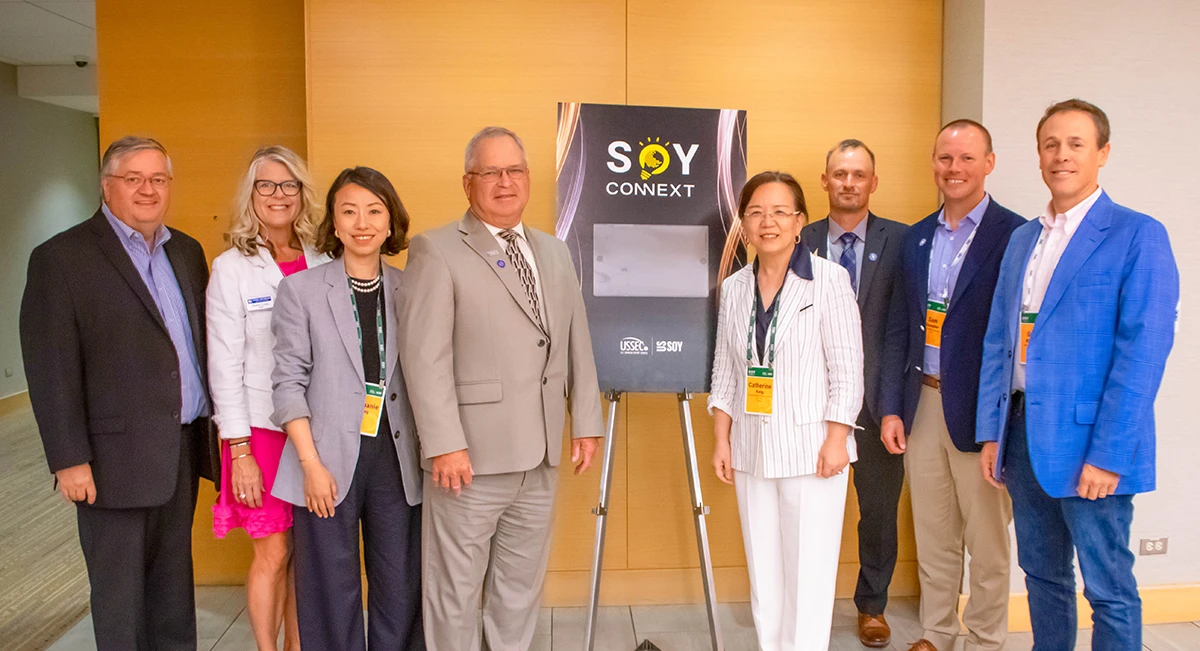
The U.S. Soybean Export Council’s Soy Connext conference opened with a record attendance of more than 800 participants, including 400 international buyers spanning 67 countries. For Iowa growers stepping off the farm to participate in face-to-face meetings with customers, it was an opportunity to hear how the soy they grow helps customers succeed.
For buyers, the early August event provided insights into the new-crop soybeans making their way to maturity. They learned that while dry weather in parts of the soybean-growing areas has reduced crop potential, adequate rain elsewhere provides a hopeful outlook. Bottom line, “there will be plenty of soybeans available,” says Randy Miller, a soybean farmer and past Iowa Soybean Association president from near Lacona.

While customers asked about how farmers decide what seeds to plant, ISA President Tom Adam talked traits and lessons from previous seasons—and generations. He’s the fifth generation on his family’s farm near Harper. When fertilizer and technology arose as topics in the conversation, ISA directors noted their use of precision technology and the ability to utilize manure as a valuable fertilizer on their acres.
“We’re using as much technology as we can to grow a crop as efficiently and affordably as we can,” says Miller, who serves on the USSEC board.
Farmers learned from buyers about how the soy they grow was ultimately used in feed and food products. They heard from buyers about the quality of the soy products received in their respective countries, how the expected super El Niño could impact shipping routes and the price they’ll pay as a result.
Buyers learned about port expansions at the Port of Grays Harbor and the Port of Milwaukee, which will expand export capacity through the Pacific Northwest and Great Lakes. Both bode well for expanding soybean shipments and usage globally.
Still, it comes down to relationships.
“USSEC staff are the boots on the ground in markets around the world, and they know that when farmers come and have one-on-one conversations with our buyers it makes all the difference in the world,” says Robb Ewoldt, past ISA president and current United Soybean Board director. “That’s why we need to make every effort we can as farmers to get out and tell them what we’re doing. When you build that relationship, you also build loyalty. We want loyalty. We want repeat customers. We want them to feel confident about what they’re buying.”
“I can’t sell the beans from my farm directly to the people I’m meeting with today, but I can help the AGPs of the world make a sale,” says Jeff Ellis, an ISA District 9 director from Donnellson. “That’s what I hope I’m doing.”
Diversified portfolio
USSEC’s market diversification strategy is paying off for U.S. soy, farmers learned. While year-to-date total exports dropped 11% in marketing year (MY) 2025-26 due to geopolitical trade friction (shipments to China down 45%), shipments to the rest of the world were up 9%, USSEC CEO Jim Sutter says. Combined with a return to normalized trade with China—backed by a 25 million metric ton annual purchasing commitment—U.S. soy exports are projected to grow 5% in MY 2026-27, which began Sept. 1, 2026, and runs to Aug. 31, 2027.
“Our work through Soy Connext and our trade teams is what turns that global demand into lasting relationships with U.S. Soy,” Sutter says.
Iowa Soybean Association farmer leaders and staff met with leaders from Shandong Bohi Industry Group, a major soy processor in China. The company serves food, feed and industrial markets through integrated supply chains.
Quality advantage
Ewoldt stressed the processing advantage of U.S. soy that cheaper competitors can’t match. U.S. soybeans dry down naturally, allowing farmers like him to harvest at lower moisture levels, around 13%. In contrast, South American soybeans are often harvested at 20% to 24% moisture, requiring high-heat commercial drying.
That artificial heat breaks down essential amino acids, he says, lowering protein digestibility for livestock. Feed millers from Costa Rica and Nicaragua noted that the superior amino acid profile of U.S. soybean meal allows them to incorporate higher inclusion rates—up to 17% in cattle and pig feed rations—without sacrificing animal gain.
Demand shifts
The global market map is shifting as international buyers navigate regional processing challenges
and infrastructure expansions:
- Taiwan: Buyers highlighted strict regional scrutiny surrounding processing contaminants, specifically benzo(a)pyrene (BaP) in crude oil. High-heat drying of damaged beans elevates BaP risks. Following a major processing plant shutdown over elevated BaP levels from Brazil-sourced soybeans, Taiwanese crushers said they are shifting toward U.S. supply due to lower heat damage and higher processing integrity.
- Europe: Representatives showcased major infrastructure moves, highlighted by a $10 million port expansion in Spain designed to double import and distribution capacity specifically for U.S. soy and meal.
- Southeast Asia: Whole bean imports into Vietnam, Malaysia and Indonesia are feeding dynamic domestic systems, ranging from poultry and aquaculture feed mills to food-grade soy oil processing.
Expanding the pie
Data from Oil World shows global soybean production climbing to 441.2 million metric tons, yet global stocks-to-use ratios are projected to tighten to nearly 28%. World demand for protein and vegetable oil is simply growing faster than total output, Sutter says.
“Global demand for soy is growing faster than the world can produce it, and that gap is exactly why buyers are looking for partners they can count on,” Sutter says. “Increased global demand for oil is driving more crush capacity worldwide, and those facilities need more soybeans to crush, not less. In the meantime, regions without their own domestic crush capacity are clamoring for more soybean meal to meet their livestock and aquaculture feed demands—a market U.S. Soy is ready to serve.”
“What we’re seeing isn’t a shrinking pie, it’s a bigger one,” Sutter adds. “Historically between 50% and 60% of the U.S. soy crop is exported and our industry is geared up to keep doing that. USDA projects 54% in both MY 2025-26 and MY 2026-27, and I think the signs point to it being even higher. All this combines to a very positive outlook for U.S. Soy.”
As Iowa farmers head into the field this fall, they’ll remember the interactions with customers in Chicago in early August. They’ll think about the global customers who proudly use the Sustainable U.S. Soy label on their products as part of their marketing efforts. Customers will remember the faces behind the shipments of soy that reach their port—the standing invitations to Iowa farms to see firsthand how soybeans are grown. Those face-to-face visits were a reminder that soybean production is a large part of the equation—but not the only thing. By building direct trust with international customers, growers ensure that when global crushers and feed millers buy soy, U.S. soy remains at the top of their list.
Written by Bethany Baratta.
Back