Online Voting is Now Open

Quit fumbling around with paper ballots and vote online so that you don't have to worry about mailing your completed ballot. The Iowa Soybean Association (ISA) is funded and led by you, its members. If you want your voice heard and to see your input reflected in the work ISA does, it’s important that you vote.

We've opened up early online voting so that you don't have to fumble around and mail in your ballots later this summer. 

Candidate biographies

You will find the candidate photos and their respective biographies below. All biographies were compiled and written by ISA staff and approved by the candidate. Candidates marked with (Incumbent) are currently serving on the board.

At-Large Candidates (Race 1)

Aimee Bissell (Bedford) and Cole Olson (Brooklyn)

Farmer director candidates for the at large race 1

Aimee Bissell (Incumbent)

Aimee Bissell grows soybeans and corn with her husband, Klint, and their two sons. They emphasize maintaining profitable sustainability on their farm.

Bissell earned an associate’s degree in respiratory therapy from Des Moines Area Community College, and worked for Montgomery County Memorial Hospital as a registered respiratory therapist, certified asthma educator, and pediatric advanced life support instructor.

She serves on the Iowa Soybean Association’s (ISA) board as secretary and also as the chair of the demand committee. Bissell is also a member of the ISA Research Center for Farming Innovation (RCFI) advisory committee. She has participated in ISA’s District Advisory Council, Experience Class, Communications Squad, Iowa Food and Family Project, Policy Leaders Fellowship and served as a voting delegate at ISA’s Winter Soy Summit. She currently serves as treasurer for the Adams-Taylor County Corn Board and District 7 Corn Board.

Why are you interested in serving on the ISA board?

While serving the past three years on the ISA board, I have seen firsthand the value of conversations with purchasers, nutritionists, and exporters around the world to continue to sell our products both domestically and internationally. I would feel privileged to represent soybean farmers, promoting our products, developing and expanded markets, and upholding the integrity of the soybean checkoff.

What's the biggest issue facing Iowa soybean farmers right now, and how can the board address it?

There is currently a large supply of soybeans and soybean meal that need to find a home. U.S. soy products are not always the lowest cost, but definitely have an advantage when it comes to quality and digestibility. Highlighting this can increase demand for our product, ultimately leading to more stability in our market.

Cole Olson

Cole Olson grows soybeans and corn and raises cattle with his wife, Kayla, and their two daughters. They credit family member Roger VanErsvelde for the opportunity to get their start in farming in Poweshiek County.

He graduated with a bachelor’s in agriculture system technology at Iowa State University.

Olson is an Iowa Soybean Association Advocate member, and a member of the Iowa Corn Growers Association.

Why are you interested in serving on the ISA board?

I’m interested in serving the Iowa Soybean Association board because I care about the long-term success of Iowa soybean farmers. Through my participation in the Iowa Soybean Association’s Grassroots Fellowship and the United Soybean Board’s See for Yourself trade mission to Egypt, I gained valuable insight into policy, advocacy, and global demand for Iowa soybeans. I want to bring that perspective to the board, represent farmers in my area, and help strengthen profitability and opportunities for soybean growers across Iowa.

What's the biggest issue facing Iowa soybean farmers right now, and how can the board address it?

The biggest challenge I see right now is profitability. We're raising good crops, but margins are tight with lower soybean prices and high input costs. Iowa farmers rely heavily on exports, which creates uncertainty, so expanding demand is critical. The Iowa Soybean Association should continue investing in renewable fuels, new uses for soybeans, and expanding export markets. If we can create more demand and strengthen markets, we help improve profitability for every soybean farmer in Iowa.

At-Large Candidates (Race 2)             

Sharon Chism (Huxley) and Joe Shirbroun (Farmersburg)

Two candidates running for director elections at-large

Sharon Chism

Sharon Chism and her husband, John, grow corn and soybeans in Story and Palo Alto counties.

She earned an associate degree from Iowa Lakes Community College and a bachelor’s in ag business from Iowa State. Chism is currently a director on the Iowa Soybean Association board. She participates in ISA on-farm research trials on plant population and row width. On her own, she is doing soybean pollination research with bees. She was active with the ISA District Advisory Committee, policy programs and the Iowa Ag Water Alliance. She is involved with the National Corn Growers Mentor program, ISU Extension Leadership conference planning committee and volunteers at her local church and food pantry.

Why are you interested in serving on the ISA board?

To listen to farmers and share their requests with fellow ISA directors and staff. As a director, I want to continue to help build export demand. I was blessed to meet buyers in central Mexico who procure Iowa soybean meal. I stay in touch with them and encourage them to buy more Iowa soybean meal. They value our reliable, year-round supply of meal that arrives at their feed mills, in about a week, by rail.

What's the biggest issue facing Iowa soybean farmers right now, and how can the board address it?

A return to profitability for soybean farmers by increasing demand and more efficient freight by rail to rivers and ports, also improved vessel loading. A 1,000-acre soybean farmer pays an estimated $3,000 soybean checkoff annually. The ISA Board of Directors are farmers working with ISA staff to invest the farmers’ checkoff dollars wisely for the good of the soybean producer.

Joe Shirbroun

Joe Shirbroun farms with his wife, Suzanne, and their son, Andrey. They grow soybeans and corn. Their family is in the rolling hills of Clayton County and soil conservation is very important to them. They grow cover crops, practice no-till and minimum tillage, and use terraces and waterways where necessary.

Shirbroun graduated from Iowa State University with a bachelor’s in ag studies/farm operations.

He is a director for the Clayton County Corn and Soybean Growers board and is a member of the Clayton County Ag Extension Council. He serves as an executive director at the Northeast Iowa Research Farm in Nashua. Shirbroun has been on the Clayton County 4-H Youth Council and the Norway Lutheran Church council.

Why are you interested in serving on the ISA board?

I give the Iowa Soybean Association a lot of credit for exploring new markets and new uses for soybeans. The Iowa Soybean Association has been a leader in the industry to keep soybeans moving around the world while also helping farmers improve yields through supporting university research. I want to help direct our checkoff dollars to where it benefits Iowa farmers the most.

What’s the biggest issue facing Iowa soybean farmers right now, and how can the board address it?

The biggest challenge facing Iowa soybean farmers right now is creating more demand for our soybeans whether through exports or new uses. We need to continue to find new customers, expand marketing opportunities in established markets and build trust with both new and established customers. The second challenge is rising production cost factors. Iowa Soybean Association is in a good position to address input costs with our industry partners and government officials.

District 1 Candidates

Cody Gradert (Le Mars) and Paul Kassel (Spencer)

Two farmers running for a district 1 director in Iowa

Cody Gradert 

Cody Gradert grows soybeans, corn and operates a beef cattle feedlot alongside his wife Katelyn and four kids, his dad and two brothers. He implements no-till practices and manure management to better his natural resources and improve soil health.

He graduated from Iowa State University with a bachelor’s degree in ag systems technology.

Gradert is an Iowa Soybean Association Advocate member, a member of the Iowa Corn Growers Association, Iowa Farm Bureau and his local church. He was previously a territory manager selling farm machinery and a sales engineer providing precision farming solutions to customers all over the world.

Why are you interested in serving on the ISA board?

I'm interested in serving on the Iowa Soybean Association so I can collaborate with other industry leaders and bring real-world insight to the problems Iowa soybean farmers face today. My background working with farmers across the world and designing precision solutions offers a unique perspective to help make meaningful change for Iowa farmers. I value thoughtful, data-driven decisions while also considering the people and communities impacted.

What’s the biggest issue facing Iowa soybean farmers right now, and how can the board address it?

I believe the biggest issue is the uncertainty of the biofuel industry. The board can address this by collaborating with various industry partners and decipher how that can progress to increase domestic demand for our product. First, we need a stable, viable market for our product. Next, we must identify long-term partners who can utilize soy-based fuel to ensure a profitable market for soybean farmers for years to come.

Paul Kassel (Incumbent)

Paul Kassel and his wife, Julie, grow soybeans and corn in Clay County. They grow soybeans in a no-till system. Cereal rye has been grown as a cover crop on part of the soybean acres the last eight years.

Kassel earned a bachelor’s in agronomy and horticulture from Iowa State University and a master’s in agronomy from Iowa State University.

He is currently an Iowa Soybean Association director, and a member of the Grace United Methodist Church in Spencer and the Spencer Daybreakers Kiwanis. He is also treasurer of the Northwest Iowa Ag Stewardship Alliance. Paul is a retired Iowa State University Extension and Outreach field agronomist. Kassel received the Exceptional Service to Agriculture award by the Iowa Master Farmer Foundation in 2022.

Why are you interested in serving on the ISA board?

I would like to continue my service to Iowa soybean farmers on the ISA board and continue to help address challenges that we’re facing as farmers. I would like to promote the ISA programs and research projects that support the reduction of soil and nutrients from Iowa farm fields. There are also programs that support agronomic research and pest management. I want to continue ISA’s efforts in supporting market discovery and market development.

What’s the biggest issue facing Iowa soybean farmers right now, and how can the board address it?

There is a need to continue research, education, and market development to assure that Iowa soybean production will continue to be relevant in future. Efforts to promote policy that benefit soybean farmers are also essential for the vitality of the industry.

District 2 Candidates

Shane Beenken (Titonka ) and Sam Showalter (Hampton)

Two farmers running for district 2 directors in Iowa 

Shane Beenken

Shane Beenken grows soybeans and corn on a century farm in Titonka with his mother, his wife, Hillary, and their two sons. He also operates a Pioneer seed dealership.

Beenken graduated with an associate degree from Iowa Lakes Community College and a bachelor’s in agronomy with an ag business minor from Iowa State University.

He serves on the board for Titonka-Burt Communications and volunteers for the Titonka fire department and ambulance service. He also supports the local FFA chapter, helping students work toward their Iowa FFA degree. He has served on the Pioneer Representative Council and is a member of the Kossuth County Farm Bureau.

Why are you interested in serving on the ISA board?

I’m excited to serve on the ISA board because it aligns my experience and values. I’m running for the ISA board to increase my involvement in a great organization. I look forward to learning about policies and markets affecting soybean trade and seeking new uses to maintain profitability. Serving on the board lets me contribute skills from my 30 years in agriculture to strengthen the farming community and help ISA adapt to future challenges.

What's the biggest issue facing Iowa soybean farmers right now, and how can the board address it?

We must work to create greater demand for Iowa soybean products through trade policy and partner relationships. Iowa soybean growers need to be the voice of reason with current and future administrations. While policy implementation is critical, bringing substance and value to these relationships is also important. Placing value on creating new market opportunities while also working to improve soybean profitability for all growers will improve the industry and the value for farmers everywhere.

Sam Showalter (Incumbent)

Sam Showalter is a fifth-generation soybean, corn and hog farmer. He farms with his wife, Laura, and his younger brother, dad, and cousins around the Hampton area.

Showalter graduated with a bachelor’s degree from Iowa State University. He is the treasurer of the Iowa Soybean Association’s Board of Directors and serves as a Franklin County Soil and Water Commissioner. He is the vice president of his church and has volunteered as a wrestling coach and as a Franklin County Fair Board member.

Why are you interested in serving on the ISA board?

As a younger farmer, I have a vested interest in the long-term viability of Iowa soybean production. I spent my first term on the ISA board learning about the programming areas, bringing an open mind to finding avenues to improve the bottom line of Iowa's soybean farmers through strategic investment of their checkoff and non-checkoff dollars. I dived headfirst into multiple leadership roles within the organization, and I’m proud to work with the great group of farmers on our board. I hope to continue to do so moving forward.

What's the biggest issue facing Iowa soybean farmers right now, and how can the board address it?

Many challenges exist, including the current economic conditions facing the soybean industry, both on the demand side and crop input side. The ISA board can help through advocacy at the state and federal levels. Sound policy helps stabilize demand for domestic soy consumption, giving farmers clarity on the markets they are selling into. We must prioritize building domestic and international demand for our high-quality Iowa soybeans and value-added products like soybean meal and soy-fed animal products to ensure our industry remains successful.

District 4 Candidates

Josh Blair (Wall Lake) and Gary Langbein (Sac City)
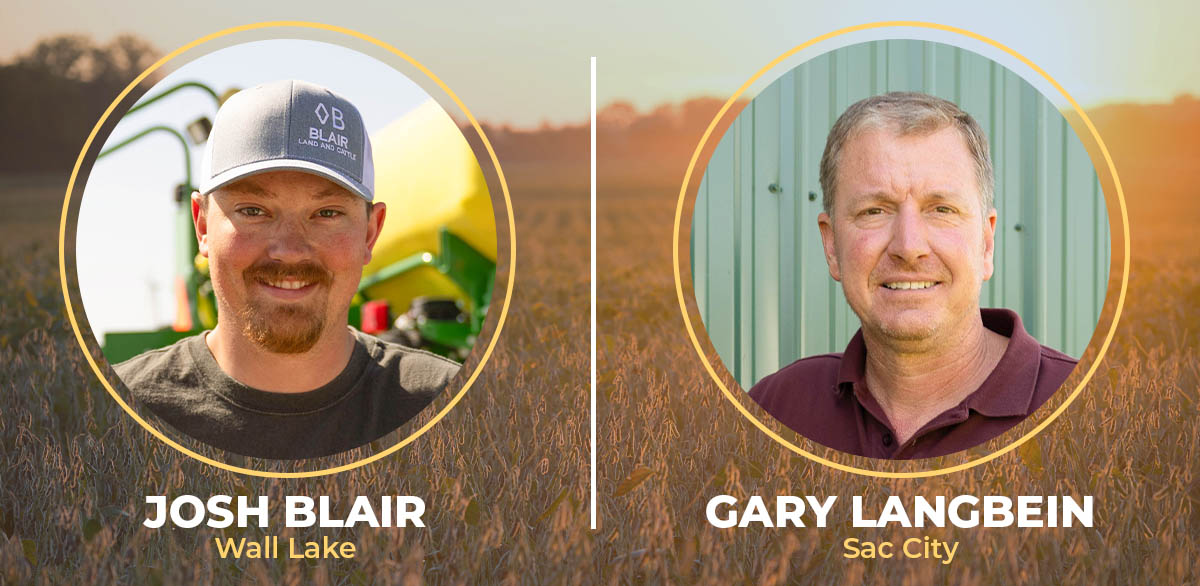
Two farmers running for district 4 in Iowa

Josh Blair

Josh Blair and his wife, Taylor, own and operate a corn, soybean, and cow-calf operation in Sac and Crawford counties. They practice conservation techniques such as no-till, implement waterways, buffer strips, terraces, and cover crops.

He earned a bachelor’s in agronomy from Northwest Missouri State University.

Blair has participated in the Iowa Soybean Association’s Experience Class and is involved with ISA’s Grassroots Fellowship Program. He serves on the Crawford County Farm Bureau board, as a member of the Sac County Cattlemen’s Association, as an usher at Peace Lutheran Church, and as a township trustee. He served on the Sac County Farm Bureau Board and has volunteered at Kiron First Baptist Church.

Why are you interested in serving on the ISA board?

As a farmer, I see the need for the advocacy for all other farmers in the community, state and country. I can be an asset to the ISA board in helping to sort through difficult challenges that are impacting farmers and the soybean industry. I also bring ideas to the table for research and development on conservation, soybean production, and technology that could help other soybean farmers.

What’s the biggest issue facing Iowa soybean farmers right now, and how can the board address it?

Low commodity prices. The board can continue to converse with trading partners and promote our quality soybean products. Doing so would help build demand and therefore encourage higher commodity prices for our industry.  We need to also keep exploring new avenues for soybean uses in the United States and within the state of Iowa through more fuel, asphalt, cooking oils, feed for animals, etc. There are several opportunities to expand the soybean industry locally.

Gary Langbein

Gary Langbein is a fourth-generation farmer, growing soybeans and corn, and raising cow-calf pairs. 

He graduated with an associate degree in ag business. 

Langbein has served in several leadership roles on the Sac County Farm Bureau board. He’s a member of the Governor's Iowa Renewable Fuel Infrastructure Board, SLY Investment Club, and serves as the vice president at St. Paul's Lutheran Church. 

Why are you interested in serving on the ISA board?

I am interested in serving on the ISA board to help proactively address misinformation about the agriculture industry. Public conversations and opinions are often shaped by misleading "catchphrases" used by politicians and media. Serving on the board would allow me to help communicate the truth about what we do, why it matters, and how farmers continue to improve.

What’s the biggest issue facing Iowa soybean farmers right now, and how can the board address it?

One of the biggest issues is water quality. Even though water quality has improved, politicians and the public continue to focus heavily on it, often pushing for more regulation and oversight. We need to clearly demonstrate the progress farmers are making and communicate the practices in place. The board can lead by promoting data, highlighting successes, and ensuring farmers’ voices are represented. 

Another key challenge is regaining momentum in the biofuels space. We’ve lost ground with the decline of flex fuel vehicles and shrinking market share, and that affects long term demand for corn and soybean-based fuels. The board can help by advocating for policies and partnerships that support biofuels, promoting research and innovation, and working to rebuild market access so soy continues to play a strong role in the renewable energy landscape.

District 5 Candidates

Corey Goodhue (Carlisle) and Lisa Obrecht (Zearing)

Farmers running for district 5 in Iowa

Corey Goodhue (Incumbent)

Corey Goodhue farms with his wife, Rachel McClung, their son, his parents and two brothers in Polk County. The family operates a diverse cropping operation, including soybeans, corn, winter wheat, cereal rye, green peas, wine grapes, nursery trees, alfalfa, and grass hay.

He earned a bachelor’s in industrial technology from Iowa State University.

Goodhue is a current director for the Iowa Soybean Association and the American Soybean Association, and serves on the boards for Agriland FS and GROWMARK, Inc.

Why are you interested in serving on the ISA board?

The soybean checkoff has incredible reach and benefit for farmers all across the United States of America. I have had an amazing opportunity to serve on the board and play a part in directing our shared checkoff and non-checkoff resources for the betterment of farmers and I would be honored and privileged to continue to serve in that capacity.

What's the biggest issue facing Iowa soybean farmers right now, and how can the board address it?

Farmers are dealing with a complicated set of issues that drive tight and even negative margins. Difficult trade situations create unnatural trade flows for our inputs and our crops. Policy uncertainty creates a weight on demand and clouds investment in new uses for soybeans. We continue to struggle with the new reality that the United States of America has become the residual supplier for soybeans globally instead of the primary exporter.

Lisa Obrecht

Lisa Obrecht is a fifth-generation farmer, growing soybeans, corn, rye and finishing cattle with her parents, brother and son near Zearing. Obrecht and her family practice sustainable farming and conservation techniques, including enrolling fields in Conservation Reserve Program (CRP) and Conservation Reserve Enhancement Program (CREP), maintaining buffers, grassed waterways, and terraces, cover crops and no-till practices. They’ve also participated in on-farm ISA trials.

Obrecht works for the Iowa Department of Transportation in the Right of Way Department, helping manage projects that support our communities and infrastructure.

She earned her bachelor’s in business administration from William Penn University.

Obrecht participated in ISA’s Policy Leaders Fellowship and ISA Experience Class and received the ISA’s New Leader Award. She was recently selected by the Untied Soybean Board to participate in the See for Yourself trade mission.

Why are you interested in serving on the ISA board?

I want to help Iowa farmers keep farming their land and make a living. I want to ensure legislative representatives hear what farmers really need and encourage them to support policies that help increase soybean revenue. New ideas take time, so it’s vital we stay connected with legislators, partners, processors, researchers, and others to stay informed and create opportunities for farmers.

What's the biggest issue facing Iowa soybean farmers right now, and how can the board address it?

Uncertainty in global markets. Many farmers are barely breaking even, and high input costs make it even tougher. ISA does a great job working with industry partners to find build demand for soybeans through new products, including soy-based asphalt products and firefighting foam. are helping demand beyond food and feed. ISA should continue to support research and build partnerships.

District 7 Candidates

Scot Bailey (Anita) and Steve Dolch (Villisca)

Farmers running for district 7 in Iowa

Scot Bailey (Incumbent)

Scot Bailey grows soybeans, corn and hay in Cass County. He also raises cows in a family corporation owned by him and his wife, Cheryl, his parents, two sisters and aunt. They have farmed no-till for 33 years and strip-till for 12 years and use variable rate for planting and fertilizer. The family continues to research economically sustainable ways to incorporate cover crops into their acres.

Bailey earned his bachelor’s degree in ag studies from Northwest Missouri State.

He is a director on the Iowa Soybean Association’s board and represents Iowa Soybean Association on the Soy Transportation Coalition board. Bailey is also a voting delegate for the American Soybean Association. He previously served as president of the Cass County Cattlemen’s Association and served on his local Farm Bureau board.

Why are you interested in serving on the ISA board?

I want to be the voice from my district to make sure the checkoff is spent wisely. I also want to continue to represent the voice of the farmers who don’t have the time to be on the board.

What’s the biggest issue facing Iowa soybean farmers right now, and how can the board address it?

It is not one issue the Iowa Soybean Association needs to look at, it’s several. We need to look at demand, market, share, transportation infrastructure, research and policy. We need to increase the competitiveness of Iowa soybean producers in the changing food, feed, and fuel industries. We must enhance the understanding in consumers, the media and farmers that science plays a critical role in the future supply of food. We must elevate on-farm research to provide systems-based solutions for environmental and production challenges.

Steve Dolch

Steve Dolch farms with his wife, Linda, and co-owns and operates a farm with his brother and nephew. They grow soybeans, corn and hay and raise cow-calf pairs, feeding out the cattle in their own feedlot.

Dolch graduated with a bachelor’s in animal science from Colorado State University.

He’s served on the Montgomery County Farm Bureau Board of Directors, the Iowa FFA State Alumni Board, the nominating committee for Farm Credit Services of America (Iowa, Nebraska, Wyoming and South Dakota area) and was a past board member of the local cooperative in Villisca. He’s president of the East Ridge Estates Condo Association. The family received the Good Farm Neighbor Award from the Coalition to Support Iowa’s Farmers.

Why are you interested in serving on the ISA board?

My board service has focused on serving all, especially average and smaller patrons. I draw on 54 years of experience to find answers to today’s complex agricultural challenges. With two sons and two nephews wanting to return to our operation, we must remove obstacles for all families in this situation. Beyond policy, we must develop new soybean uses through innovative research.

What’s the biggest issue facing Iowa soybean farmers, and how can the board address it?

Input costs and export tariffs threaten profitability. ISA must continue to lead the charge in boosting yields and diversifying end-product use. Because our industry’s future depends on transitioning knowledge and assets, ISA should facilitate the resources and communication necessary for succession planning. This ensures our collective “power in numbers” remains strong. We must be on the cutting edge of these conversations to ensure the next generation of farmers has a clear, viable path to profitability.

District 9 Candidates

Jeff Hedges (Oakville) and Brent Pacha (Richland)

Two farmers from district 9 running for board of directors

Jeff Hedges

Jeff Hedges grows soybeans and corn with his wife, Kim, in Des Moines County. He worked as a district and regional sales manager in the seed business for 30 years before returning to the family farm full-time in 2021. He owns and operates Hedges Ag, a seed and agronomy sales business.

Lawler earned a bachelor’s degree in ag business from Iowa State University.

He currently serves as a trustee on the Two Rivers drainage district and also as a trustee for his local township. Lawler has served on the Mediapolis FFA alumni committee.

Why are you interested in serving on the ISA board?

I'm interested in serving on the ISA board because of my passion for agriculture and the opportunity to give back to a great organization. I want to help ISA be a vital organization that serves farmers and the next generation of farmers. My background in production ag and agronomy, coupled with my leadership experience in ag sales management, will provide valuable insights in this role.

What’s the biggest issue facing Iowa soybean farmers right now, and how can the board address it?

One of the biggest issues facing soybean farmers is maintaining global soybean demand to market our products. The board must continue building markets domestically and internationally to strengthen soybean demand.

Brent Pacha

Brent Pacha grows soybeans, corn and hay and integrates cover crops on his farm in Jefferson County. He also raises a 50-head cow-calf herd.

Pacha earned his bachelor’s degree in agronomy and a master’s in crop production and physiology from Iowa State University.

He is president of the Greater Jefferson County Fair board and was on the board for his local church. He works full-time as an integrated solutions manager for Sinclair Tractor.

Why are you interested in serving on the ISA board?

I partnered with the Iowa Soybean Association while working toward my master’s degree at Iowa State University, and I have been a featured speaker for several ISA 4R Stewardship Field Days. I want to give back to ISA through service on the board. I support ISA’s extensive research and promotion efforts and want to be involved in helping create new markets and new avenues for soybean producers to expand market opportunities and profitability potential.

What's the biggest issue facing Iowa soybean farmers right now, and how can the board address it?

Selling our soybeans to exporters will continue to be important, but as Brazil and others expand production and sales, we must do a better job of selling and using our products domestically. Building robust domestic demand is essential to protect local markets from large price swings caused by increased Brazilian production or fluctuating sales to China. The board can continue to explore and invest in domestic uses that provide value-added opportunities for our crop and open up new markets for producers to grow soybeans in a way that benefits everybody by ensuring a more consistent, reliable bottom line regardless of global trade volatility.