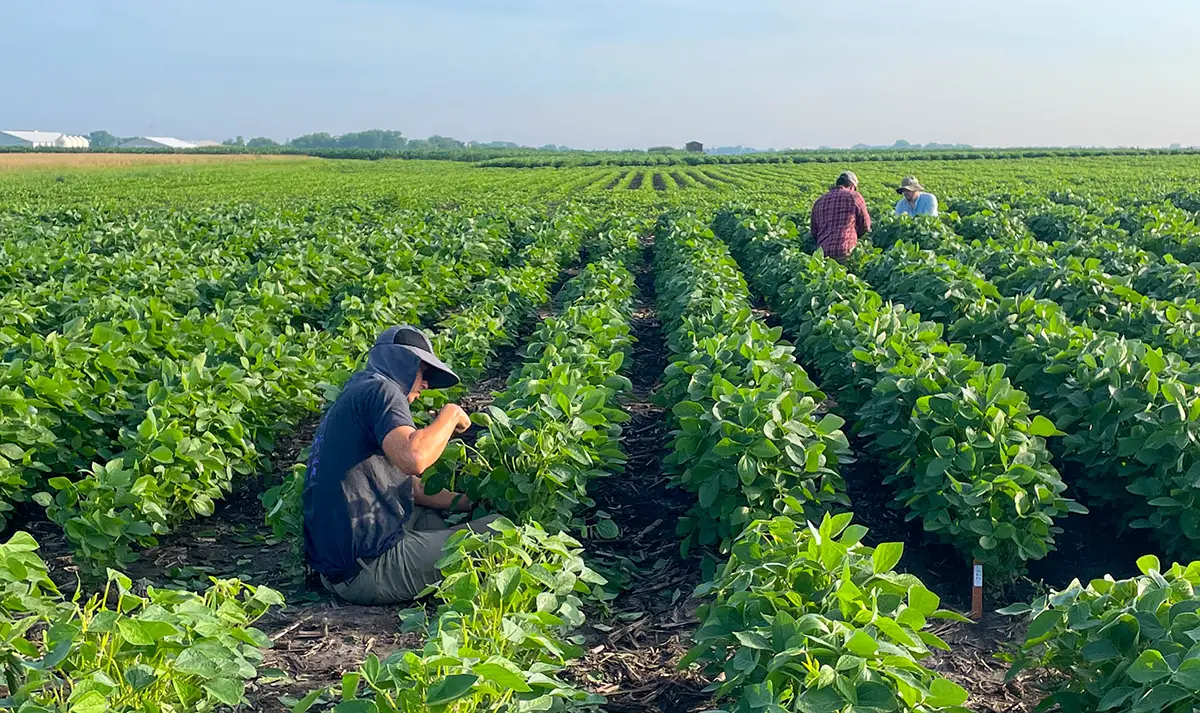
(Photo: Victoria Moser)
When does soybean leaf loss hurt yield?
November 23, 2026 | Kriss Nelson
A soybean field battered by hail or damaged by insects can look like a lost cause. But missing leaves don’t necessarily mean missing bushels.
New research at Iowa State University shows soybeans can tolerate substantial leaf loss, particularly early in the growing season. However, even plants that rebuild their canopies may not recover their full yield potential.
Victoria Moser, an ISU doctoral student, presented her research during the Iowa Soybean Research Center’s Nov. 19 webinar, “Defoliation in Soybeans: When Does Leaf Loss Really Cost Yield?”
Conducted with Fernando Miguez, ISU professor of agronomy, her research combines findings from 21 studies in the U.S., Brazil and Argentina with two years of field trials near Boone.
The research focuses on two questions: When does leaf loss affect yield, and how much damage can soybean plants withstand?
Moser says accurately assessing damage is important when deciding whether to apply an insecticide or fungicide, replant or file a hail insurance claim.
“We can be overestimating the damage, and that will mean extra cost and a faster pest and fungicide resistance because we will be applying a product that was not necessary,” she says.
Underestimating damage, on the other hand, could cost farmers bushels they cannot recover.
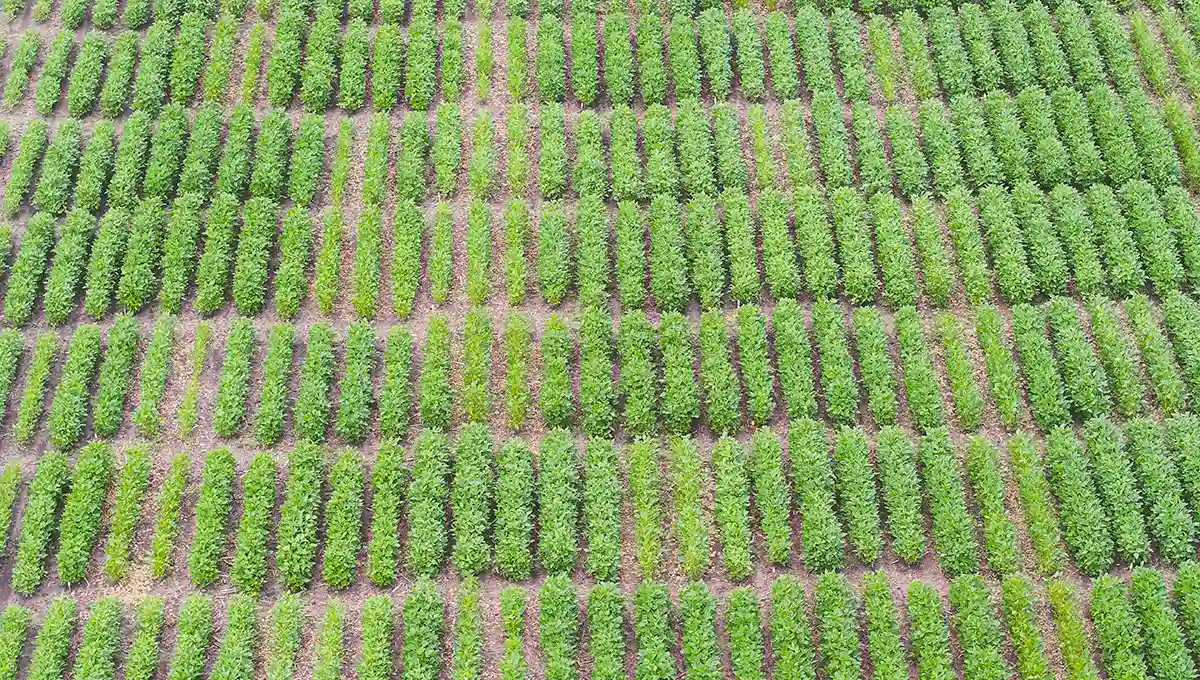
Individual plot after defoliation was applied (Photo: Victoria Moser)
Timing makes a difference
Soybeans have some natural protection against yield loss when leaves are damaged by hail, insects or disease, Moser says.
“They tend to have a buffer, so they produce extra leaves that they can lose without losing sunlight and, therefore, without losing yield,” she says.
But timing matters.
Moser’s review found soybeans could tolerate losing about two-thirds of their leaf area during vegetative growth without a significant yield reduction.
At flowering, however, 67% defoliation resulted in an average yield reduction of about 8%. Losses increased during pod development, with soybeans most sensitive to leaf loss during seed filling, between the R5 and R6 growth stages.
“This is the moment where we need to keep an eye on our crop and be sure that it has everything that it needs,” Moser says.
When assessing damage, farmers should consider more than the percentage of missing leaves.
“How much leaf loss can soybeans tolerate? Unfortunately, this question doesn’t have a unique answer because there are many factors that we need to consider,” Moser says.
Those factors include growth stage, soybean variety and weather conditions following defoliation.
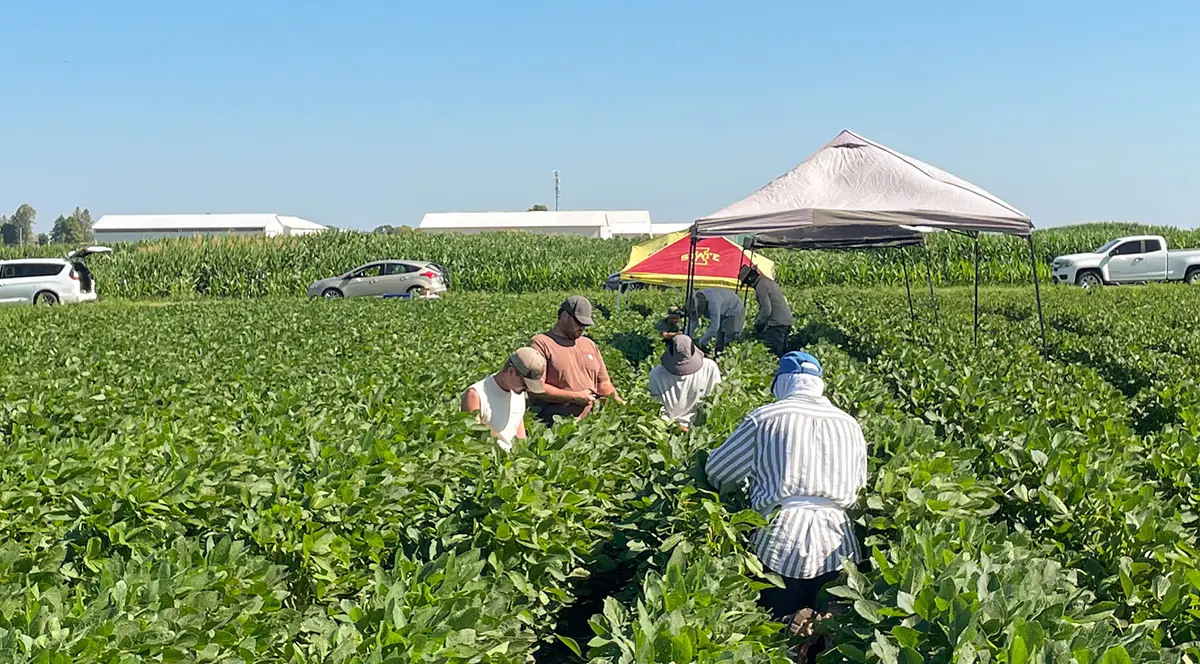
(Photo: Victoria Moser)
Recovery doesn’t guarantee yield
To better understand how soybean plants recover, researchers conducted field trials near Boone during the 2025 and 2026 growing seasons.
At R2, or full flowering, researchers manually removed two of the three leaflets from soybean trifoliates, targeting 67% defoliation.
Measurements showed the treatment reduced leaf area by approximately 50%. However, the amount of sunlight intercepted by the crop declined by only about 20%.
Defoliated plants experienced a seven-day delay in canopy development compared with untreated plants. By the end of the growing season, both had reached full light interception.
“So we can say that there was almost a complete recovery of the defoliated plots at the end of the growing season,” Moser says. “However, although those plots were able to recover, yield was significantly reduced in both growing seasons.”
Researchers found that defoliated plants produced fewer pods per reproductive node and fewer seeds per pod, resulting in approximately 9% fewer seeds per plant.
Seed weight also declined, falling 4% in 2025 and 1% in 2026.
“During 2025, the crop experienced much drier conditions during the seed filling period, and that mainly affected the seed weight,” Moser says.
Not all soybeans respond alike
The research also identified differences between determinate and indeterminate soybean varieties.
Across the 21 studies, approximately 67% defoliation resulted in an average yield reduction of 18% for determinate varieties, compared with 10% for indeterminate varieties. Those averages covered defoliation at different points throughout the growing season.
Moser believes indeterminate soybeans may have an advantage because they continue producing new leaves after flowering. Miguez says their extended reproductive period also allows more time to recover from stress through the production of additional flowers and pods.
“In many places around the world, determinate varieties have been replaced with indeterminate varieties because they’re more consistent from year to year because they have a better ability to buffer stress,” Miguez says.
That difference could affect how soybean damage is assessed.
Moser says some hail damage assessment tables rely on research conducted decades ago, with the last documented revision dating to 1991.
Although separate tables exist for determinate and indeterminate varieties, Moser says they may not adequately reflect differences in how the plants respond to defoliation.
“They don’t really show a consistent difference between the level of damage that they report for both of them,” she says.
Her comparisons suggest the tables may overestimate damage, particularly for indeterminate varieties.
Miguez says preliminary findings suggest modern soybean varieties grown using current agronomic practices may be more tolerant of defoliation than existing assessment tables indicate. The research is ongoing, and the findings have not yet been published.
Before deciding to replant
For farmers assessing a damaged field, the researchers emphasized the importance of evaluating the entire field rather than focusing on the worst-looking areas.
Miguez says hail damage may be concentrated in portions of a field, making it important to determine how much acreage was severely affected.
Replanting also comes with additional seed, weed control and other expenses. Delaying planting can further reduce yield potential.
“Damages early on have to be pretty severe to justify the replanting economically,” Miguez says.
Mark Licht, co-director of the Iowa Soybean Research Center, says farmers also need to distinguish between leaf loss and more serious plant injury when assessing storm damage.
While defoliation during vegetative growth typically results in minimal yield loss, Licht says more severe storms can result in “stand loss and the apical meristem broken off and so effectively losing nodes.”
Those injuries may warrant in-season management decisions or crop insurance settlements.
Insect damage
Moser says visible insect feeding doesn’t always translate into economic yield loss.
“You may be losing more money just by applying a product because of the cost of the product and the cost of the application than the yield that you may get back because of that,” she says.
The researchers also discussed whether fungicide applications can help soybeans recover from defoliation during seed filling.
“By the time we get into the seed filling period, early or late, getting a response from a fungicide for their plant recovery is really quite minimal,” Licht says.
What comes next?
Moser says more research is needed to understand how modern soybean varieties respond to defoliation, particularly when stressful weather follows leaf loss.
“It’s important for seed companies and breeders to start thinking about canopy recovery after a leaf loss, and that could be measured and even be included as a variety trait when we release a new soybean variety,” she says.
In the meantime, Miguez encourages farmers to assess damage across the entire field before making management decisions.
“I think it’s common to look at a field and judge the whole field by the part of the field that looks the worst,” he says. “So you have to consider how much, what percent area of that entire field has been affected severely.”
Written by Kriss Nelson
Back