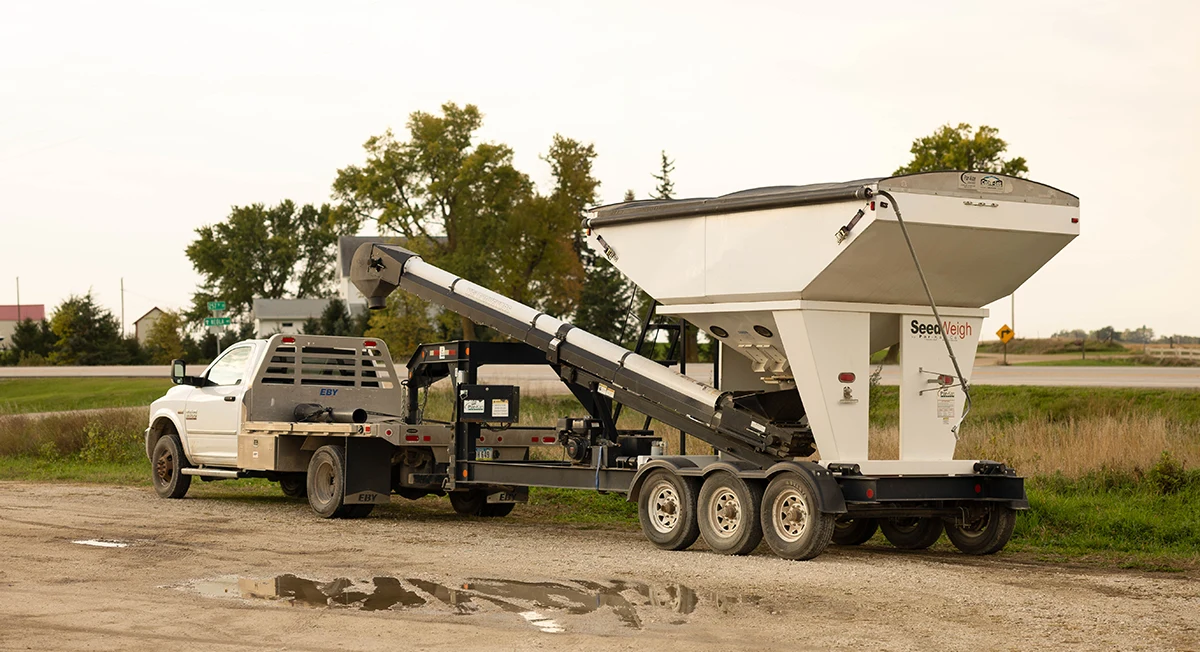
(Photo: Iowa Soybean Association / Joclyn Kuboushek)
Wet fall puts cover crop plans to the test
October 29, 2026 | Kriss Nelson
Wet fields and a delayed harvest are testing fall cover crop plans, leaving some Iowa farmers wondering whether there’s still time to get seed in the ground.
Brock Webb, Iowa Soybean Association conservation agronomist, says persistent rainfall has slowed harvest and narrowed the window for farmers planning to drill cover crops after combining.
“Some of the cover crop plantings are definitely going to be pushed back,” Webb says.
For farmers relying on drills or other ground equipment, field conditions may determine whether planting remains an option. With corn and soybean harvest still underway in parts of Iowa, finding time to establish cover crops is another challenge.
Webb expects some farmers may ultimately decide to skip cover crops this fall.
“Do I think there’ll be a decrease in acres planted this year because of the late harvest? Yes, I do,” he says.
However, warmer fall temperatures could provide additional opportunities for farmers who still want to plant.
Planting windows narrow
Beyond weather and field conditions, farmers participating in conservation programs must also consider planting deadlines.
The Natural Resources Conservation Service establishes planting dates for various cover crop species, including overwintering options such as cereal rye, camelina, winter wheat and triticale.
Many of those deadlines fall in October or early November.
With wet conditions delaying fieldwork, farmers are waiting to hear whether NRCS will extend planting deadlines to provide additional time to establish cover crops.
Webb says he has heard discussions about possible extensions into December in some counties, but no official confirmation was available at the time of his interview.
Farmers participating in conservation programs should check with their local NRCS office before making changes to planting dates or species.
Even if deadlines are extended, Webb says farmers will need to consider whether field conditions and available time make planting practical.
Other options remain
For farmers unable to drill cover crops because of wet soil conditions, Webb says alternative seeding methods may offer another opportunity.
Broadcasting seed with dry fertilizer is one option. Aerial seeding may also be worth considering for farmers determined to establish cover crops this fall.
However, both methods come with considerations.
Without the seed placement provided by a drill, seed-to-soil contact can be less consistent, potentially affecting germination, stand establishment and overall cover crop performance.
Webb encourages farmers to weigh those factors against the benefits they hope to achieve.
The decision also depends on the type of cover crop being planted and whether it can survive winter conditions.
Consider the end goal
As the calendar moves into November, Webb says farmers should consider what they expect their cover crops to accomplish.
Those hoping to establish significant fall growth may have limited opportunities as temperatures decline and the growing season comes to an end.
However, overwintering species such as cereal rye can establish with minimal fall growth and resume growing when conditions improve in spring.
Webb says farmers may be surprised by how little growth is visible before winter compared with the amount of cover that develops the following spring.
“They’ll just have to decide what the purpose is for the cover crop and whether it’s going to be effective,” Webb says.
For farmers primarily interested in spring soil cover, planting later in the fall may still offer benefits. Those counting on substantial fall biomass may need to reconsider their expectations.
Moisture brings mixed results
While rainfall has delayed some planting, Webb says many cover crops already established this fall are performing well.
However, excessive moisture has also created challenges in some fields.
Webb has observed brassicas that germinated early but failed to produce as much growth as expected. He suspects saturated soils limited oxygen availability around the roots, slowing development.
The conditions illustrate how moisture can both benefit and hinder cover crop growth.
Webb is also interested in hearing from farmers who have used cover crops for several years to learn whether improved water infiltration helped them return to fields sooner during this wet harvest.
Those observations could provide additional insight into the long-term benefits of cover crop adoption.
For now, Webb encourages farmers to evaluate their workload, field conditions and conservation goals before making late-season planting decisions.
ISA conservation agronomists can help farmers evaluate seeding options, planting windows and potential adjustments to their cover crop plans. For assistance, contact ISA’s conservation team at conservation@iasoybeans.com.
Farmers participating in conservation programs should also consult their local NRCS office about planting requirements and possible deadline extensions.
Written by Kriss Nelson.
Back