(Photo: Iowa Soybean Association / Joclyn Kuboushek)
Walking Rows: Protecting yield
July 30, 2026 | Kriss Nelson
As Iowa crops move through the reproductive stages, the focus is shifting from establishing yield to protecting it. While disease and insect pressure remain relatively low across much of the state, Iowa Soybean Association’s research agronomists say August scouting will be critical as weather, moisture and late-season pests determine how much yield reaches the combine.
Shane Beck - Northeast/Northern Iowa
The weather is hot again, with hopefully some relief in sight in the next few days. The heat has also brought strong storms and heavy rain, leading to more fields experiencing ponding and some hail damage.
It seems like a nonstop fight against the weather. In fields that have not had the strong storms, the crops look really good with very little disease and insect pressure so far.

In corn, there have been some gray leaf spot, northern corn leaf blight and tar spot across the area.
We are seeing low numbers in our survey for corn rootworms. There are a couple of fields where we have seen numbers above the economic injury level, which is two beetles per trap per day, but most are well below that level.
Some of our soybean fields have also had aphid pressure. Scouting will help you know if they are present and how the population is progressing.
I also had the opportunity to look at a few of our sulfur-with-cover-crop trials in soybean fields this last week. Overall, I didn’t see a lot of visual differences between the four different treatments at a field level, but when we dug some roots, it appeared that the higher treatment had more nodules on the roots.
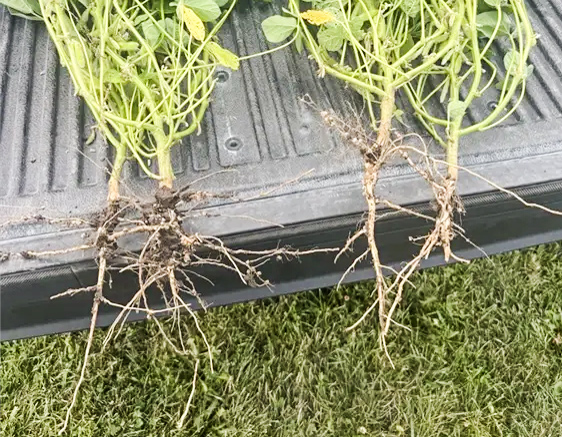
The plot on the left received 300 pounds per acre of SO₄, while the plot on the right received no SO₄.
Craig Woods – Northwest/West Central Iowa
Soybeans in my area are around the R2-R4 growth stage, and corn is around the R1-R2 stage.
With both fungal and insect pressure relatively low, moisture is currently the largest concern as we continue to get drier. Right now, there are possibilities for rain on the horizon, but time will tell if there will be enough rain for pod fill during the reproductive stages.

While out scouting, insect pressure has been relatively low, but I did see Japanese beetles, northern corn rootworm, and colaspis beetles.
Corn rootworm, whether northern, western, or southern, in its larval stage can prune roots and cause not only yield loss but also lodging if severe enough.
Now is a good time to get out and scout fields that have been in corn for a longer rotation to assess the effectiveness of management strategies. Ways to assess the level of corn rootworm pressure include root digs to determine larval feeding and potential yield loss, and sticky traps for adults, which can inform decisions for next season. Specific methods can be found here.
Fungal pressure has been rather limited in my area due to the lack of moisture; however, there have been reports of northern corn leaf blight, bacterial leaf streak and tar spot.
There have been more reports of tar spot in west-central Iowa as opposed to northwest Iowa; however, scouting will remain an important tool in making the most out of your management decisions going forward.
Issues like sudden death syndrome will begin showing symptoms in soybeans in the coming weeks. While nothing can be done in season, it is important to note where it is and how varieties performed to help influence future management decisions.
Evan Brehm – Southeast/Eastern Iowa
Soybeans have entered reproductive stages. R3 is a critical stage for fungicide applications. Diseases have been noted, but there are no economic thresholds on the eastern side of the state.
Insect pressure has been hindered with greater moisture and cooler days. Japanese beetles have been noted but not at the economic threshold.

Iowa Soybean Association has secured several fungicide and insecticide trials this growing season with local ag retailers to determine the advantages of these applications for the Iowa farm. Be on the lookout for the results this winter.
Corn is fully tasseled in the area, and fungicide is being applied. Southern rust has been found in various areas but has not been a major contributor to fungicide application decisions. Northern corn leaf blight and tar spot are still prevalent with fungal diseases. Airplanes, drones, and ground rigs are options to apply fungicide to the growing corn crop in districts 6 and 9. I have seen all of these options, which vary based on the operation's accessibility.
Cover crop programs are available for the fall of 2026. Cereal rye is the king of cover crops in Iowa, with 90% of acres having cereal rye in the mix.
Programs are now open for cost-share funding, ranging from $15 to $ 60/acre, depending on contracts with state, federal or private funding sources. Cover crops reduce soil erosion up to 90% and nutrient runoff from 30% to 90%. ISA is here to support you in your decision-making process and finding programs to assist in offsetting costs associated with adding cover crops to your acres. Three trials of fungicide and no fungicide have been lined up with a local ag retailer in Benton and Linn Counties. We are looking at fungicide/insecticide against no applications with a drone application. With low soybean disease pressure, this will be a great season to discover the economic return.
Water monitoring continues on edge-of-field implementations for the first-ever Batch & Build in Benton County. Denitrifying bioreactors and saturated buffers continue to show nitrate reductions 35% and greater. Recent funding toward oxbows is a priority.
Reach out today to get started in your water quality journey with a huge line of supporters waiting to help you.
Conservation in Action tour
Conservation in Action was a self-guided tour in both east central and west central Iowa. Although it has concluded, these fields are still available to see various conservation methods farmers might consider adding their their own farms. Let Alex Slagle or me know if you’d like to see what cover crops this time of year look like in corn/soybeans or edge-of-field practices. Be sure to head to Big Grove Brewery in Cedar Rapids for “Beer for Water” as they are donating $1/pint sold to the Iowa Agriculture Water Alliance.
They have supported our eastern Iowa Conservation in Action tour and will host a future event in 2027.
Avreeanna Tweedy – Southwest/South Central Iowa
Field activity across southwest and south central Iowa continues to focus on protecting yield as crops move through the reproductive stages.

Most corn is in the R2–R3 stages, while soybeans are primarily R2–R3. Fungicide applications are underway across much of the area, and although some locations received scattered rainfall over the past week, many fields could still benefit from additional moisture as grain fill continues.
Throughout the area, disease and insect pressure have remained relatively low. However, with periods of heavy morning dew and humidity, continue monitoring corn for foliar disease development over the coming weeks.
Soybeans have handled the recent heat fairly well, but August is one of the most important months for determining yield as plants focus on pod retention and seed fill. Maintaining healthy leaf areas during this time will be key to maximizing yield potential.
What to watch
Continue walking fields and monitoring soil moisture, disease development, insect feeding and overall plant health. Every green leaf counts during grain fill, so identifying and managing stressors early can help protect yield potential through the remainder of the season.
Compiled by Kriss Nelson.
Back