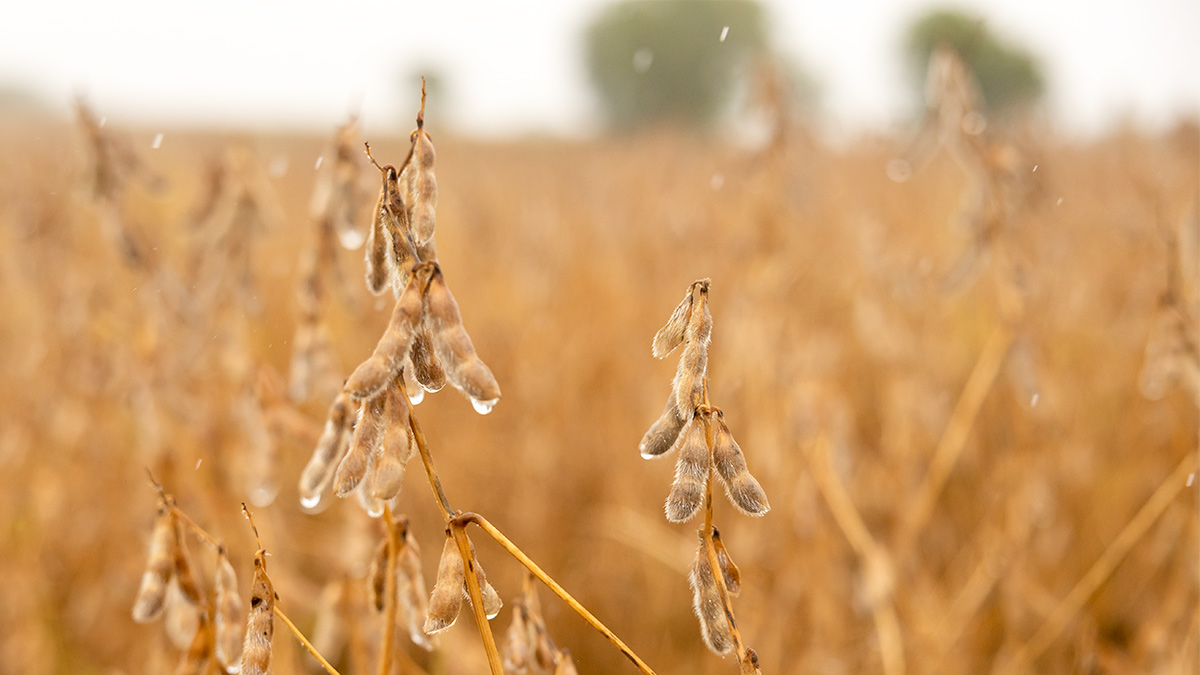
Raindrops falling on soybean plants (Photo: Iowa Soybean Association / Joclyn Kuboushek)
Strong demand shapes soybean outlook
September 17, 2026 | Kriss Nelson
Little change was made to the soybean forecast, but USDA took some bushels out of the 2026 corn crop in September. Al Kluis thinks there may be more to come.
But the September numbers may not be the final word on crop size.
Al Kluis, managing director of Kluis Commodity Advisors, says corn and soybean yields could move lower again as harvest provides a clearer picture of the crop. “The reports came in close to what we thought they would,” Kluis says. “As far as the yield on corn being down, odds are it will be lower again in October. Soybeans are about unchanged, but I think they could move lower depending on the bean size.”
Soybeans steady
USDA made only a slight adjustment to its soybean yield estimate, increasing it from 52.7 bushels per acre in August to 52.8 bushels in September.
National soybean production is forecast at a record 4.535 billion bushels, based on 85.9 million harvested acres. Farmers planted an estimated 86.9 million soybean acres.
In Iowa, USDA projects farmers will harvest 9.73 million soybean acres, with an average yield of 64 bushels per acre. That would produce nearly 623 million bushels.
USDA crop estimates provide a snapshot of conditions at a particular point in the growing season, Kluis notes, while crop conditions can continue to change ahead of and during harvest.
Corn moves lower
USDA lowered its national corn yield estimate 2.2 bushels from August to 178.5 bushels per acre. With 88.5 million acres expected to be harvested for grain, production is forecast at 15.8 billion bushels, down 213 million bushels from the August estimate.
Farmers planted an estimated 96.8 million acres of corn nationally.
Iowa's corn crop is forecast at 2.8 billion bushels, based on 12.8 million acres expected to be harvested for grain and an average yield of 219 bushels per acre.
Kluis says some of the bigger production concerns are showing up outside the central Corn Belt.
“When you look at the state-by-state crop yields, the problems are in the southern Plains and the extreme western Corn Belt,” he says.
Kansas and other areas of the Plains benefited from favorable weather and strong production last year, Kluis says. This year, hotter and drier conditions have reduced yield prospects in portions of Kansas, Oklahoma and the Dakotas. He also points to challenges in northwest Iowa and southwest Minnesota.
Demand holds
While soybean production changed little in the September report, Kluis says soybean demand deserves attention.
“If I had to disagree with USDA at all, I think they’re underestimating demand,” he says. “Both soybean processors and ethanol manufacturers are making good money, and exports are large. We just do not see any evidence so far that we’re seeing any type of demand destruction.”
USDA projects 2.78 billion bushels of soybeans will be crushed in 2026-27, reflecting continued demand from domestic processors. Soybean ending stocks are projected at 310 million bushels.
Kluis says strong processing margins and exports are indications that soybean demand remains solid. “We continue to see global demand increase, and stockpiles move lower,” he says.
Strong demand could become even more significant if final soybean production comes in below USDA's September forecast.
He expects USDA’s Sept. 30 Grain Stocks report to provide additional insights on supplies, followed by updated corn and soybean production estimates in October.
Harvest outlook
Weather could add another wrinkle as harvest gets underway.
Kluis says significant rainfall across portions of the Corn Belt could slow fieldwork. That becomes increasingly important as days shorten and fields have less opportunity to dry between rain showers.
Looking specifically at corn, Kluis is optimistic about the market once the seasonal pressure of harvest begins to ease.
“I’m optimistic that we’ll see higher futures prices by the time we get to December and get through harvest,” he says. “We have about 1.2 billion bushels less corn in the U.S. than a year ago. You have consumption exceeding production, so that’s a recipe, I think, for higher futures and a pretty good improvement, potentially, in basis post-harvest.”
For farmers with available corn storage, Kluis says that could create opportunities beyond harvest.
“If you can store the crop, carry it into next year,” he says. “I think you’ll have some pretty good profits made on those decisions.”
Written by Kriss Nelson.
Back