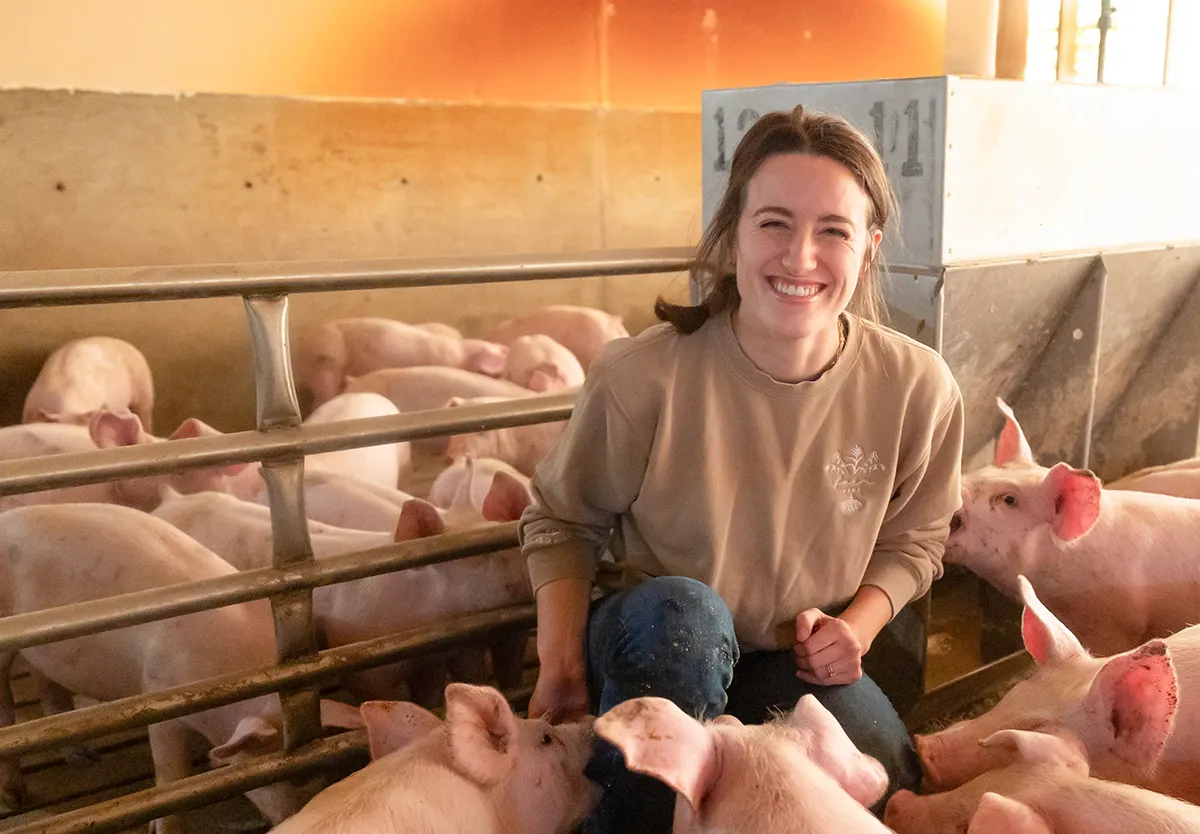
(Photo: Iowa Soybean Association / Joclyn Kuboushek)
Pork and soy: A partnership worth celebrating
October 22, 2026 | Kriss Nelson
When it comes to Iowa agriculture, soybeans and pork go hand in hand.
As October Pork Month shines a spotlight on the state's pork producers, it's also an opportunity to recognize the soybean farmers who help keep pigs fed and growing.
For Amanda Tupper, an Ionia farmer and Iowa Soybean Association District 3 director who raises both soybeans and pigs, that connection is especially meaningful.
“October Pork Month is an opportunity to celebrate one of Iowa's best examples of agriculture's symbiotic relationships,” Tupper says. “While I think people should eat more pork year-round, October is a great time to highlight the mutual benefits between two of Iowa’s largest ag industries.”
Fueled by soy
Soybean meal plays a critical role in pork production, providing an affordable, digestible source of protein and amino acids that support pig growth.
On Tupper's farm, soybean meal makes up approximately 20% of the weaned pig ration, helping young pigs adjust and grow when they arrive on the farm. Soybean meal remains an important part of their diets through finishing.
“The nutritional components of soy help to get the pigs adjusted quickly and growing well right when they get to our farm,” Tupper says.
Soybean meal’s nutritional value also helps reduce the need for supplemental synthetic amino acids and other feed ingredients, providing an economical option for pork producers.
Driving demand
That relationship extends well beyond the feed bunk, with Iowa’s pork industry providing a strong source of domestic demand for soybean meal.
“Livestock is a soybean farmer's number one customer, and in Iowa, swine makes up a huge chunk of that,” Tupper says. “In periods of market uncertainty, knowing that the domestic pork industry is and will remain a large share of the market definitely helps provide some stability.”
For farmers raising both crops and livestock, that demand can also create opportunities to add value to what they grow.
“We like to say that it's more profitable to walk the grain off the farm, and the past couple of years has really proven that to be the case,” Tupper says.
Raising pigs gives Tupper a firsthand appreciation for the quality of the soybeans she produces.
“As a farmer, we're always trying to raise a valuable, high-quality crop, regardless of who our customer is, but raising pigs myself gives a deeper perspective and appreciation for how important that is,” Tupper says. “A higher quality crop means higher quality pork, and that, in turn, leads to a better bottom line for our operation and a better end-product for the consumer.”
That emphasis on quality also carries into international markets, where soybean meal consistency and nutritional value can influence purchasing decisions.
While soybean exports often dominate conversations about market opportunities, Tupper says it’s important not to overlook customers closer to home.
“Roughly half of the soybeans grown in Iowa stay in Iowa, and somewhere around 70% of Iowa’s meal demand comes from hog production,” Tupper says. “It's easy to talk about exporting soybeans to China or the Philippines or Mexico, all of which are important to discuss, but I think we sometimes forget about the pork producer right in own our backyard.”
October Pork Month is a reminder of just how much the two industries depend on each other, Tupper says.
“One industry really could not exist at the size and scale that they currently do without the other.”
Written by Kriss Nelson.
Back