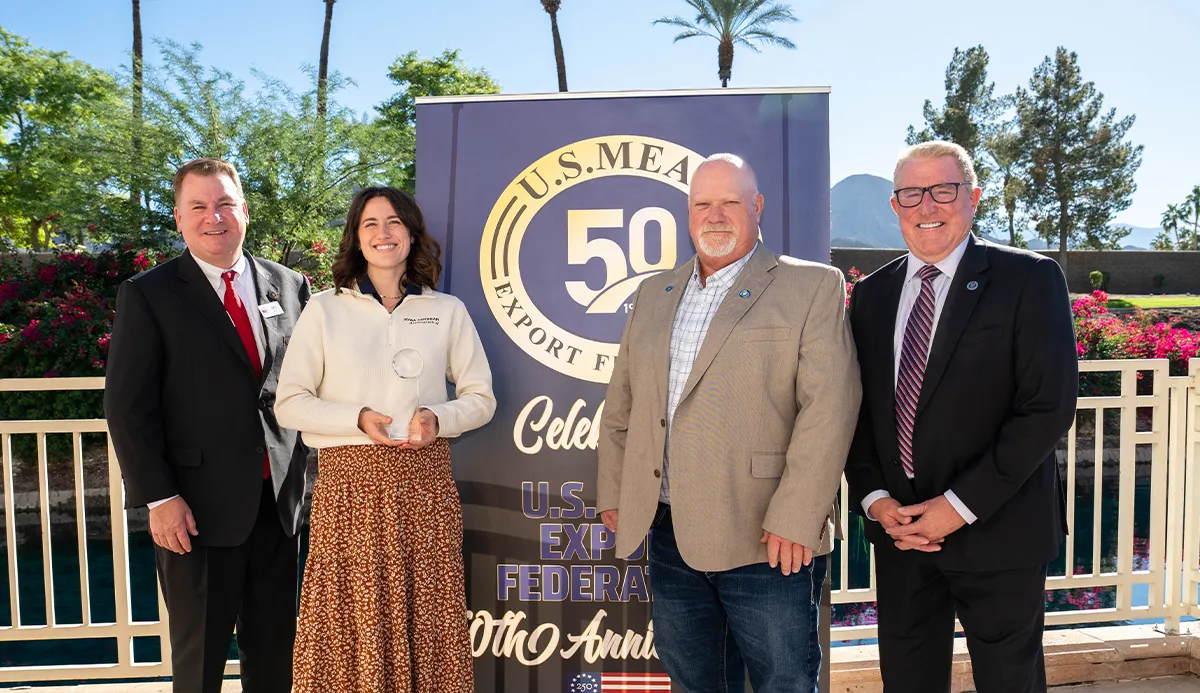
Iowa Soybean Association was recognized recently for its support of the U.S. Meat Export Federation during USMEF’s meeting in Palm Springs, California. Pictured are John Hinners, senior vice president of industry relations for USMEF; Amanda Tupper, ISA District 3 Director; Lee Brooke, ISA president; and Dan Halstrom, USMEF president and CEO. (Photo: Iowa Soybean Association/Aaron Putze).
How to sustain U.S. meat export growth
November 19, 2026 | Aaron Putze, APR
Cooperation, communication and collaboration will be essential to sustaining U.S. meat export growth amid global volatility, intensifying competition and evolving consumer preferences, says Dan Halstrom, president and CEO of the U.S. Meat Export Federation.
Speaking at USMEF’s 50th strategic planning conference held last week in Palm Springs, California, Halstrom emphasized the importance of building on decades of export growth while continually adapting to changing global markets and consumer demands.
Since opening its first international office in Tokyo in 1977, USMEF has expanded its global presence to 22 offices. This reflects the increasing importance and diversity of international markets that’s helped deliver significant returns for U.S. livestock producers.
The success of USMEF is defined by increasing the value of U.S. red meat. Since 2010, the value of U.S. pork exports has grown from approximately $43 per head to $66 per head in 2026. The value of beef and variety meat exports has increased even more dramatically, climbing from $153 to $433 per head over the same period.
A key part of this growth has been China. It remains a significant market opportunity, although U.S. exports have declined sharply in recent years amid ongoing market access challenges and uncertainty between the world’s two largest economies.
Pork and beef exports to China in 2020 totaled $2.3 billion and $2.1 billion respectively. Now, they amount of $857 million and $498 million respectively.
“No one knows what’s going to happen, but the number one opportunity to add value for U.S. beef and pork tomorrow is China,” Halstrom said.
Halstrom began his career as an exporter more than 40 years ago. The Cherokee, Iowa, native said there’s probably no bigger success in the past 15 years than Mexico. Pork and variety meats from 2010 to 2025 are up 189% (now $2.8 billion) while beef exports are up 59%, a$1.3 billion market in 2025.
Meanwhile, South Korea, Japan and Taiwan have become increasingly important destinations for U.S. beef. Looking ahead, opportunities in Colombia, Central America, the Dominican Republic, Saudi Arabia and Indonesia offer additional potential.
Examples of that innovation are already generating results. Boston Butt Burgers introduced in Colombia and U.S. pork-based CarniSnack products now available in 30,000 convenience stores in Mexico demonstrate how creative product development can stimulate demand, reach new consumers and maximize the value of each animal.
Growth depends on diversifying markets, securing and maintaining trade access, delivering superior quality and consistency, and responding to consumers’ demand for greater convenience and product innovation, Halstrom said.
The competitive landscape, he added, is becoming more challenging. He cautioned that countries such as Brazil are aggressively pursuing international market opportunities, underscoring the need for the U.S. industry to remain proactive and competitive.
“Where is the next Colombia for pork and the next Korea for beef? That’s what we keep asking ourselves,” he said.
Ultimately, Halstrom believes sustained export success will require the industry to tell a compelling story about the superior taste and quality of U.S. beef, pork and lamb while continually identifying emerging markets and understanding demographic shifts and changing consumer preferences.
ISA recognized
USMEF also capitalized on the historic gathering to present Heritage Partner Awards. The Iowa Soybean Association was among those recognized for 40 years of dedicated investments in USMEF and advancing the U.S. red meat industry around the world.
“We are deeply grateful for the financial commitment, collaboration, and trust our partners have shown over the years,” said John Hinners, USMEF’s senior vice president of industry relations. “Their contributions have helped shape our success and create lasting impact for the U.S. red meat industry. It is an honor to recognize their achievements during this 50th anniversary.”
USMEF Chair Jay Theiler, executive vice president of Idaho-based Agri Beef Co., also paid tribute to those who founded the organization a half-century ago.
“We all owe a debt of gratitude to the past leaders of USMEF for their vision and foresight, which made possible these 50 years of growth and success,” Theiler said. “But to properly honor their legacy, we need to keep our eye on the future and continue to build on USMEF’s strengths. One of our greatest strengths is our diverse membership, bringing many sectors of U.S. agriculture together to work toward a common goal.”
Written by Aaron Putze.
Back