
(Photo: Iowa Soybean Association / Joclyn Kuboushek)
Where are the major yield gaps for midwest farmers?
September 1, 2026
Key Insights
- Crowd-sourced farmer data at scale delivers actionable insights.
- Leveraging this data improved field-level profitability by $44 an acre.
- To maximize soybean yields and profits, start with early planting and then tweak other inputs for field-specific management.
Just over a decade ago, a group of agronomists came to the North Central Soybean Research Program (NCSRP) with an idea: Let’s survey soybean farmers across the Midwest to determine where the major yield gaps are in our production systems.
Today, this research has evolved into what academia and industry leaders have chased for decades: field-specific recommendations that optimize production. This optimum cropping system unlocks maximum yield potential while increasing farm profitability and sustainability.
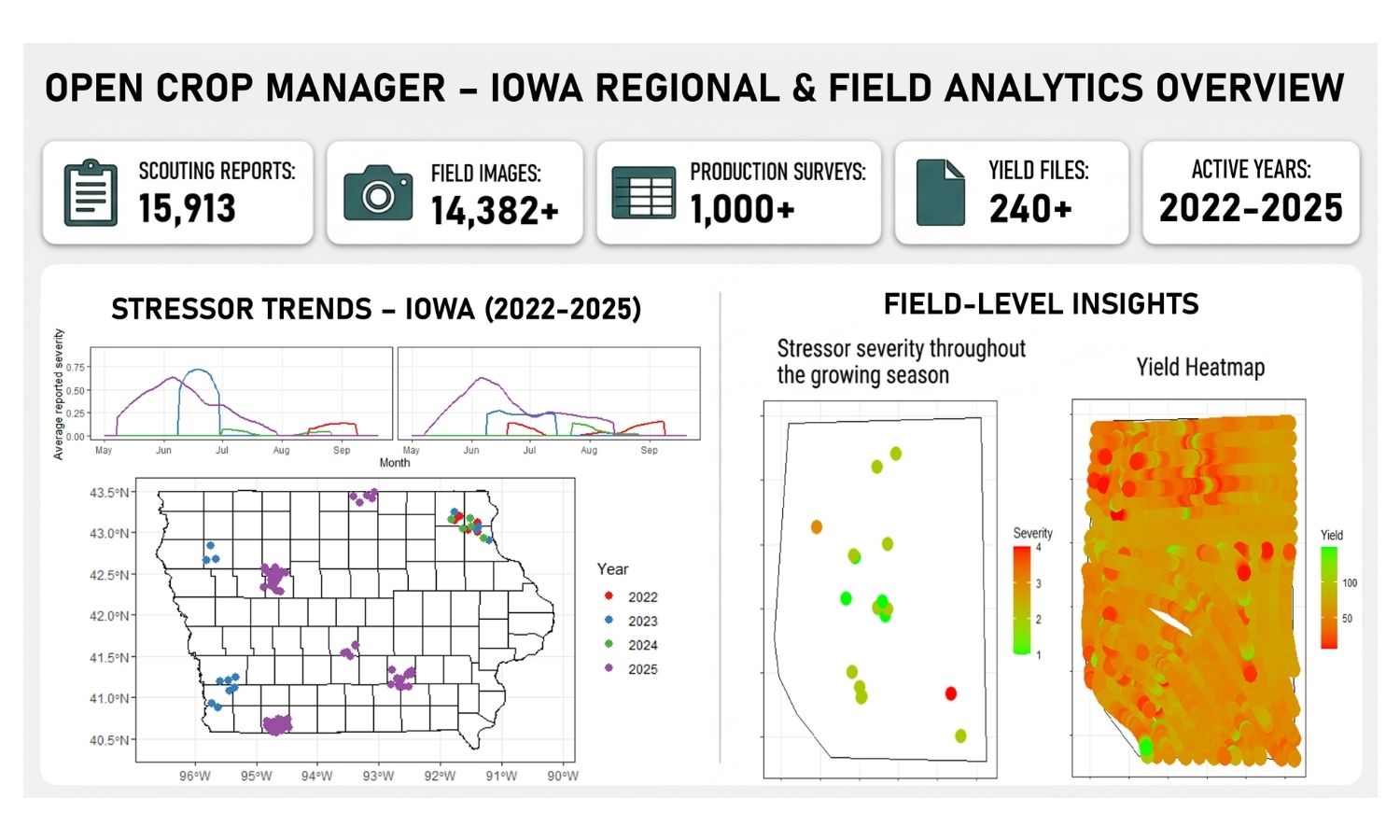
The Open Crop Manager (OCM) is a scouting and database platform enabling the collection of field data on diseases, pests, weeds, and abiotic stressors affecting various crops. It allows data to be explored at local within-field scales and aggregated to higher regional levels. Data example from Iowa.
The challenge in identifying an optimal system is that too many variables interact at once to evaluate them all in standard replicated trials. Because these agronomic factors constantly interact, the management practices that maximize yield will vary from field to field, even within the same region.
Half-million acres
During the first project from 2014 to 2017, researchers collected yield data and management information from more than 8,000 soybean fields across 10 North Central states, including Iowa. The study tracked variables such as planting date, maturity group, seeding rate, row spacing, tillage, seed treatments, fertility, and pesticide use, representing nearly 500,000 acres.
By analyzing this data, we identified the key management-related factors contributing to substantial yield gaps across the region. Across Iowa, planting date was identified as the most important management factor a farmer can change to substantially increase soybean yield. Other factors, such as maturity group, row spacing, seeding rate, and the use of foliar fungicides and insecticides, were also important but differed based on geography.
Putting it together
Using the knowledge gained from this first project, we developed improved management practices by combining two to three of the most crucial factors tailored to different regions.
We then put these practices to the test on the farm, conducting field trials in Nebraska, Iowa, North Dakota, Minnesota, Wisconsin, Michigan, and Ohio. In each field trial, we evaluated the improved treatments (optimized planting date, maturity group, and seeding rate) against a reference treatment that reflected the typical producer’s management in that specific region.
The results were clear in Iowa: The improved treatments delivered roughly a $40-an-acre higher profit compared to typical producer management.
This foundational work allowed us to identify the single and combined management practices that most impact soybean yields, providing actionable insights to help farmers increase their yields and profits. However, we recognized that these initial recommendations were averaged over large regions and based on static economic assumptions.
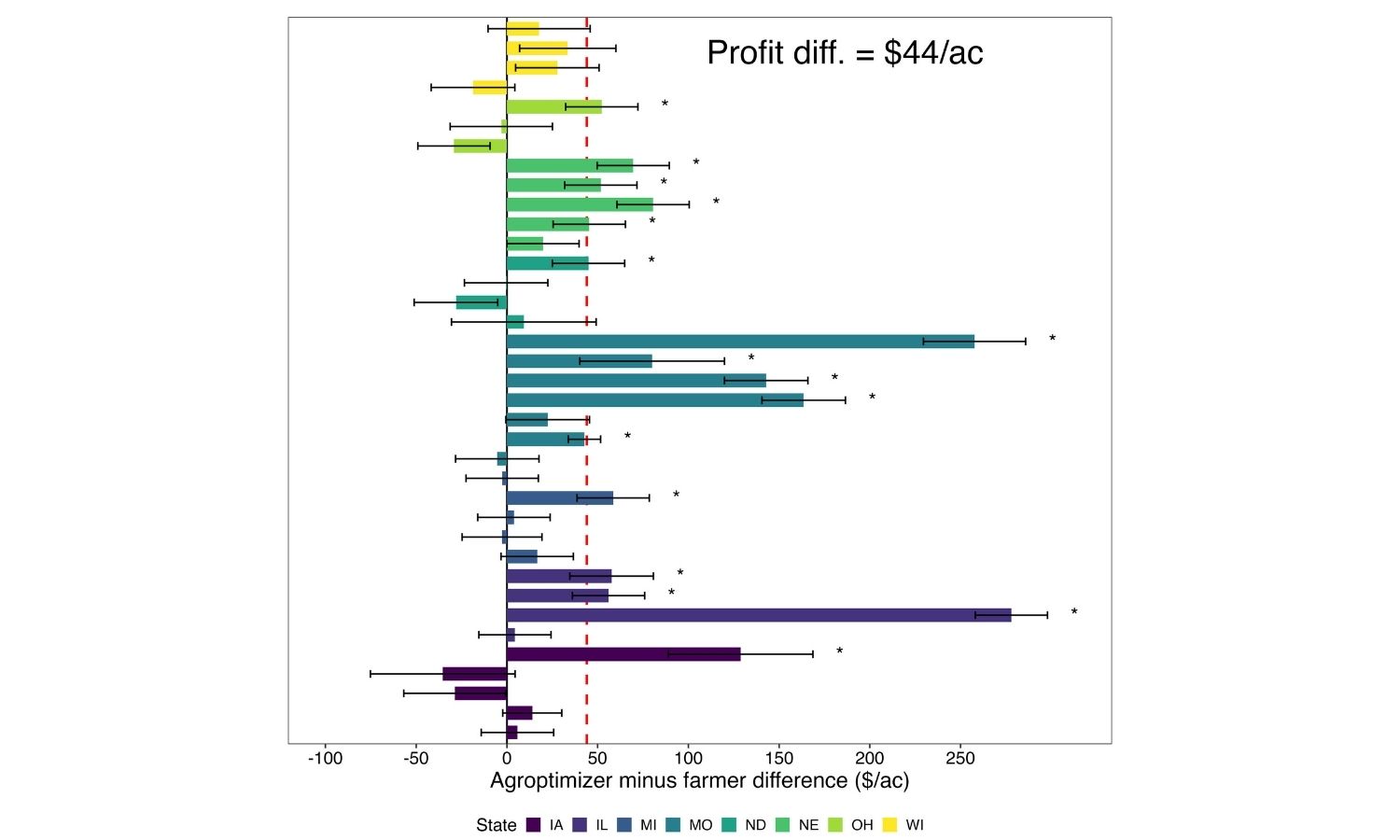
Profit difference at 37 fields across eight states. We observed a significant profit difference in 16 of the fields, while the remaining fields held steady. On average across the trialed region, Agroptimizer recommendations generated a $44-an-acre greater profit than standard soybean systems (red dashed line). Stars indicate fields where the profit increase was statistically significant ($P < 0.05$).
Building better tools
This made us wonder: Can we do better?
To improve, we needed a platform and tools to house, protect, and run our immense, farmer-driven data repository. So, we developed the Open Crop Manager (OCM), a cloud-based decision-support tool.
The OCM offers a user-friendly platform for in-field crop scouting and data collection, tracking crop production practices at the farm and field scale across 14 states. Currently, the OCM database houses 15,913 unique scouting reports and 14,382 stressor images. These reports track field conditions across the growing season, including specific growth stages, active stressors, and beneficial species.
Since 2022, the project has amassed 488 field-years of data. Additionally, we have gathered roughly 1,000 production surveys detailing yield outcomes, planting and harvest dates, seed choices, and pesticide treatments. In 2026, the OCM launched the corn and wheat platforms for testing and validation.
What’s next?
We have the data (600,000 acres and counting), we have the house (OCM), and — to quote The Six Million Dollar Man — “We have the technology ... better, faster, stronger.”
Following initial research funded by the Wisconsin Soybean Marketing Board from 2021 to 2023, we began evaluating an AI decision-support tool called Agroptimizer regionally in 2025. This platform enables farmers to compare current field practices against a predicted, optimized system, allowing them to fine-tune management to maximize either yield or profit.
First-year results across 37 fields in eight states show immense potential: In 2025, Agroptimizer increased farm profits by an average of $44 an acre.
Over our 11 years of research, NCSRP has remained committed to producing actionable insights and tools that farmers can use to directly increase yield and profit in their own fields. We know from experience that great results stem from strong collaborations and high-quality data. We welcome all researchers, organizations, and individual farmers to contribute and collaborate with us in this ongoing effort to optimize soybean research.
Shawn P. Conley, Ph.D.
Soybean and Small Grains Specialist
University of Wisconsin, Madison
spconley@wisc.edu
Have a trial or project you're interested in?
We can consider it as a topic for a future edition. Better yet, we'll connect you with your local expert so you can implement a trial on your far. Send an email to jmcclure@iasoybeans.com for more information.
Back