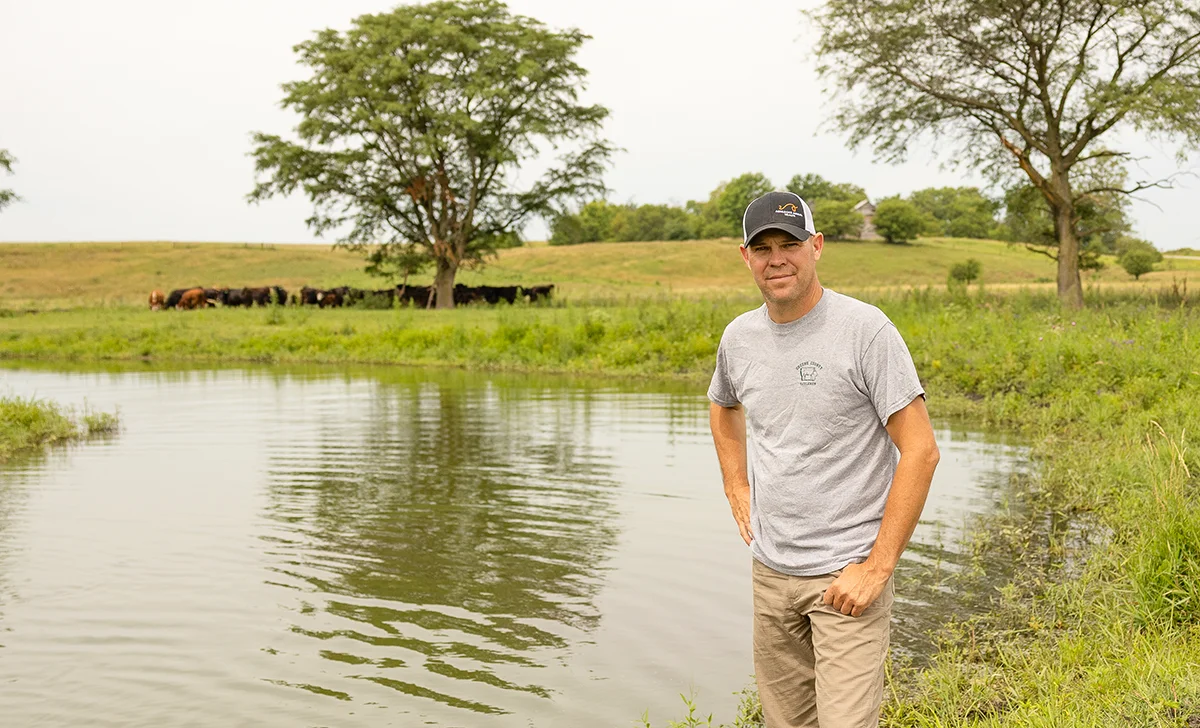
Along with cover crops, rotational grazing and buffer strips, the Fields family recently restored an oxbow on low-yielding ground to improve water quality and pasture management. (Photo: Iowa Soybean Association / Joclyn Kuboushek)
Cover crops with a fall purpose
September 1, 2026 | Kriss Nelson
For Bill Fields, conservation practices have to work for the farm before they become permanent fixtures. As crop margins tighten and weather remains unpredictable, he relies on dual-purpose practices that serve both his row crops and livestock.
“We’re always trying different things to see what works,” says Fields, who grows soybeans and corn near Paton with his brother John. He also manages an 80-head cow-calf operation with his wife Christy. That mindset has led the family to adopt cover crops, rotational grazing, buffer strips and an oxbow restoration project. None were adopted simply for the conservation label; they must make financial and operational sense.
Cover crops with a purpose
Fields has used cover crops for the past five years, primarily aerially seeding cereal rye into corn stalks each September across a portion of his 700 acres.
While the rye reduces erosion and holds nutrients, its immediate value is forage.
The family’s cattle graze the cover crops in the fall and spring. They also drill 20 acres of rye directly around the home acreage as a clean paddock for spring calving.
“From the conservation and soil erosion aspect, it helps there,” Fields says. “Then from the grazing standpoint, it’s really helpful.”
Establishment remains the largest hurdle.
“If you can get it in and get rain on it, that’s the key,” he says.
When moisture arrives at the right time, the rye can provide valuable forage. They’ve experimented with ways to establish cover crops earlier and maximize fall growth, though not every attempt has worked.
“We tried some things last year that didn’t work that well,” he says. “But we’re always looking for what yields the most tonnage and grazing.”
Looking beyond rye
While cereal rye has become a regular part of the operation, Fields is still searching for an effective cover crop to follow soybeans. He has experimented with aerially applying oats into soybeans with mixed results due to varying moisture from one year to the next.
With soybean acres representing nearly half of the operation, he sees an opportunity to boost forage production while capturing additional conservation benefits. The challenge is finding a mix that provides fast fall growth without complicating harvest. “I think it’s going to be some kind of concoction of various species,” he says.
Conservation costs
Like many farmers, Fields says economics plays a major factor in conservation decisions.
Cover crops provide benefits, but they also come with costs.
To help offset seed and application costs, the family has used available funding through Greene County Soil and Water Conservation District programs and Practical Farmers of Iowa.
Fields encourages other farmers to explore every available funding opportunity.
“If you can’t stack some of this stuff together, it’s just tough to make it pencil out on paper,” he says.
While grazing helps create an economic return, he acknowledges that cover crops can be difficult to justify strictly from a row-crop perspective, especially in years when weather limits cover crop growth.
Even so, he believes the benefits are real.
“If you’re doing it for soil erosion, holding nutrients in place and things of that nature, it works well,” he says.
Improving the landscape
Beyond cover crops, Fields uses rotational grazing and maintains buffer strips where practical. He would like to add buffer strips in some locations, although livestock management requirements can make those decisions more complicated.
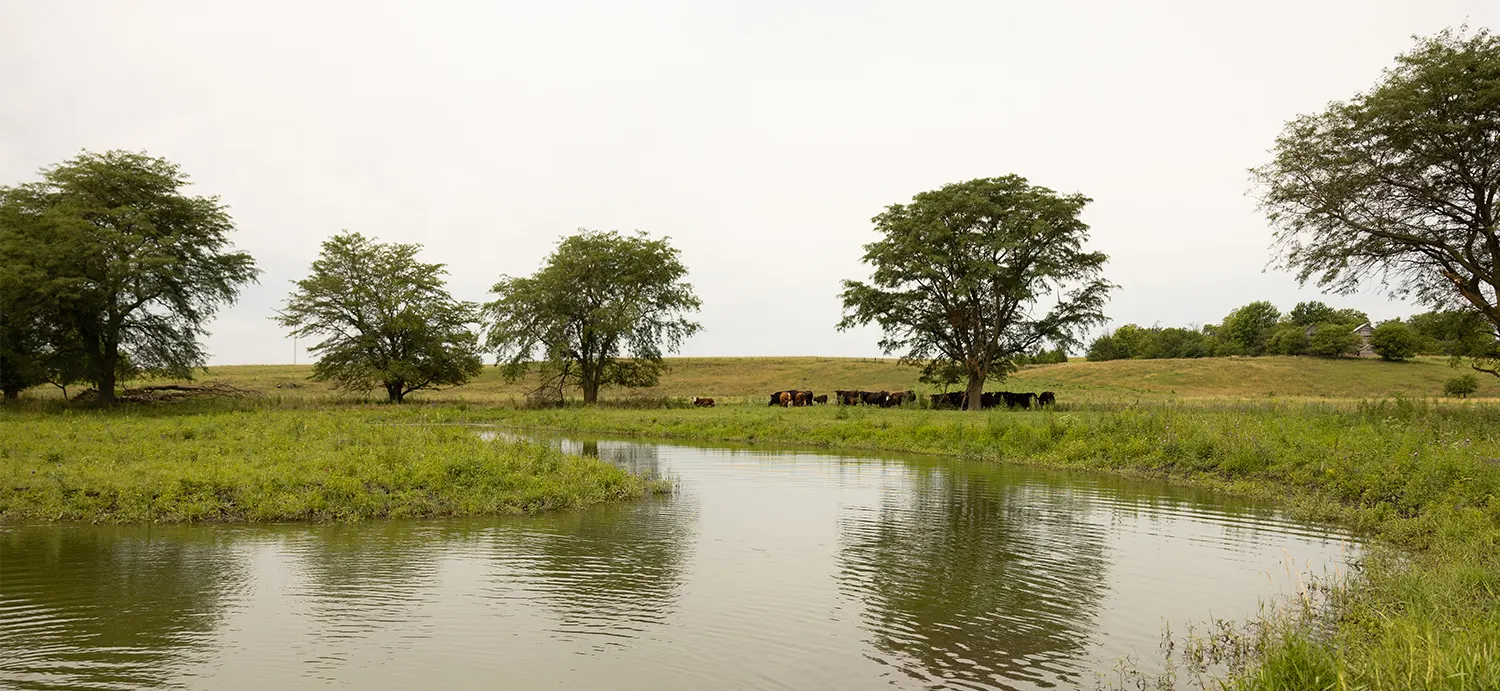
Recently he worked with ISA Senior Conservation Services Manager Brandon Iddings to restore oxbows on 1.5 acres on low-yielding ground. Moving soil during excavation helped address an erosion-prone area within a pasture, and once fully established, the project is expected to improve water quality and pasture management.
While some restored oxbows become livestock watering sources, Fields says that isn’t the primary goal on his farm.
“My hope is not to have cows watering out of them anymore than necessary,” he says.
Keep learning
Fields doesn’t claim to have all the answers. Instead, he approaches conservation much the same way he approaches farming: try new ideas, evaluate the results and keep what works.
For farmers considering cover crops or other conservation practices, his advice is straightforward: monitor moisture, use available cost-share programs and be willing to adapt.
Written by Kriss Nelson.
Back