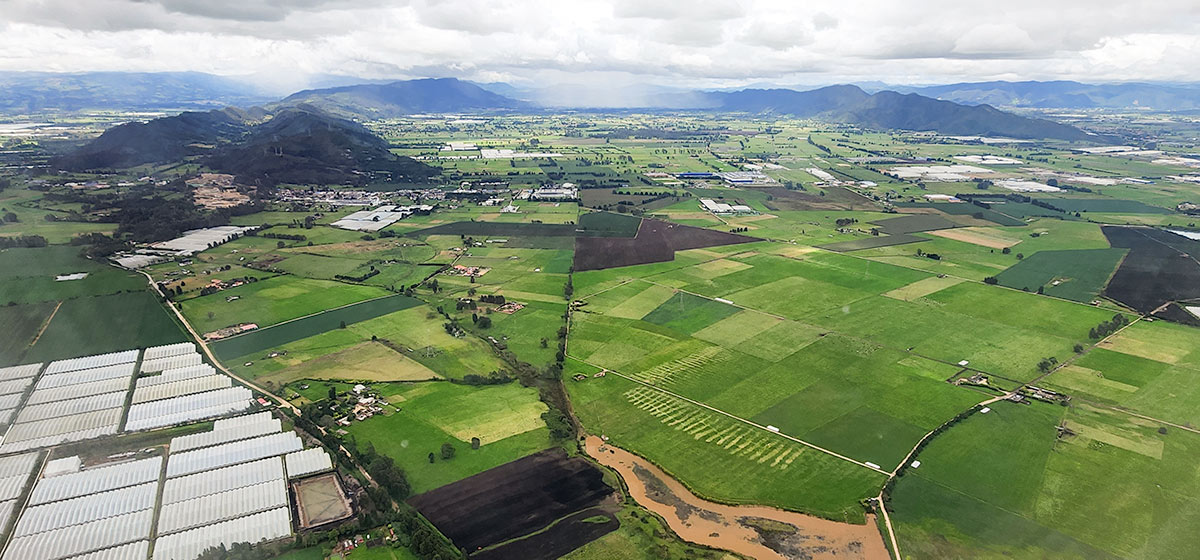
Beautiful Bogotá by air (Photo: Iowa Soybean Association / Aaron Putze)
Colombia Prefers U.S. Soy
September 1, 2026 | Aaron Putze, APR
Ag Processing, Inc. (AGP), an Omaha-based soybean crusher sourcing soybeans from its network of Midwest farmer-owned cooperatives, led a delegation of soybean farmers and state soybean association staff to Colombia in June. The group included representatives from the Iowa, Missouri and South Dakota soybean associations, the U.S. Meat Export Federation and the U.S. Soybean Export Council.
Sponsored in part by the Iowa Soybean Association, the trade mission included meetings in Bogotá and Medellín with leaders from Colombia’s three largest buyers of U.S. soybean meal — Italco, Contegral and Solla. The delegation visited major retailers and food service outlets, including Pigasus restaurant and Carulla, Colombia’s largest supermarket chain, where participants sampled U.S. pork and beef products.
The group also met with meat importers and distributors who source U.S. pork and beef for customers throughout central Colombia.
“The delegation sought to better understand market opportunities, company growth expectations and the logistical challenges influencing imports,” says Scott Ritzman, president of Ritz Ag Consulting, who coordinated the trade mission on behalf of AGP.
Why Colombia?
Colombia is a reliable and growing market for U.S. soybean meal. In 2025, the country imported more than 2 million metric tons (MMT)—nearly triple the volume purchased two decades ago. Those imports were valued at nearly $850 million.
The United States supplies more than 96% of Colombia’s soybean meal imports. The rest is sourced from Bolivia. Demand is expected to continue climbing, with imports projected to reach 2.3 MMT in 2026-27 as Colombia expands its poultry, pork, dairy, aquaculture, equine and pet food industries.
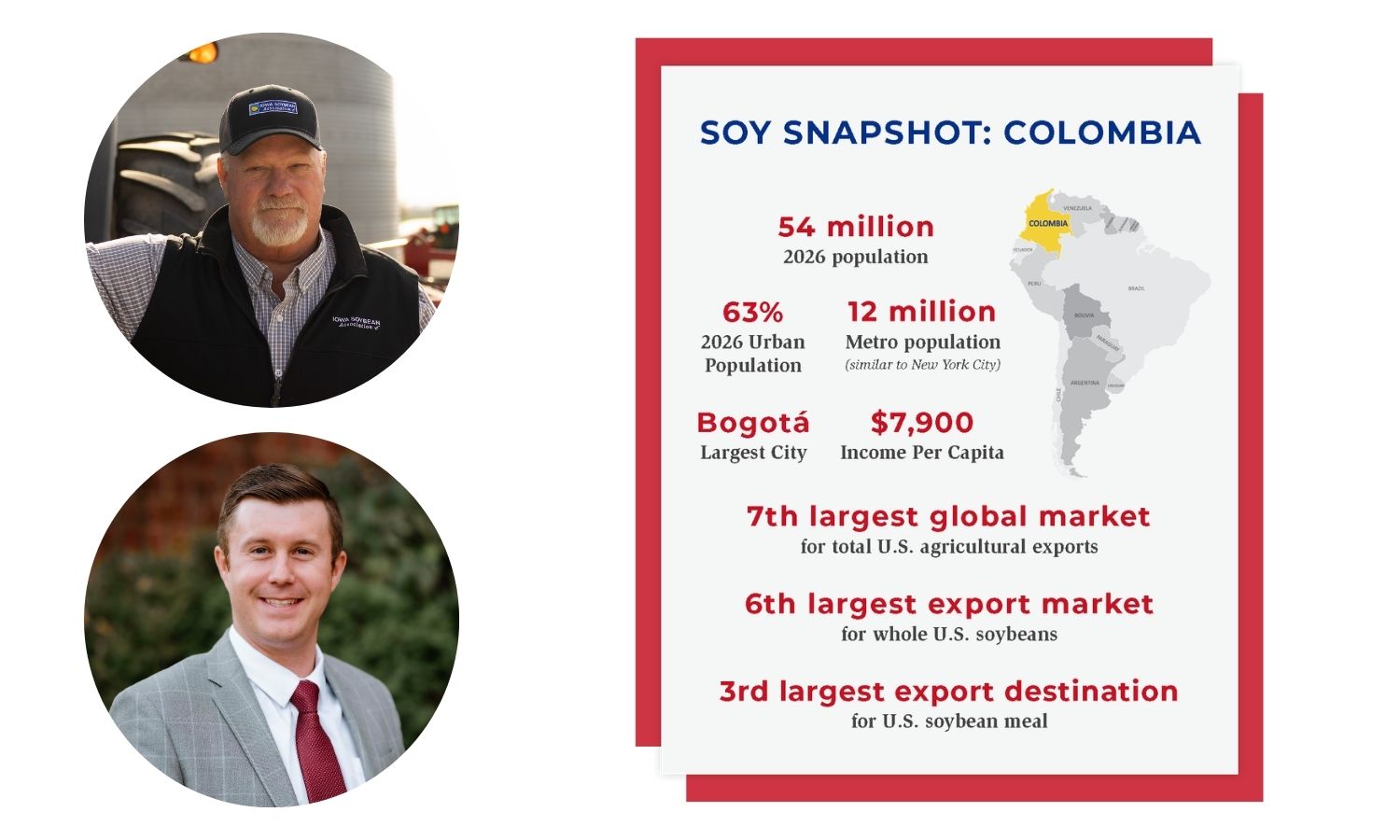
Lee Brooke, ISA president-elect (top) and Scott Ritzman, Ritz Ag Consulting (bottom)
“While it’s important to pursue new and emerging markets, there’s also tremendous opportunity to grow sales with customers we already have,” says Lee Brooke, ISA president-elect and a soybean farmer from southwest Iowa.
Brooke, who represented ISA on the trade mission, says every export market is becoming increasingly important as Iowa and U.S. farmers continue to produce and process more soybeans. Increased demand for soybean oil driven by renewable fuels has also resulted in greater supplies of soybean meal — making the need for dependable export markets even more critical.
“That meal has to find a home,” Brooke says. “Colombia is a close, strategic market that understands the value of U.S. soybean meal. They know it’s about more than price — it’s the superior protein quality, amino acid profile and digestibility.”
Brooke says the buyers the delegation met with consistently expressed confidence in U.S. soy.
“They recognize and prefer the quality of U.S. soybean meal,” he says. “As Colombia’s population grows and consumers demand more protein, we expect to see even greater opportunities for U.S. soybean farmers.”
In addition to soybean meal, Colombia imports more than 560,000 metric tons of whole soybeans from the United States each year. Because the country has limited soybean crushing capacity, most of those beans are roasted and used in poultry and aquaculture feed.
Soy demand growth
Colombia is a country — and an economy — on the rise.
Production of fish, bananas, coffee, avocados and flowers continues to expand, while the country has also become a leading manufacturer of textiles, automotive parts, pharmaceuticals and more.
Much of that economic growth is centered in Bogotá and Medellín. Together, the two cities are home to nearly 16 million people and serve as Colombia’s hubs for commerce, manufacturing, retail and innovation.
As economic opportunities continue to concentrate in urban areas, more Colombians are leaving rural communities in search of better jobs, housing and quality of life. By 2050, 65% of the country’s population is expected to live in cities, according to USSEC. Rising incomes and urbanization are expected to fuel demand for higher-quality protein, creating additional opportunities for U.S. soybean farmers.
Many Colombians, however, continue to face economic hardship. A significant share of the workforce earns a living through informal, day-to-day employment rather than full-time jobs, limiting household income and food purchasing power.
As incomes rise, Brooke expects diets to evolve.
“As people become more financially secure, they’ll eat more frequently, dine out more often and begin choosing more premium proteins, including beef,” he says. “Domestic egg and poultry production is helping meet that demand, which is why Colombia’s soybean meal imports continue to increase. Pork imports from the U.S. are also growing because domestic production hasn’t kept pace with consumer demand — at least not yet.”
Brooke believes the trend represents long-term opportunity for U.S. agriculture.
“Colombia is an important market for U.S. soybean and pork producers,” he says. “As demand for protein continues to grow, so will opportunities for U.S. soybean meal, pork and, potentially, beef exports.”
According to USSEC, Colombia’s compound feed production reached nearly 12.6 million metric tons in 2025, up from 11.5 million metric tons the previous year. Growth is projected across every major livestock sector, including egg production, poultry, pork and beef.
Dairy evolution
The country’s dairy industry also shows significant potential. Colombia has one of the world’s largest cattle populations, yet much of the industry remains fragmented and dependent on traditional grazing systems. Companies such as Medellín-based Contegral are investing in improved genetics, nutrition and feed technologies to modernize production and improve efficiency.
“We’re introducing better genetics and more advanced production systems so the industry can transition from primarily grass-fed operations to professionally formulated feed programs,” says Julio Gonzales, Contegral’s supply chain manager.
Market logistics
Colombia’s location gives it access to both the Atlantic and Pacific oceans, with six major seaports in operation and additional facilities under construction. Those ports provide multiple gateways for importing agricultural products, including U.S. whole soybeans, soybean meal and corn, as well as fertilizer from China.
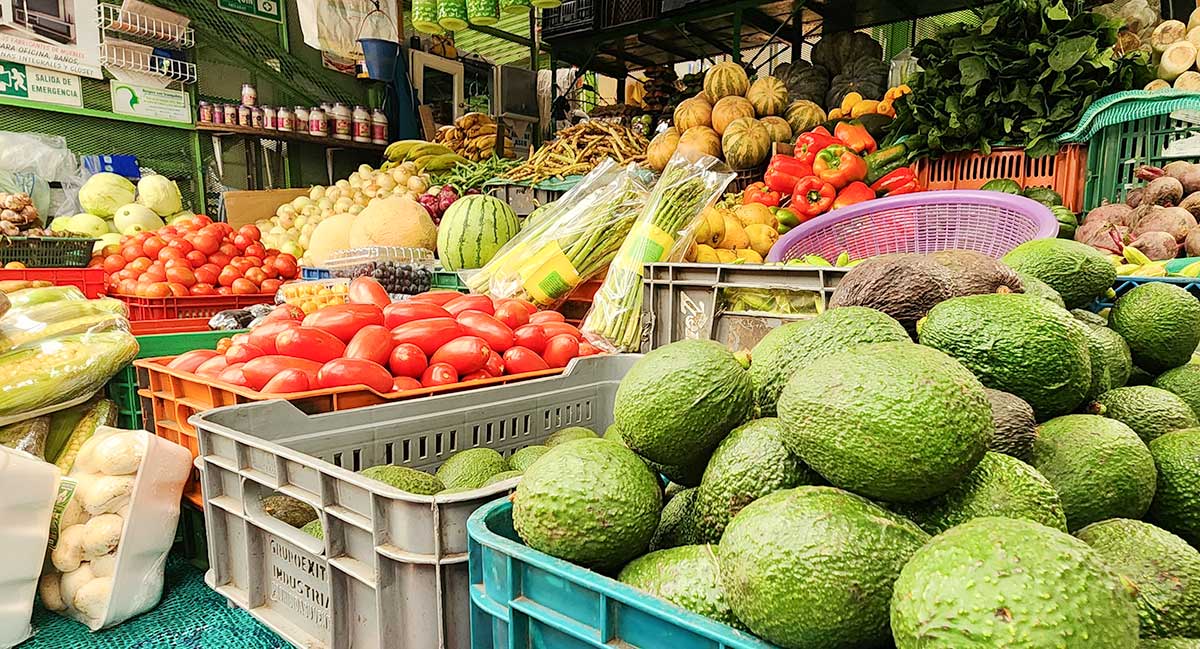
Fresh produce from Medellín and Bogotá.
Getting those products inland, however, is another matter.
Much of Colombia’s population lives hundreds of miles from the coast, and the country lacks a robust rail network. All freight moves by truck through rugged terrain dominated by the Andes Mountains, making transportation one of the greatest costs of doing business.
That challenge was a common theme in meetings with executives from Italco, Contegral and Solla. Growing congestion, delays and higher costs associated with the Panama Canal are prompting buyers to explore alternative shipping routes, including direct service from the U.S. Gulf Coast to Colombia’s northern ports and shipments from AGP’s Grays Harbor export terminal in Washington.
“Logistics are the greatest cost because nearly everything has to be moved by truck,” Ritzman says. “Moving product from the ports to feed mills in Medellín adds roughly $50 per metric ton in freight costs.”
Preferred partner
Despite those challenges, Colombian companies remain committed to sourcing U.S. soybeans and soybean meal because of its consistent quality, dependable supply and their strong relationships with American suppliers.
Contegral exemplifies that commitment. The fourth-generation, family-owned company has grown into one of Colombia’s leading providers of animal nutrition, genetics and agricultural retail products.
The company manufactures more than 2 million metric tons of feed annually for poultry, swine, dairy, beef, equine, aquaculture and pet food markets. Nearly 98% of the raw materials used in that production are sourced from the United States.
Gonzales says the country’s geography presents daily logistical challenges.
“Medellín sits in a valley surrounded by mountains,” he says. “The city is growing so quickly that development expanded to the other side of the mountains, requiring the construction of a tunnel to connect the two.”
Even so, Gonzales sees tremendous value in the company’s partnership with U.S. agriculture.
“We love working with the U.S. and sourcing our soybeans and soybean meal from America,” he says. “We trust the reliability and quality of your products.
“We also appreciate that your soybean farms are family businesses, just like ours. We’ve visited the U.S. several times and have seen firsthand how responsibly you farm. What you do helps feed the world, and we value that partnership.”
Written by Aaron Putze.
Back