Cover crops cut nitrogen loss and protect water quality
March 2, 2026 | Tony Seeman
Key insights
- Cover crops consistently reduce the amount of nitrogen lost through tile drainage.
- The amount of nitrogen reduction varies from year to year, but continued use provides increased reductions.
- Water monitoring results indicate the benefits of cover crops can be seen at the stream scale.
Cover crops are one of the most effective conservation practices for reducing nutrient loss, particularly nitrogen, which is a major concern for drinking water quality and impact to downstream waterbodies. Cover crops also improve soil health over time and keep unused nitrogen in the field for use by future crops.
The Iowa Nutrient Reduction Strategy estimates that cover crops reduce nitrogen loss by an average of 27%, similar to edge-of-field practices. However, unlike edge-of-field practices, which are limited to specific locations, cover crops can be implemented virtually anywhere cash crops are grown.
Performance is highly variable because cover crops require several management decisions — species selection, seeding rate, planting method, timing and termination — all of which affect germination and growth.
Successful growth is critical because it determines how effectively cover crops capture nitrate before it leaches below the root zone, so it is important to have a plan for success and the ability to adapt as conditions change to maximize benefit and minimize risk to the following cash crop.
For cover crops to reduce nitrogen loss, they must be actively growing during leaching events.
Measured results
Iowa Soybean Association (ISA) tile monitoring results consistently show that cover-cropped fields have lower nitrate levels than conventional fields.
Recent years illustrate this variability. In 2024, cover-cropped fields averaged 33% lower nitrate levels following a significant spring flush. In 2023, a dry year, the difference was only 13%.
This finding is further supported by infield soil testing in long-term research trials. On-farm research in 2024 conducted by ISA showed soil nitrate tests in cover cropped strips within fields had a 44% reduction compared to strips without cover crops.
Consistent, year-after-year usage of cover crops provides continued water quality benefits. That’s because water repeatedly moves through the soil over time as rain and snowmelt soak in and drain out.
During this movement, nitrates can wash downward into groundwater and tile drainage. Weather conditions are a factor in overall leaching and movement. Wet periods increase leaching because more water moves through the soil. Dry periods slow leaching, but without plants taking up nitrates they can accumulate and be vulnerable to loss in the future.
Temperature affects plant growth and soil microbes, which influence how much nitrogen is taken up or released.
While we regularly see the impact of cover crops in an individual field, the results are often masked by scale.
In 2020, ISA partnered with Practical Farmers of Iowa (PFI) to implement cover crops across the Van Zante Creek watershed in the South Skunk River basin. PFI was focused on using a variety of cost-share options and farmer-to-farmer learning to increase the adoption of cover crops in this small area. ISA was tasked with water monitoring to assess the impact at the field scale and more importantly to see if the results translated to the receiving streams.
A subset of field tiles in the project area was monitored. As expected, fields with cover crops were significantly lower in nitrate concentrations as a group compared to fields without cover crops each year by an average of 6 parts per million (ppm). The difference was similar between corn and soybean acres, but demonstrated the overall benefit that cover crops have on nutrient retention on the field (Fig 1).
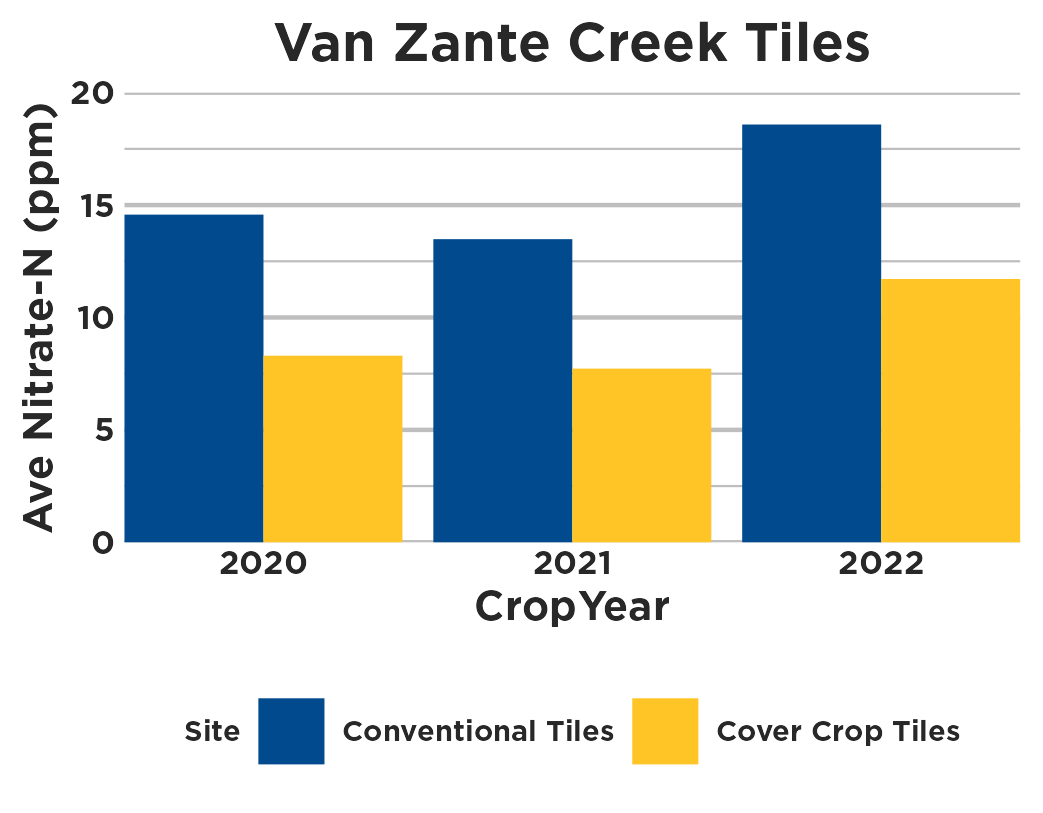
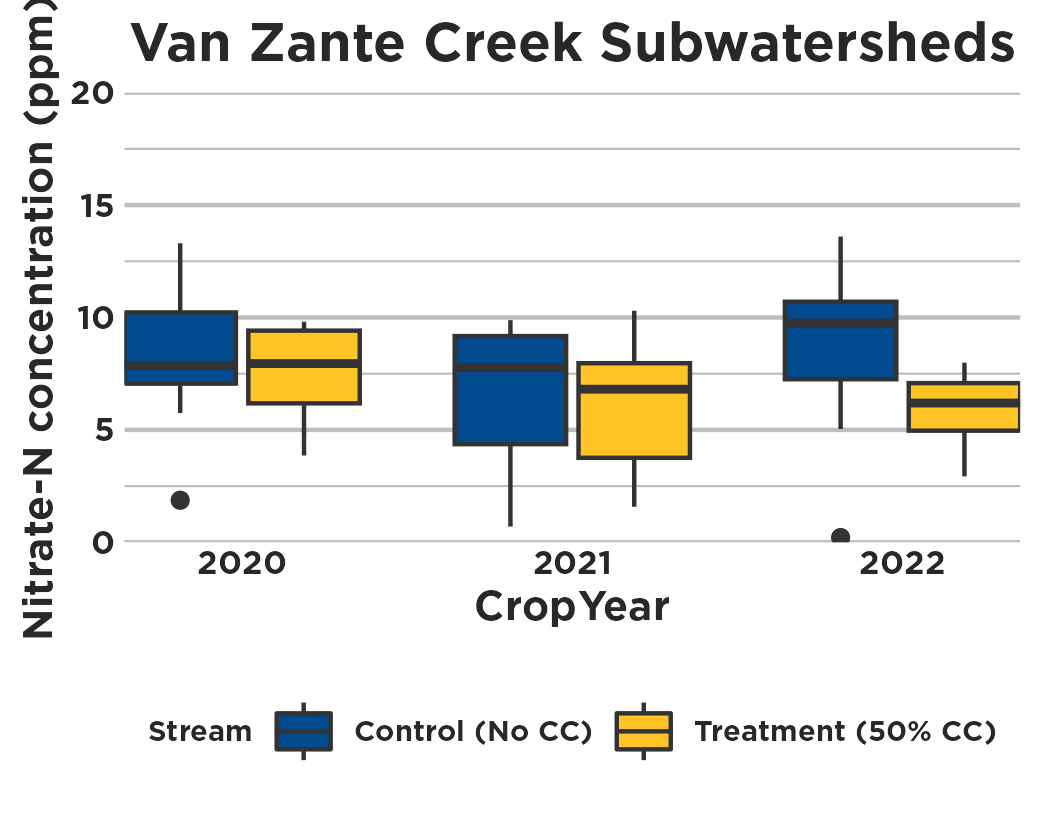
Stream sites were selected within the watershed including one with over 50% of the drainage area in cover crops in each of the three years of the project. Stream nitrate concentrations during the first two years showed very similar results between the site compared to an upstream control site without cover crops. However, the third year showed a significant difference. Concentrations in the control site increased from 2021, while the treatment site continued to decline. Of note is the fact that in the heavily cover-cropped watershed, concentrations only topped the 10 ppm drinking water limit once, while the control watershed had multiple exceedances in two of three years (Fig.2).
Statewide benefits
Cover crops are a versatile and impactful conservation practice. While results vary based on management and weather, long-term and large-scale implementation consistently demonstrates significant reductions in nitrate loss. These benefits can extend beyond individual fields to entire watersheds when substantial amounts of cover crops are implemented, making cover crops a cornerstone of Iowa’s nutrient reduction strategy and a critical tool for protecting drinking water and improving soil health.
Written by Tony Seeman.
Back