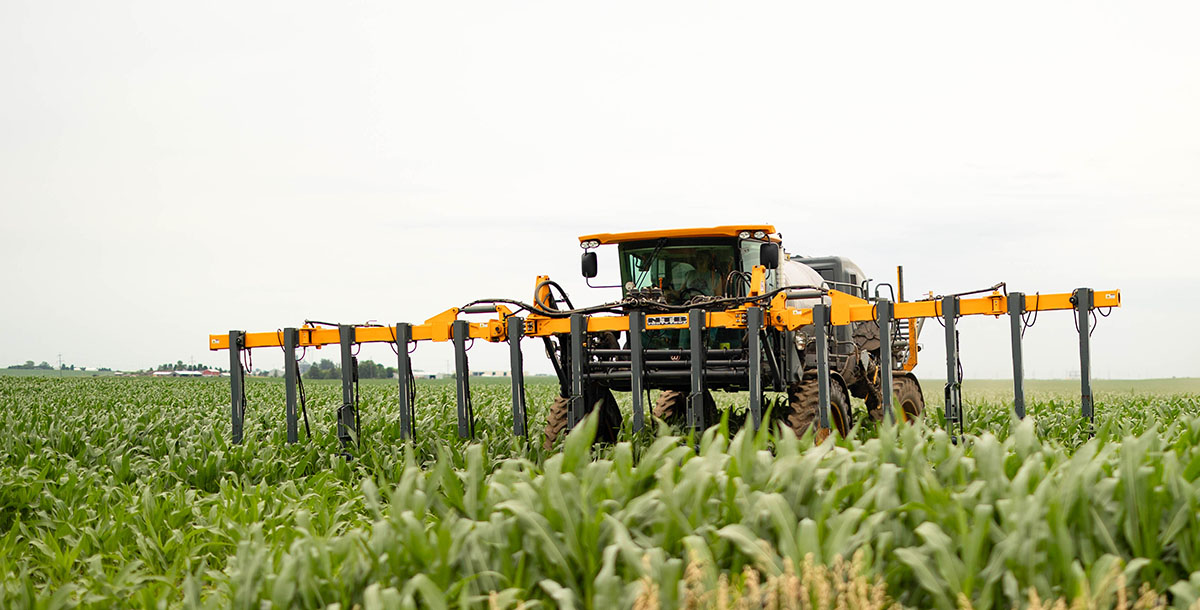
A sprayer applies sidedress nitrogen to a corn field. Farmers are encouraged to conduct late-spring soil nitrate tests to help fine-tune nitrogen rates. (Photo: Iowa Soybean Association / Joclyn Kuboushek)
Late-spring nitrogen tool helps farmers fine-tune fertilizer decisions
April 30, 2026 | Kriss Nelson
Residual soil nitrogen levels may be higher than average heading into the 2026 growing season due to relatively warm winter weather, meaning some fields may need less sidedress nitrogen fertilizer than in a typical year.
Iowa State University has developed a tool to help farmers interpret soil nitrate test results, often called the late-spring nitrate test (LSNT).
The late-spring nitrogen test nitrogen decision support tool can be used to reduce uncertainty in nitrogen fertilizer needs, lowering the risk of both under- and over-application.
The tool uses data from 62 on-farm trials, totaling 136 unique measurements, conducted in partnership with the Iowa Nitrogen Initiative from 2023 to 2025. These samples are used to estimate the probability of a yield increase from additional nitrogen and the sidedress nitrogen (pounds per acre) needed to reach the Economic Optimum Nitrogen Rate (EONR).
A maximum corn yield of 230 bushels per acre is assumed based on the average yield in Iowa Nitrogen Initiative trials, which ranged from 210 to 260 bushels per acre.
Alex Schaffer, Iowa Soybean Association research agronomy lead, says timing matters, as late-spring nitrogen tests allow farmers to adjust while the crop is still responsive.
“It’s relatively rare for farmers to measure soil nitrogen at this point in the season,” he says. “It makes a lot of sense to look and equip ourselves with the information to address some of the water quality challenges we see, while also helping farmers be as efficient and productive as they can be.”
For farmers interested in using the tool, Schaffer says ISA support is available.
“We take a lot of soil samples,” he says. “We’d be happy to come out and help a farmer collect a sample or even just talk through it over the phone, explaining where to sample in a field or how to think through a strategy.”
How to use the tool
The tool requires two user inputs:
- The soil nitrate concentration in parts per million (ppm) nitrogen for one-foot depth, which is the standard LSNT measurement.
- An acceptable level of yield loss if no further nitrogen is applied.
The tool outputs:
- The probability of a yield increase from an additional nitrogen application.
- The likely range of sidedress nitrogen needed to reach the EONR when there is sufficient probability of a yield response.
To use the tool, adjust the soil nitrate slider to your LSNT result and enter the yield loss you are willing to accept if no additional nitrogen is applied. The tool will automatically estimate the likelihood that yield will increase from an additional nitrogen application and provide a probability-based range of nitrogen needed to reach the EONR.
For instance, with an LSNT of 7 ppm and an acceptable yield loss of 12 bushels per acre, the tool suggests a 71% chance that yield will increase with a sidedress application.
The average amount of sidedress nitrogen needed to reach the EONR is 149 pounds per acre, but it could range from 13 to 193 pounds per acre.
The range reflects field-to-field variability in weather, soil type and management. All of which affect in-season nitrogen mineralization and availability.
Nitrogen Soil Sampling Project
The Iowa Department of Agriculture and Land Stewardship recognizes the benefits of late-spring nitrogen testing.
Iowa Secretary of Agriculture Mike Naig and the Iowa Nutrient Research & Education Council recently announced a three-year Nitrogen Soil Sampling Project. More information on the project can be found here.
According to IDALS, the free Nitrogen Soil Sampling Project will conduct nitrogen soil testing for farmers in targeted areas upstream from the Des Moines metro. Testing for residual nitrogen in soil can help farmers dial in their fertilizer application rates, potentially cutting input costs while delivering meaningful water-quality benefits.
The first phase of the project begins this spring. INREC is currently enrolling farmers in Boone, Calhoun, Greene, Hamilton and Webster Counties.
“Farmers are operating in a very challenging economy with low commodity prices and high input costs, including fertilizer prices near record highs,” says Naig. “With affordability top of mind, this is the perfect time for farmers to take a closer look at their fertilizer management programs.”
Naig notes soil sampling, coupled with the Iowa Nitrogen Initiative's N-FACT tool, gives farmers better data to make input decisions.
“This project is a win-win,” he says. “Soil sampling has the potential to save farmers money on fertilizer costs while maintaining yields and delivering water quality benefits.”
Schaffer says the effort is unique because it gives farmers in those areas the opportunity to combine field measurements supported by INREC and IDALS with Iowa State University’s late-spring nitrogen test support tool.
“Farmers now have tools being paired with real, in-field measurements that the state is supporting farmers to take, at a time when they can still manage nitrogen,” Schaffer says.
Written by Kriss Nelson
Back