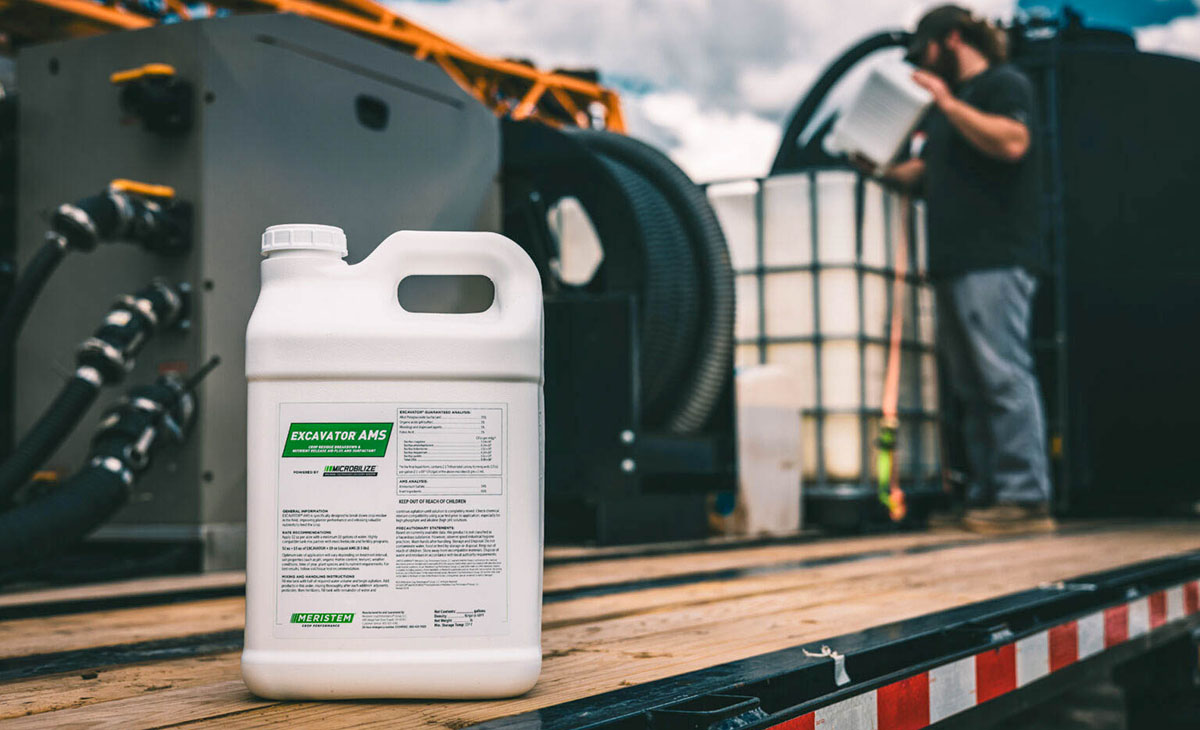
(Photo: Meristem Crop Performance)
ISA research evaluates new tools for cover crop termination
April 30, 2026 | Kriss Nelson
As farmers look for better ways to manage cover crop termination, some new systems aim to go beyond simply killing the crop and instead capture its nutrient value.
As interest in biologicals and residue management tools continues to grow, the Iowa Soybean Association is evaluating how new products may fit into real-world farming systems.
Testing new tools
Craig Woods, ISA research agronomist, says the work is less about promoting a specific product and more about understanding what options are available to farmers.
“We’ve been working with Meristem Crop Performance on one of their new products, primarily as an opportunity to evaluate it in a system we’re already studying,” Woods says.
Meristem’s Excavator AMS plus CycleStrike LR is being used in ISA’s long-term cover crop trials, allowing researchers to observe its performance under established conditions.
“It’s a first-year look, so we’re not going to have measurable results yet,” says Woods. “But it gives us a chance to start evaluating how these types of products might fit into a system.”
Woods says biological products focused on residue breakdown have become more available in recent years, creating new opportunities for farmers to consider.
“These tools are becoming more common, and part of our role is to help understand where they might provide value,” he says.
That includes examining how residue management could affect nutrient availability. In some cases, slower breakdown of cover crop residue may contribute to nutrient tie-up, particularly with elements like sulfur.
“One of the things we’re looking at is whether slower residue breakdown could be part of why we see more sulfur deficiency in some cover crop systems,” he says. “That’s still a hypothesis, but it’s something we’re working to better understand.”
Ultimately, the goal is to provide farmers with practical insight as new tools enter the market.
“It’s about giving farmers more information,” Woods says. “The more we can evaluate these products in real field conditions, the better we can help them make decisions on what fits their operation.”
Beyond termination
Shane Brockhoff, director of sales for Meristem Crop Performance, says the Excavator system is designed to do more than just terminate cover crops.
“Excavator AMS plus CycleStrike LR is a multi-faceted approach to help terminate cover crops and turn that material into plant-available nutrition,” Brockhoff says.
The system starts with a built-in adjuvant package that includes liquid ammonium sulfate and a high-load surfactant. That combination enhances herbicide performance and speeds up termination.
“The Excavator AMS adjuvant systems make your termination herbicide very hot and works to rapidly kill the green cover,” he says.
Live biology
The second component, CycleStrike LR, uses a biocapsule to keep live microbiology separate until application.
“Keeping microbiology alive is critical,” says Brockhoff. “The biology goes to work quickly to eat and convert the cover crop into nutrients available for the next crop.”
That process helps farmers capture the nutrient value of cover crops while reducing the risk of tie-up.
“Excavator AMS plus CycleStrike LR really is a fertilizer pass that can help farmers take costs out of production,” he says.
Spring performance
Brockhoff says the system is also designed to perform in less-than-ideal spring conditions.
“The surfactant built into Excavator AMS is one of the most powerful available for penetrating the cuticle of the green cover crops,” he says. “We’ve seen strong advantages in speed of kill and desiccation compared to traditional programs.”
For farmers integrating cover crops, the goal is to balance soil health benefits with operational efficiency.
“Kill the cover crop fast and efficiently, then turn that residue into plant-available nutrition as quickly as possible,” he says. “That helps protect yield and sets up the next crop for success.”
Written by Kriss Nelson.
Back