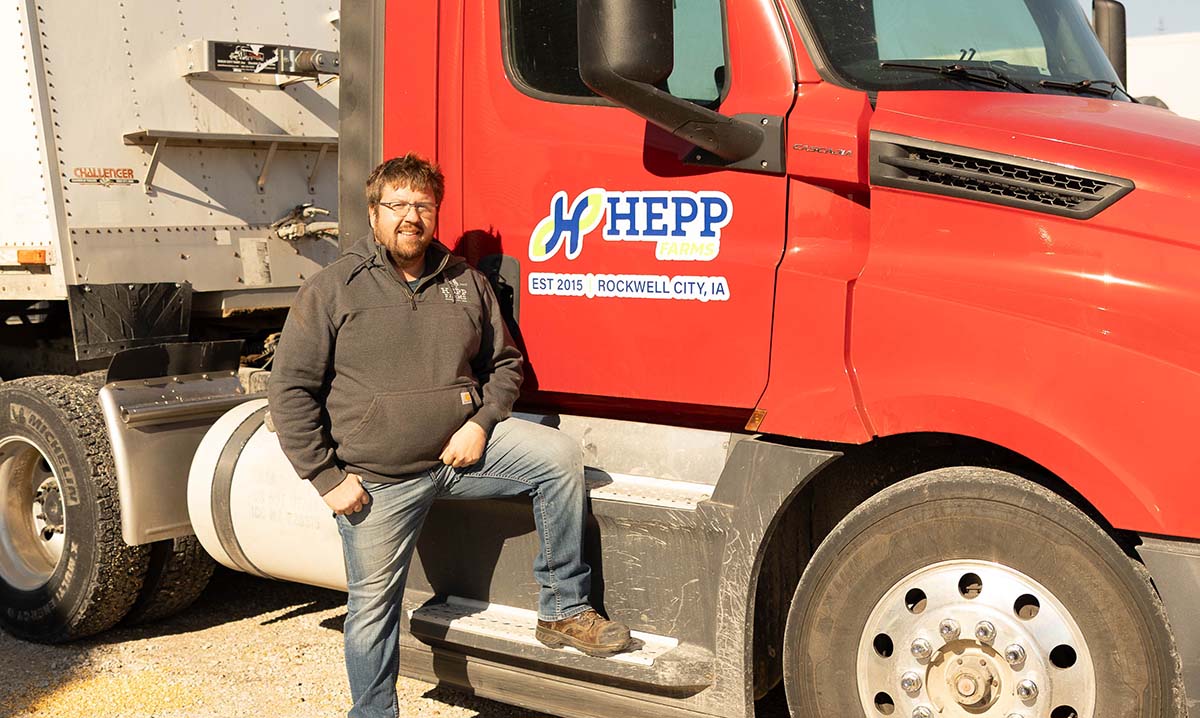
(Photo: Iowa Soybean Association / Joclyn Kuboushek)
Beyond the old playbook
March 2, 2026 | Kriss Nelson
James Hepp has an important message for farmers: farming is changing, and the practices that served your dads and grandpas well aren’t always enough for the challenges we face now.
The Calhoun County farmer says conservation should be a mindset farmers adapt to protect soil, improve water quality and keep Iowa agriculture resilient for the next generation.
Economics also plays a role. Hepp believes practices like cover crops, reduced tillage and strategic nutrient management can sharpen a farmer’s bottom line, helping farmers manage risk, reduce input costs and make acres more profitable.
He’s been sharing that message with other farmers at field days, conferences and events, encouraging others to think differently about how they manage their acres.
Farm and family
Hepp, his wife Paige, and sons Karsten and August, are first-generation farmers. Hepp was given the opportunity to farm when Keith Sexton, a farmer he had worked for as a hired hand, retired.
Alongside raising soybeans, corn and small grains for cover crop seed, Hepp runs Hepp Ag Company, a crop insurance and ag retail business providing seed, adjuvants, chemicals and fertilizers. The operation also uses a variable-rate fertilizer spreader to target nutrients where and when they’re needed.
Taking it further
Inspired by Sexton's conservation, Hepp is taking conservation management practices a step further on his farm.
“When I started working with Keith, he was already experimenting with some no-till and strip-till,” says Hepp. “He had that conservation philosophy and was taking it as far as he felt comfortable as he got closer to retirement. I saw that, and that’s kind of all I ever knew, so I took it to the next level.”
Cover crops on every acre
One example is implementing cover crops. This is the second year he has planted cover crops on all acres.
“All of our soybeans are no-till. They are planted green into a three-way blend of rye, camelina and tritcale. For corn, this year will be the second year we’ve planted into a cover. This fall we had a good stand of triticale, a splash of rye and a little bit of camelina. We drilled it and we’ll strip-till and plant corn into it this spring.”
Fertility and crop nutrition
Hepp’s focus on conservation also extends to how he manages fertility across his acres. All of Hepp’s nitrogen is applied in the spring through split applications, followed by one or two Y-drop passes to meet the crop’s needs.
Hepp says he’s been rethinking crop protection focused on a more balanced, plant-health approach.
“We’ve been trying to cut out a lot of the fungicides and insecticides and do more of trying to balance the plant,” he says. “We’re pushing a lot more micros and we’re SAP testing corn about every 10 days to two weeks throughout the growing season to see what it needs.”
As he’s adjusted his fertility and crop management, Hepp says the economic and environmental benefits have become clear.
“The more I’ve balanced the plant and soil and conservation, the more I’ve found that profitability and conservation kind of converge. And it’s better for the environment,” he says.
Reaching farmers
Honored with Iowa Soybean Association’s (ISA) New Leader Award in 2022, Hepp continues to lead by example, speaking with farmers about conservation and profitability.
He sees the work ISA is doing in the research and conservation space, and Hepp wants to continue to push farmers.
“The soybean checkoff is helping speed up and scale regenerative ag by putting real dollars behind on-farm trials that farmers trust,” says Hepp. “I feel the Iowa Soybean Association does more than any other commodity group in that space, but we all need to keep pushing to do more and do better. When research clearly shows net return, especially for regenerative practices, more farmers are willing to try them. The checkoff helps connect conservation and management changes back to profitability, and that’s what brings more farmers to the table.”
His field days on water quality and soil health led to an invitation to speak at last year’s National No-Tillage Conference.
“I spoke to close to 100 people in a room and shared my story in the hallway afterwards,” he says. “A week later, I was asked if I would present on the main stage for this year’s conference. This year, I’ll be speaking to nearly 700 people about sustainability, passing the farm to the next generation and remaining profitable through conservation.”
His core advice: “Just try it.”
“Don’t just take my word for it, try it on your own acres,” Hepp advises others. “Take ten or 20 acres and experiment. Find others in your area who are doing the same thing. There are more of us conservationists than you think.”
He says he speaks up because conservation changes are likely coming, and farmers need to remember that hard transitions aren’t new, farmers have adapted before, and they can again.
“When everyone was switching from the plow to the ripper, I bet they all squawked at first,” he says. “But now, you’d never go back to the plow.”
Shared labor
Conservation isn’t just about soil and water; it’s also about keeping the operation manageable when labor is tight, he says.
“The fewer passes you make in your field, the less labor you need, and once again, you’re more profitable,” he says. “Everything we do is to help water quality, soil health and my own health.”
Hepp believes the answer may be neighbors working together more often, by sharing equipment, trading labor and lightening the load for everyone.
“We’re coming to a crossroads where there’s no labor, no help and the next generation can’t walk in and buy the older generation out,” he says. “That’s why I’m trying to get people to think and work together.”
Building tomorrow
Thinking about his farm’s future, Hepp hopes more farmers will adopt practices that keep land productive.
“With the kids, I’m trying to build a platform for them,” he says. “When they get older, if they want to farm, I want them to take off where I drop the torch and not have to climb all these hurdles I’m climbing daily.”
Written by Kriss Nelson.
Back