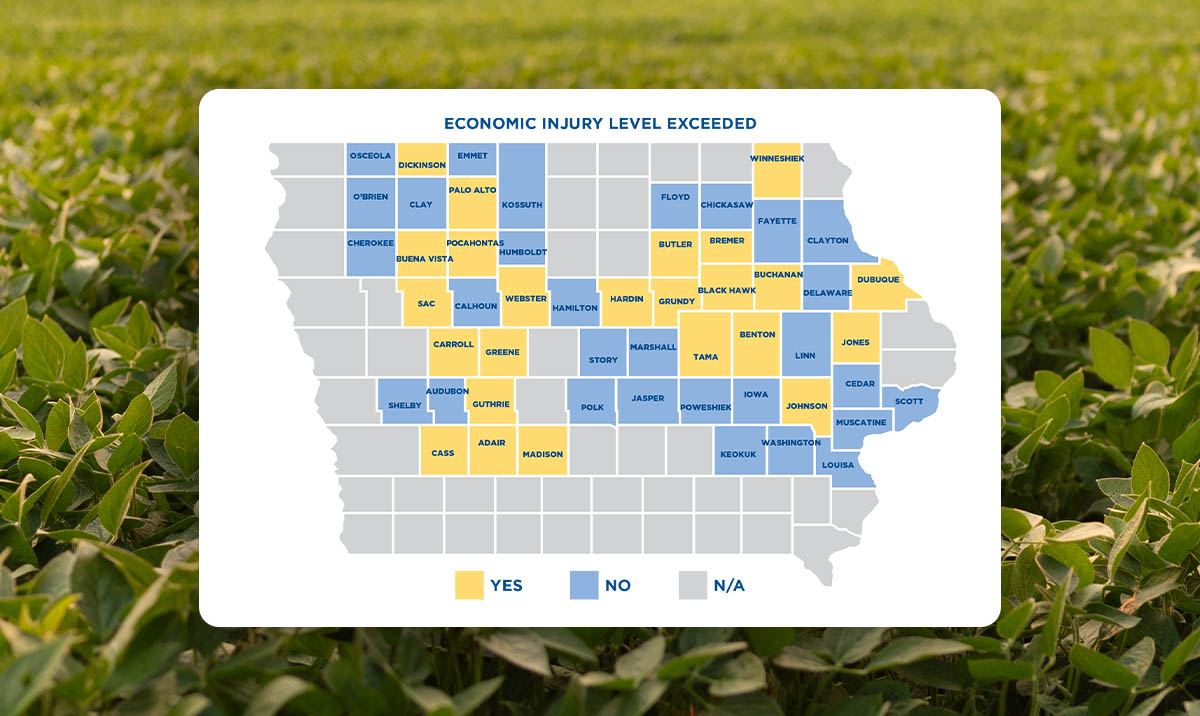
Figure 1. Counties in yellow exceeded the economic injury level (EIL) of two beetles per trap per day. The counties shaded in blue did not show high pressure. Counties in grew were not surveyed. (Graphic: Iowa Soybean Association)
Managing corn rootworm pressure
January 6, 2026 | Matthew Carroll, PhD
Key Insights
- Foliar-applied insecticide is unlikely to have an impact on corn rootworm pressure.
- Double-check BT traits if planning to use them for CRW control.
The Iowa Soybean Association (ISA) conducted statewide surveys of corn rootworm (CRW) pressure in 2025 with support from Bayer Crop Science. Working with local crop advisors and agronomists, ISA surveyed 130 locations in 53 counties across the state.
Corn rootworm beetles typically emerge over a 6-week period and begin emergence once growing degree days have reached between 684 -767 growing degree days, according
to Iowa State University research.
Previous research from universities has pointed to this long emergence window as a reason that foliar insecticide for managing CRW is not recommended, because it is unlikely to have a meaningful impact on the adult CRW population.
Low beetle counts in 2025
Crop scouts observed relatively low counts of beetles across fields with only 35 of the 130 locations surveyed exceeding the economic injury level (EIL) of two beetles per trap per day.
Of the 53 counties surveyed, 24 had at least one field that exceeded the EIL.
Management techniques and outcomes
There are four techniques farmers commonly use to manage CRW. Each has varying levels of effectiveness.
These tactics include:
- Traits including Bt and RNAi technology
- Soil-applied insecticides
- Crop rotation
- Foliar-applied insecticides
Traits to control for CRW
Surprisingly, only 55 of the 130 locations used a Bt trait rated for CRW control, while 50 fields used Bt traits not designed for CRW management. Commonly used Bt traits that do not control CRW include Agrisure, AcreMax, PowerCore, Trecepta and VT Double Pro.
ISA agronomists recommend consulting labels and Texas A&M's "Handy Bt Trait Table for U.S. Corn Production" when making seed purchase decisions.
Within fields that did use a Bt trait for CRW, 60% of fields were using traits that also included the use of RNA interference (RNAi) as an additional source of CRW protection. In the study, 18% of fields that used RNAi exceeded the EIL for CRW. However, CRW traits that did not include RNAi technology exceeded the EIL in 32% of the fields.
Soil-applied insecticide
Soil-applied insecticide can be an effective method for fields that are expecting a low level of CRW. This year soil-applied insecticides were used in 22 locations, with 41% of these locations exceeding the EIL.
Crop rotation
Crop rotation remains an effective management technique for CRW. Eighty-two sites were in their first year of corn with 22% of these exceeding the EIL. Fields that were planted to continuous corn exceeded the EIL at a rate of 31%.
Extended diapause in northern corn rootworm (NCR) has made some biotypes resistant to rotations. This was observed in this dataset with 90% of fields that exceeded the EIL in first year corn having a majority species of northern corn rootworm. All of the fields that exceeded the EIL in continuous corn had a majority species of western corn rootworm.
Of the locations that were first year corn that exceeded the EIL, only two of the locations utilized Bt traits to control for CRW. Northern corn rootworm has fewer traits that it has developed resistance to, making it easier to control with Bt traits compared to western corn rootworm.
Foliar-applied insecticide
A foliar-applied insecticide was used in 40 of the 130 locations surveyed. These 40 locations exceeded the EIL at a rate of 47%, and only 33% of applications saw a reduction in CRW beetles in the following sampling dates. This aligns with previous research showing little benefit to applying foliar-applied insecticides to help control CRW adult beetles given limited residuals of insecticides and the long emergence windows.
CRW lessons learned
Based on the field surveys that were conducted, pressure from corn rootworm was relatively low in 2025. There was, however, some localized pressure across the state.
No single method of control showed 100% efficacy against CRW, which is expected based on previous work. When it comes to managing corn rootworm, an integrated approach is best. This includes crop rotation, ensuring Bt traits used are effective against likely pressure, and also using soil-applied insecticides.
ISA data from this year and previous studies further prove that using foliar-applied insecticides is not likely to have a consistent benefit when trying to control adult CRW populations.
Written by Matthew Carroll.
Back