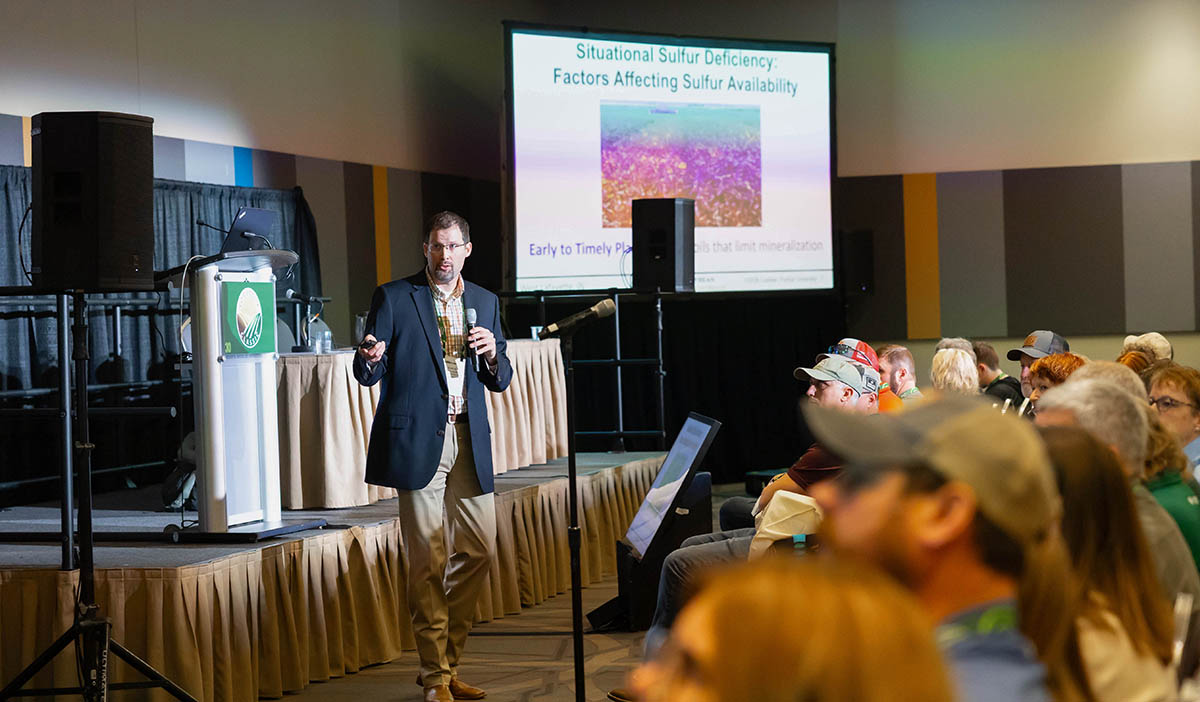
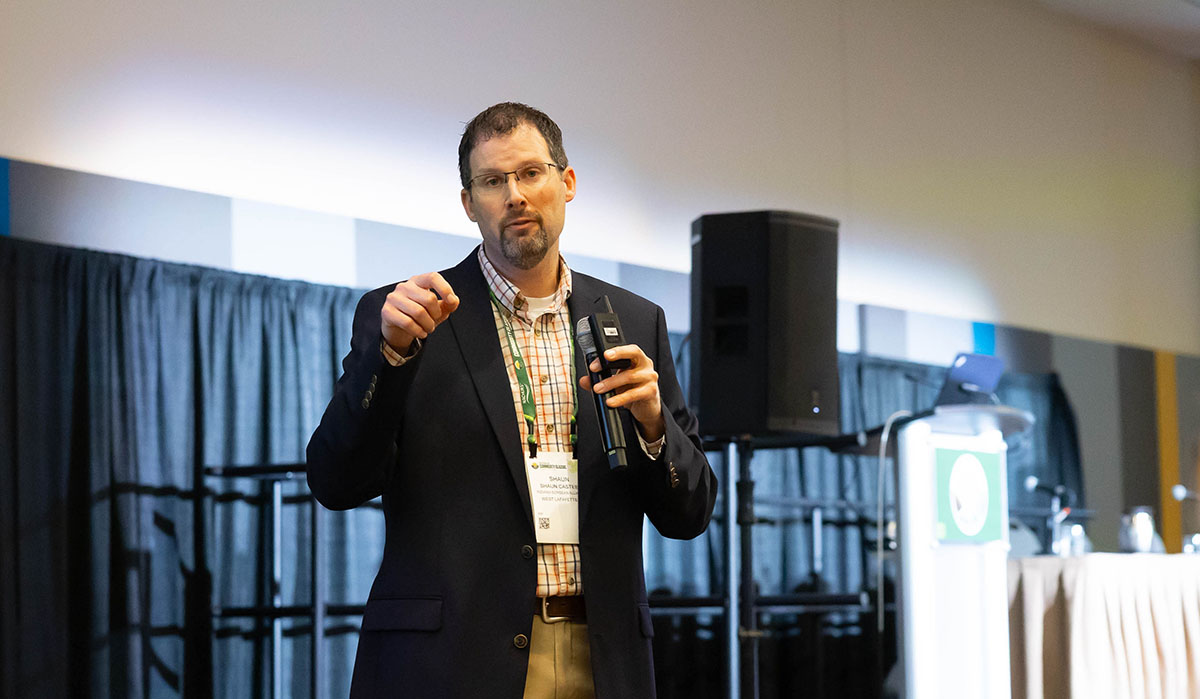
Shaun Casteel, associate professor of agronomy and Extension soybean specialist at Purdue University, spoke during Commodity Classic on the potential effect sulfur can have on soil borne diseases such as sudden death syndrome. (Photo: Iowa Soybean Association / Joclyn Kuboushek)
Commodity Classic: Sulfur research raises new questions about managing SDS in soybeans
March 5, 2026 | Kriss Nelson
A chance observation in soybean trials has led to new questions about whether sulfur applications may do more than improve plant nutrition.
Shaun Casteel, associate professor of agronomy and Extension soybean specialist at Purdue University, spoke during Commodity Classic, sharing how his work on soybeans and sulfur has taken some unexpected turns in recent years.
“Prior to the Clean Air Act, we were getting maybe 15 to 20 pounds of sulfur deposited from the atmosphere across the Midwest,” Casteel says. “Now we’re only getting maybe 3 to 5 pounds. Corn and soybean crops certainly need more than that.”
Sulfur plays an important role in soybeans beyond basic nutrition. Casteel says it also supports nodulation and nitrogen fixation.
“Soybeans need sulfur as a cofactor for nodulation,” he says. “If we have good nodulation and nitrogen supply, we get darker green leaves and better seed fill later in the season.”
Classic sulfur deficiencies often show up as pale green plants with reduced growth. In trials, applying about 20 pounds of sulfur per acre can correct those symptoms and improve overall plant health.
But a series of unusually wet growing seasons led to a surprising observation.
In one field trial during a rainy year, Casteel noticed soybean plants collapsing from disease pressure except in areas where sulfur had been applied.
“It happened to be in my sulfur playground,” Casteel says. “On the right was untreated. On the left was sulfur. It was right down the line where we applied the fertility. That’s when we started asking, ‘what’s going on here?’ ”
The disease was phytophthora, a soilborne pathogen that thrives in saturated conditions.
While sulfur wasn’t applied to control disease, the contrast was hard to ignore.
“We weren’t looking for phytophthora,” Casteel says. “But when you see that kind of difference, you start thinking there may be something more going on than just fertility.”
That discovery led researchers to examine whether sulfur might also influence other soilborne diseases, including sudden death syndrome (SDS).
SDS infects soybean plants early in the season under cool, wet conditions but often isn’t visible until August when leaf symptoms appear.
“It’s what I call our state fair disease,” Casteel says. “You see it show up about the time the state fair rolls around in August, but the infection actually happens much earlier.”
In trials comparing sulfur treatments with untreated plots, researchers began noticing consistent differences in SDS severity.
In fields where we had sulfur applied, researchers were seeing drastically less symptoms of SDS, which is interveinal chlorosis, compared to untreated plots.
The research caught the attention of agronomists beyond Indiana, including those working with on-farm trials in Iowa.
The Iowa Soybean Association (ISA) is partnering with Calcium Products to evaluate whether early-planted soybean fields with cover crops benefit from sulfur applications at or before planting. This trial will evaluate four different sulfur rates, including 0, 75, 150 and 300 lbs. of SO4 pelletized gypsum per acre.
Alex Schaffer, research agronomy lead with ISA, attended Casteel’s presentation and says the interest from farmers was immediately clear.
“Standing there listening in a full room, standing room only, our trial that we’re doing is well positioned to explore or see if we can replicate the exact results that he’s seen in Indiana,” Schaffer says.
The connection between sulfur and SDS control was unexpected news to Schaffer.
“The correlation with SDS—that’s new information for me and for all of us,” Schaffer says. “From a trial perspective, it will be really interesting to see if we get some SDS pressure.”
If SDS does develop in Iowa trial fields, ISA’s Research Center for Farming Innovation (RCFI) research agronomists plan to closely measure disease levels.
“We’ll be putting in the time and effort to give a good disease incidence and severity score across all the plots that do have pressure to see if we can replicate what he’s seen in Indiana on Iowa farms,” Schaffer says.
Scientifically, the concept makes sense, Schaffer says, but will the resultshold across different soils and climates?
“All of this is why it originally interested me,” he says. “Scientifically and agronomically, it makes a lot of sense. The question is whether the environment is that much different in Indiana and Iowa. Can we replicate it?”
Casteel’s research became the inspiration for the Iowa trial now underway.
“His work was the inspiration for the trial,” Schaffer says. “We’ve had a lot of interest in it since he’s been talking about this across the countryside and people are hearing about it.”
The goal, he adds, is exactly what farmer-funded research programs are meant to do.
“ We’re paying attention to what’s going on and developing trials that are interesting and meaningful for farmers to implement on their own and see if they can replicate what the scientists are talking about,” Schaffer says.
For now, Casteel says the findings highlight potential opportunities for growers managing soybeans under cool, wet planting conditions or in fields prone to SDS.
“I’m not saying sulfur is the silver bullet,” Casteel says. “But there’s enough evidence across multiple years and locations to say there are some interesting things going on.”
Written by Kriss Nelson.
Back