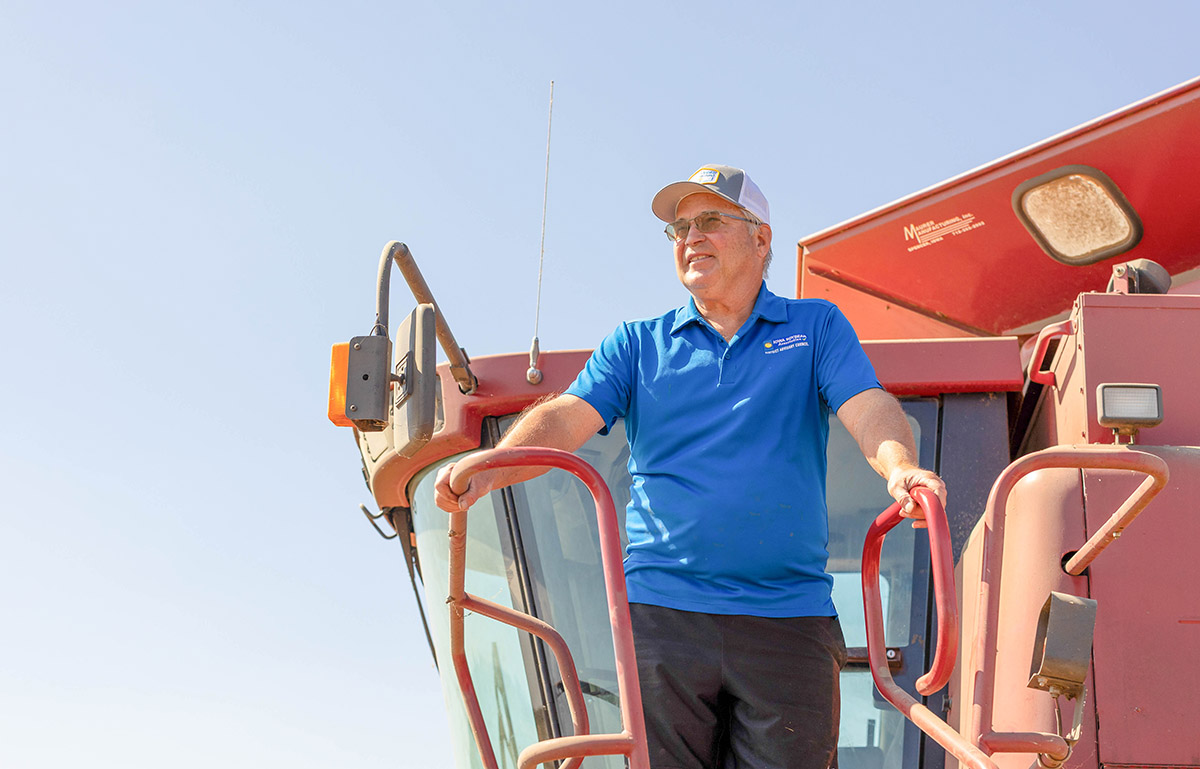
(Photo: Iowa Soybean Association / Joclyn Kuboushek)
Steward of change
December 1, 2025 | Bethany Baratta
Keep an open mind, embrace change and be flexible with your farming operation. It's the best advice Tom Adam says he's ever received. But the origins of that advice are unknown.
Perhaps it was his family; after all, his family has farmed their land in Keokuk County since 1852. You don't successfully hold on to acres for 173 years without adapting.
This approach has guided him through the ups and downs of the markets, evolving conservation practices and generational change.
Adam, a farmer near Harper, is the president of the Iowa Soybean Association (ISA). The 22-member ISA board of directors elected Adam to lead the organization upon the completion of Brent Swart's term as president in September.
Rural upbringing
Adam grew up on the family's farm between Harper and Keota, raising hogs, cattle, corn and soybeans with his parents, Wilbert and Bernadette, and his siblings.
Wilbert was committed to preserving the soil, using small grains within his acres to protect them from erosion.
"Soil erosion was very important to my dad," Adam says. "He did a lot with crop rotations and oats and hay to reduce weed pressure and stabilize the soil."
Off to college
While he was in college studying finance at the University of Iowa in the early 1980s, Adam worked for the Federal Deposit Insurance Corporation, assisting with bank examinations across Iowa, mostly in small rural banks.
"It was a period when the federal reserve was tightening credit and interest rates skyrocketed to historic levels," says Adam, noting operating loans went from 7 to 18% interest. "This time was quite the eye-opener for me to see how a single policy change could so drastically affect farmers' bottom lines."
He took a job with a manufacturing company after college until the opportunity to join the family farm emerged.
When Wilbert was ready to retire, Tom and his brother split the farmland and began farming. A few years later, when the land market crashed, Tom and his brother were able to buy additional farmland of their own.
Today, Tom and his wife, Mary Beth, live near Harper, where they raised their four children — Eric, Ryan, Emily and Megan. Family remains central to the operation, even as each of their children has found their own path in various careers.
Conservation and preservation
Adam, the fifth generation on the family farm, holds the family's legacy in conservation close.
He's built terraces to prevent soil loss, and implemented blind inlets in some of the terraces, using woodchips and pea gravel to reduce nitrate and phosphorus entering the tile line.
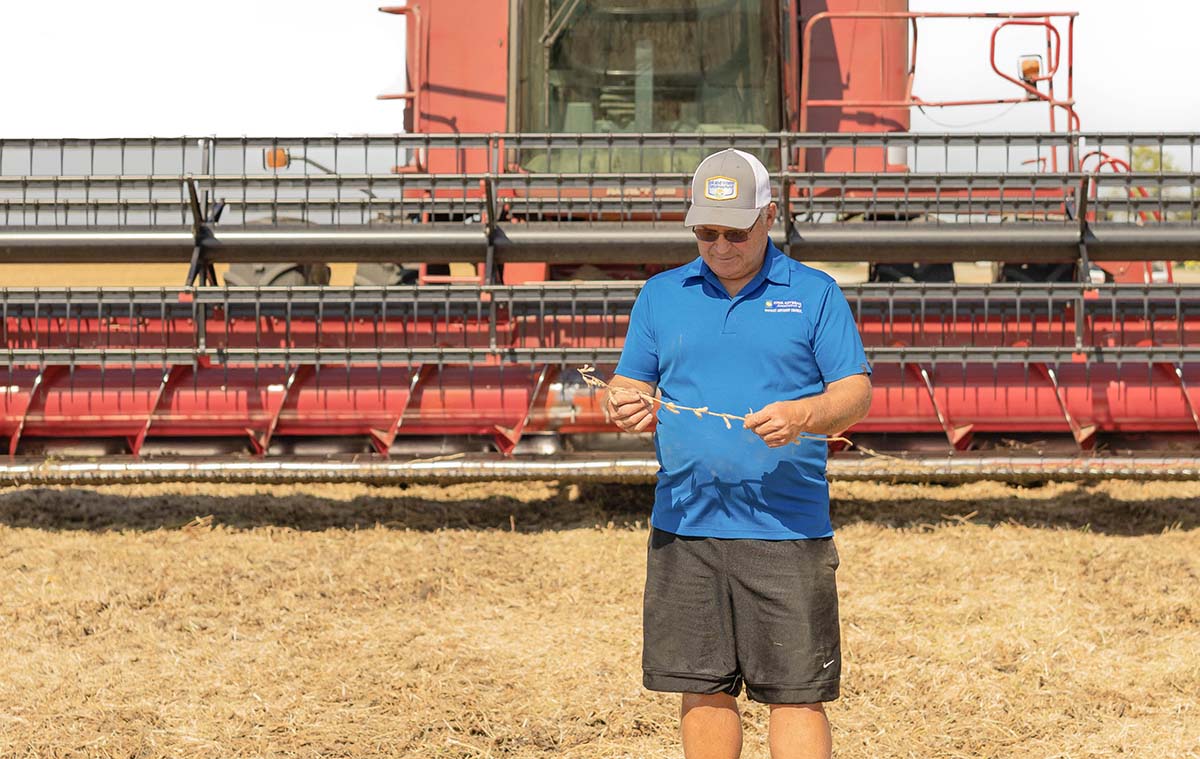
Working with the Natural Resources Conservation Service (NRCS), Adam began growing his own cover crop. He also began growing his own wheat cover crop seed. Before that, he double-cropped wheat on some of his acres.
Adam plants on a four-year rotation with corn one year, followed by three years of soybeans.
"The third year of soybeans is always the highest yielding soybeans," Adam says. "I've found that the wheat cuts down on disease pressure."
He enrolled in the Soil and Water Outcomes Fund in May 2021. In addition to adding wheat to his crop rotation, he has nearly eliminated tillage on his acres and plants cover crops on most of his acres.
His mix of conservation practices and program involvement has strengthened the resilience of his acres while creating new avenues for profit.
Like father like son
Adam's son, Eric, a district conservationist for NRCS, is taking on more ownership and management decisions each year.
"He's encouraged me to do more things when it comes to conservation," Adam says.
Eric, the sixth generation on the family farm, will someday be the primary decision-maker.
"As a farmer you always think about leaving the farm for the next generation if you can," Adam says. "I'm very proud that he has chosen farming as a career. He'll be able to keep these practices going and take things even further."
Reader to leader
Adam first learned about the Iowa Soybean Association by reading the Iowa Soybean Review.
"I felt like the magazine was a window into the Iowa Soybean Association to reveal that it is heads above other commodity organizations," he says.
But it was an invite from neighbor and former ISA President Lindsay Greiner to serve on the board that Adam got involved.
"That was my first direct connection," Adam says. "I had never even visited the ISA office."
Hundreds of miles later — to the office and to various meetings in the U.S. and abroad — and Adam is the serving ISA president.
In addition, he also serves on the American Soybean Association board, lending his voice to national policy discussions that have local impact.
"It has been an honor for me to have served as a director on this board the past eight years," Adam says. "We have a fantastic board and for my fellow board members to choose me to be president only increases that honor."
Three Main Priorities as ISA President
1. Expanding trade and market access
"We want trade, not aid," Adam says. While financial relief packages are a bridge to trade resolutions, they don't solve the issue of unsold soybeans or distorted global prices.
Expanding and diversifying global markets for U.S. soybeans remains a top ISA priority.
With shifting global supply chains and emerging demand from countries with growing middle classes, there are opportunities to strengthen existing trade relationships and open new markets for U.S. farmers.
2. Strengthening policy support through the farm bill
A strong farm bill is essential for stability and conservation progress, Adam says.
Conservation programs encourage farmers to adopt practices that protect soil and water, adding opportunities that farmers are already investing in.
Sound policy should provide practical, on-the-ground support, helping farmers stay resilient and profitable.
3. Demand through new uses
Increased biofuel mandates and improved tax policy for using domestic feedstocks are "bright spots" that can strengthen demand for Iowa soybeans.
Adam supports checkoff investments that fund research into new soybean uses — from asphalt and tires to industrial materials and household products.
Focused on turning farmer dollars into tangible results — advancing innovation in biofuels, creating new soybean-based products, and supporting research that improves farm profitability "both in the field and at the bank."
Written by Bethany Baratta.
Back