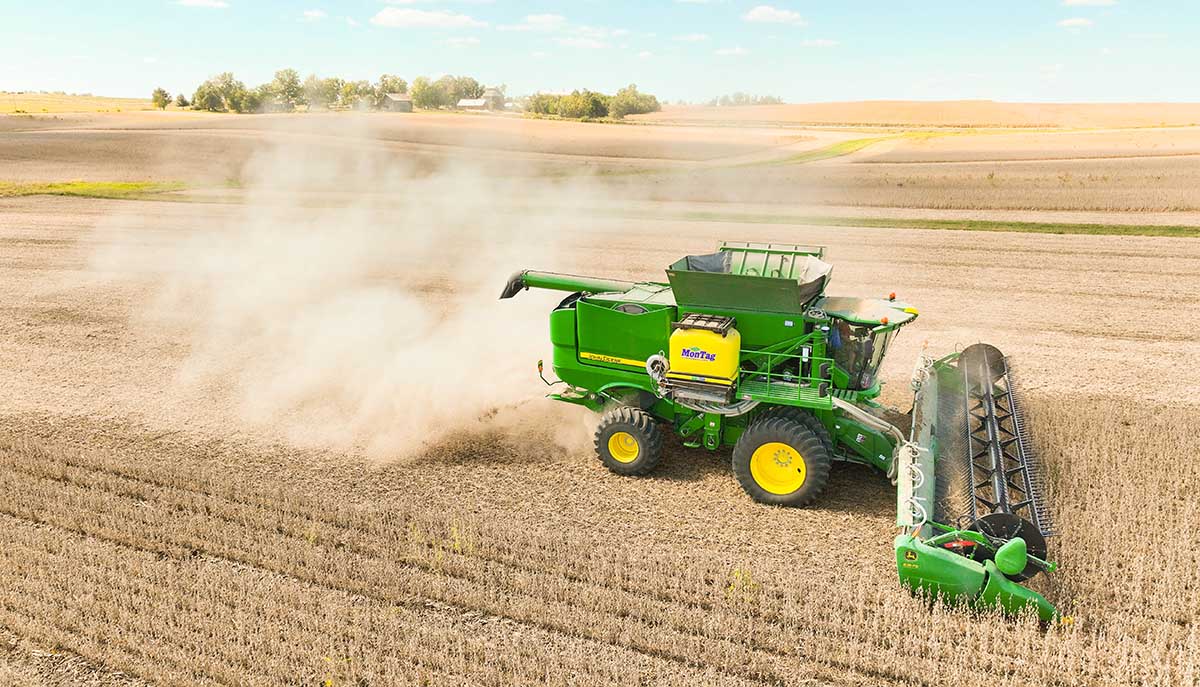
Harvesting soybeans while applying a rye cover crop with the Harvest Seeder (Photo: Iowa Soybean Association / Evan Brehm)
Overcoming cover crop seeding and establishment challenges
March 11, 2026 | Evan Brehm, CCA
Key takeaways
- Several options for cover crop establishment from in-season to post harvest.
- Winter hardy species provide more ROI.
- Experiment with various methods of seeding to fit your operation.
In 2024, Iowa farmers planted 3.8 million acres of cover crops spanning nearly 23 million acres of soybean and corn acres across the state, according to the Iowa Nutrient Research and Education Council (INREC). That’s a significant increase from 2009, when 10,000 acres were planted across Iowa.
In addition to the growing interest from landowners and farmers realizing the agronomic and environmental benefits of cover crops, cost-share programs have spurred this continuous uptick in 15 years. With the interest and willingness of various operators to plant cover crops, a challenge has always been the method and time. As cover crop acres have dotted Iowa’s landscape, the innovative methods to plant them have evolved. Overcoming Mother Nature is one thing we cannot control, but we can control how cover crops can be established from ground applications to aerial applications, and everything in between.
Iowa’s go-to covers
Cereal rye is planted on 86.6% of Iowa’s acres either in a standalone or in a mixture, according to INREC survey data. Cereal rye is the “king” cover crop due to its ability to overwinter, reduce soil erosion, sequester nutrients that may be lost, suppress weeds and provide grazing options for livestock.
Oats are another popular option. With similar characteristics as cereal rye, the main difference is that oats do not overwinter. Recommendations are to establish oats as a cover crop in the late summer/early fall for better establishment.
Weed suppression and nutrient capture
Multiyear tile sampling with the Iowa Soybean Association (ISA) has proven that no-till with a cover crop reduces nutrient runoff. Several factors including how long the cover crop is allowed to grow, soil type, rainfall and nutrient management plans effect overall reduction.
Continued in-field conservation management also continues to showcase nutrient runoff reduction.
Herbicide use has the potential to be reduced with long-term cover crop adoption. Cover crops provide in-field competition with early season weed pressure and can be another tool to help battle herbicide-resistant weeds. One Iowa farmer noted he saved $25 per acre on his soybean herbicide program this past season because of the weed suppression upfront that cereal rye provided.
Establishing cover crops
One of the main barriers to planting cover crops is time. Cover crop seeding often overlaps with harvest, creating challenges for farmers trying to fit planting into an already busy season. Every farming operation is unique with different equipment, labor and distance between fields. There is no single planting method that fits every operation, but there are many options to establish cover crops. These include:
Planter or a drill
Seed-to-soil contact is important, and a planter or drill fits this requirement. This is a common practice across the state to establish cover crops. However, this requires an extra pass and extra time post-harvest.
Broadcasting
This method can occur in season or post-harvest. Utilizing airplanes and drones to apply cover crops into a standing row crop to counter the time and labor is an option. A cover crop can also be mixed into a dry fertilizer blend application to meet the fertility needs for the next year's cash crop while establishing a cover crop.
In season
Besides aerial applications into a standing row crop, a rotary hoe with an air seeder is an option. This favors summer species of cover crops that need warmer temperatures. By using this method, livestock producers can maximize the benefits from soil health and grazing options. Establishment of cover crops to graze fare much greater when planted with this option versus waiting until later in the growing season.
At harvest
To advance, innovation is key. The Harvest Seeder by Red Barn Solutions offers farmers an opportunity to plant cover crops while harvesting their row crop. With an air seeder mounted on the combine with a series of hoses leading to the soybean platform or corn head, this option defeats the time barrier. The cover crop seed is then applied in a broadcast style low to the ground, which has a likelihood of establishment equal to all other broadcast methods.
Environmental payoff
Cover crops provide environmental benefits and continue to showcase profitability after continued use. Cost-share programs come and go, and the advice is to analyze the reasoning behind using cover crops. Long-term use reduces soil erosion, hinders weed germination, improves water quality and can provide grazing options for livestock producers. With various methods of establishment, any producer interested in cover crops has options. Each method presents various costs associated and differing time constraints. Determine the goals of cover cropping on your operation, then take action in a method that meets your goals.
For further information, contact the RCFI team at the Iowa Soybean Association at 515-251-8640, or visit our website at iasoybeans.com to learn how we can support you in your cover crop endeavors.
Written by Evan Brehm, CCA.
Back