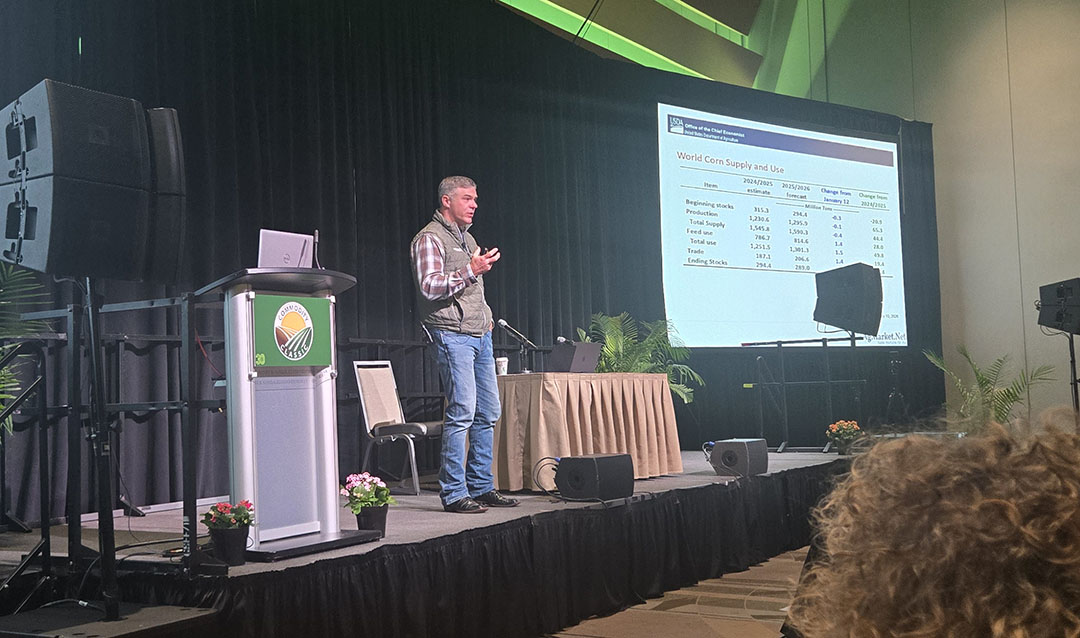
Matt Bennett, co-founder of AgMarket.net gives his take on the volatility of the markets during the 2026 Commodity Classic held in San Antonio last week. (Photo: Iowa Soybean Association / Kriss Nelson)
Grain market experts urge discipline at Commodity Classic
March 5, 2026 | Kriss Nelson
Grain market experts at Commodity Classic delivered a clear message to farmers navigating tight margins and global uncertainty: stay disciplined, reward rallies and do not wait for perfect prices.
From seasonal trends and new crop opportunities to Brazil’s expansion and shifting export dynamics, analysts urged growers to focus on profitability, manage risk year-round and make marketing decisions with intention, not emotion.
As Iowa soybean farmers turn their attention to planters, seed deliveries and spring fieldwork, those takeaways matter.
Pricing opportunity
University of Minnesota Grain Marketing Economist Ed Usset says his message from Commodity Classic is straightforward: take a hard look at today's soybean prices.
"New crop soybean values are 50 cents better today than your best opportunity a year ago," Usset says. "You've got to take a serious look at that for pricing."
He encourages farmers to start building a marketing plan for new crop soybeans rather than waiting for a perfect price.
"New crop soybeans — at least get started," he says.
As spring fieldwork ramps up and attention shifts to planting, Usset reminds farmers that marketing does not pause.
"Marketing is a year-round task," he says. "You've got to pay attention to it. You've got to pay attention to different crops, you've got to pay attention to old crop, you've got to pay attention to new crop. There's nothing easy about this."
His advice is to stay engaged, even during the busiest time of the year, and treat marketing with the same discipline as production.
Seasonal timing
Al Kluis, managing director of Kluis Commodity Advisors, says seasonal patterns should not be ignored.
The message is to use spring opportunities to reduce risk and avoid being forced to sell into seasonal weakness.
"Basically, last year we peaked early in the year. This year, I think we will, too," Kluis says.
He points to recent trends showing both highs and lows developing sooner on the calendar.
"April, right after April, early May have been good times to sell," Kluis says. "The high has been coming in earlier, and the lows have been coming in earlier."
His strongest advice centers on harvest pressure.
"Do not put yourself in a position where you have to sell between August and October," Kluis says. "I'll say that again, for 2026, do not put your farm in a position where you've got to give up ownership between August and October."
Demand focus
Matt Bennett, co-founder of AgMarket.net, says the soybean conversation starts at home.
"We need to be really focused on domestic usage here in the U.S.," Bennett says.
Bennett took the stage in front of a full house at Commodity Classic during an early riser session. He pointed to South America's steady growth, noting they continue to add 2% to 3% more soybean acres each year because “they're making more money on soybeans than we are."
Domestically, crush has been a bright spot.
"We've been crushing the daylights out of beans," Bennett says, adding that strong margins near $1.30 per bushel are keeping plants profitable and supporting demand. "These guys are making money. That's why you continue to see crush the way it is."
China remains a question mark. While officials have suggested large purchase commitments are nearly complete, Bennett says uncertainty persists.
"We need to see a formal agreement," he says. "Right now, beans are a dollar under in Brazil."
On acreage, Bennett says shifting margins could favor soybeans in some scenarios, especially as growers evaluate crop insurance, cash flow and profitability projections.
"If you feel confused, trust me, it's confusing," he says.
Still, he emphasizes demand remains historically strong.
"We have huge demand if we have any sort of issues," Bennett says, warning that tight stocks leave little room for production problems.
He reminds growers to take advantage of rallies, not get more bullish.
"When markets are going up, manage risk," Bennett says.
With soybeans working through resistance levels near recent highs, Bennett says farmers should focus less on predicting price direction and more on locking in profitability when opportunities present themselves.
"Know exactly where you can make money at your average yields and market according to that," Bennett says. "Quit worrying about trying to outguess the market."
Brazil reality
Matthew Kruse with CommStock Investments in Royal says when it comes to Brazil, Iowa farmers need to stay realistic and disciplined.
"I don't know that there's a whole lot we can do about it," Kruse says. "Soybeans are very important to our rotation. Even when soybean prices drop, I'm very resistant to wanting to take soybeans out of rotation."
He cautions that cutting U.S. soybean acres simply opens the door for Brazil to expand further.
"All that means is I feel like Brazil is going to fill that gap," he says.
Kruse acknowledges prices have improved, with soybeans rallying more than a dollar in a short time.
"Everybody when they get to over $11 says, 'Oh, I want to get to $12,' " he says. "But you've got to look at what your cost of production is."
His advice is to reward rallies.
"I like selling into those rallies," Kruse says. "You're getting at a level back where you're profitable. That's a lot better than where we were just a little bit ago."
On currency, he notes a weaker U.S. dollar has recently helped level the playing field, but that is driven more by geopolitics than farm policy.
Quality matters, but only to a point.
"I do think it helps that we have a higher quality bean," Kruse says. "But at the end of the day, price is still king."
He also pushes back on the perception that Brazil is ignoring sustainability.
"If you were to go there and see what some of the large farms are doing, I think you'd be surprised," he says, noting Brazil maintains significant protected land requirements and that many operators emphasize sustainability in their business plans.
Looking ahead, Kruse says weather remains the biggest variable. A smooth planting season and strong production could pressure prices again.
"If we have another good year, honestly, I think prices can go and retest the lows," he says. "If we shave off 10 bushels per acre, that's a different story."
Long term, he is more concerned about export reliance. Kruse says relying on China to step in and purchase U.S. soybeans every six months is not a long-term solution, adding the industry needs to focus on developing other sources of demand.
His bottom line is simple: focus on profitability, manage risk and don't wait for perfect prices.
"You've got to know where you can make money."
Written by Kriss Nelson.
Back