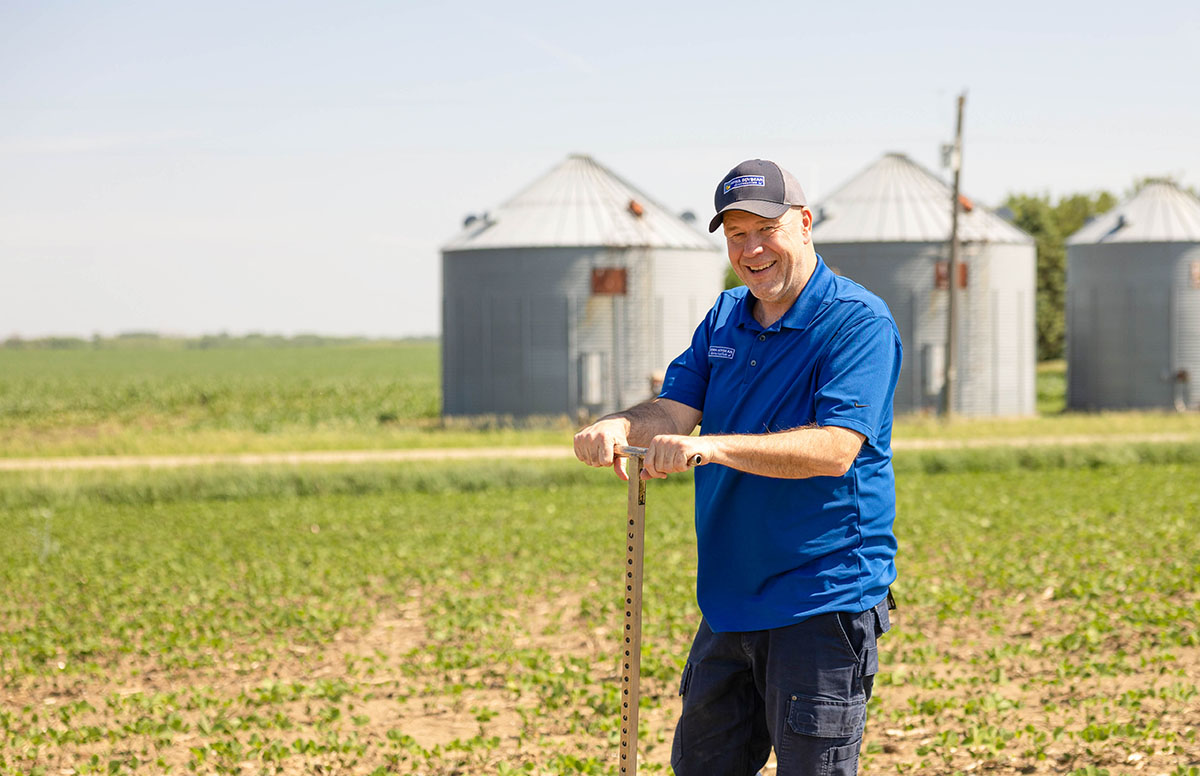
Mike Gilman, ISA Senior Conservation Program Manager (Photo: Iowa Soybean Association / Joclyn Kuboushek)
Covering the cost of adopting cover crops
March 11, 2026 | Mike Gilman
Key takeaways
- Cost-share programs are breaking down barriers to cover crop adoption.
- Leveraging multiple programs maximizes support.
- Cover crops are a long-term investment in soil health.
As rising input costs, tight margins and unpredictable weather continue to challenge Iowa row-crop producers, more farmers are turning to cover crops to improve soil health and nutrient management while protecting their land for the future. But the economics of cover-cropping can be a hurdle: seed costs, additional passes, termination considerations and the delayed payoff of improved soil health can dampen enthusiasm. Today, a growing menu of cost-share and incentive opportunities is helping bridge that gap — making cover crops more accessible and financially viable for Iowa farms.
Benefits and barriers
Cover crops offer clear benefits: they reduce soil erosion, capture residual nutrients, build organic matter, help with weed control and even produce forage depending on the system. However, costs remain a key barrier. The cost of implementing cover crops can vary widely with estimates around $30 an acre and up, depending on how the cover crops are established. For many operations, particularly those with tight budgets or rented land, taking on the additional costs and management responsibilities of cover crops requires careful consideration.
Cost-share and incentive opportunities
Fortunately, Iowa farmers have several programs at their disposal:
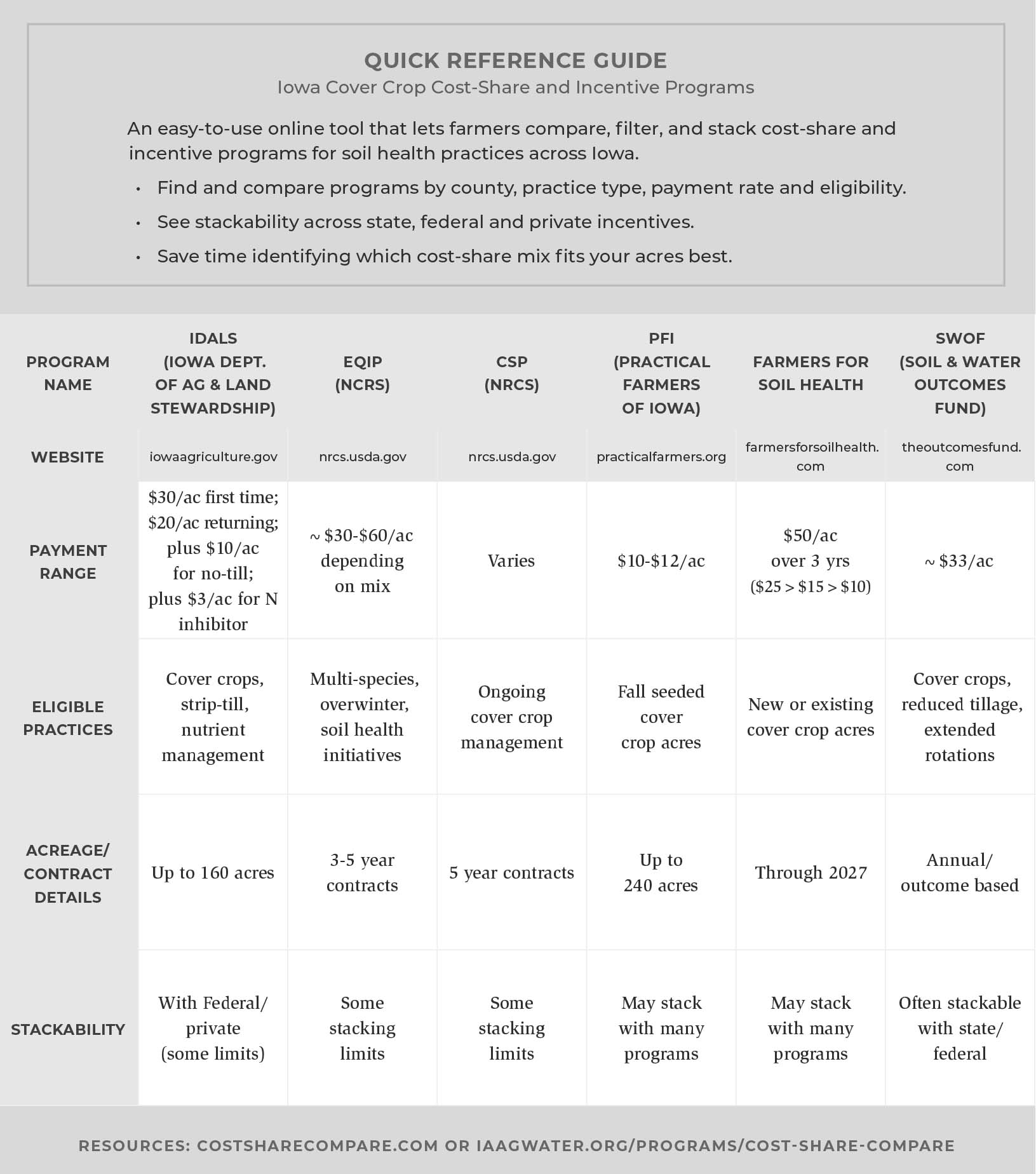
- The Iowa Department of Agriculture and Land Stewardship (IDALS) under the Water Quality Initiative offers cost-share payments for cover crops and other practices. In 2025, first-time cover-crop users were eligible for $30 per acre and returning cover-crop users $20 per acre (for up to 160 acres per farmer).
- At the federal level, the Environmental Quality Incentives Program (EQIP) and the Conservation Stewardship Program (CSP) through the Natural Resources Conservation Service (NRCS) provide payments for cover crop adoption or enhancements. Iowa's EQIP cover crop program offers varying rates, with a basic rate around $30 and up per acre for a single species, and higher payments for multi-species mixes. Iowa's CSP program does not have a fixed per-acre rate for cover crops; instead, it provides payments based on the number and types of conservation practices.
- The Practical Farmers of Iowa (PFI) cost-share program offers fall cover-crop cost-share to participants across Iowa. In 2025, payment rates of $10 or $12 per acre up to 240 acres were available depending on documentation provided.
- The Farmers for Soil Health program, a 20-state initiative, provides payments to new cover-crop users over a multi year timeframe. The payments are facilitated by the United States Department of Agriculture (USDA). In Iowa, the program is administered through the Iowa Soybean Association. The current payment structure is $50 per acre over a three-year period ($25 first year, $15 year two, $10 year three). The program has proposed program modifications to the USDA and hopes to offer a more robust simplified payment structure in 2026. Proposed acre limitations are up to 2,000 acres per farm. Go to farmersforsoilhealth.com for more information.
- The Soil and Water Outcomes Fund (SWOF) supports farmers who commit to conservation outcomes (cover crops, reduced tillage, extended rotations) and pays $33 per acre on average. The program offers a one year contract with 25% paid prior to verification. There are no limits on acres enrolled. Go to theoutcomesfund.com.
The programs mentioned above are not an all-inclusive listing. The Iowa Agriculture Water Alliance (IAWA) offers a Cost-Share Comparison Guide web tool where farmers can filter, compare and stack incentive programs across public and private sources — helping tackle the “which program is right for me” challenge. Go to costsharecompare.com or iaagwater.org.
Putting it all together
Here are some practical ways Iowa growers can leverage these programs to make cover-cropping more affordable:
Begin with IAWA’s cost-share comparison tool: Visit IAWA’s cost-share website (costsharecompare.com) to compare cover crop and related conservation incentive options, filter by what you need (payment rate, ability to combine multiple programs and contract length) and find the best fit.
- Consider state cost-share: If you are a first-time cover crop user, the IDALS cost-share payment helps offset a sizable portion of your upfront cost.
- Layer federal support: Apply for EQIP or CSP to fund additional acres or multi-species cover mixes — this adds robustness and may qualify for higher payments.
- Explore programs like SWOF, Farmers for Soil Health and PFI: These programs may provide more flexibility and could potentially stack with other programs.
- Plan your enrollment early: Many programs have enrollment windows, acreage caps and documentation requirements.
- Think long-term benefits: While cost-share helps with upfront cost, the soil-health benefits compound over time — better soil structure, improved water infiltration and improved input efficiency.
Cost-share advantage
For Iowa farmers weighing whether to adopt cover crops, the decision increasingly comes down to both agronomics and economics. With the generous range of cost-share and incentive programs now in place, the financial barrier to entry is lower than ever. By combining state cost-share (IDALS), federal programs (EQIP, CSP), and layered incentives from SWOF, PFI or Farmers for Soil Health, growers can move cover crops from “nice idea” to practical reality.
It is an opportunity for Iowa farmers to build soil resilience, improve nutrient stewardship and invest in the long-term productivity of their land — and do so with costs and risks managed. To ensure farmers can access these opportunities, the Iowa Soybean Association conservation team can help navigate cover crop programs, including identifying the right programs, understanding requirements and assisting with enrollment.
Written by Mike Gilman.
Back