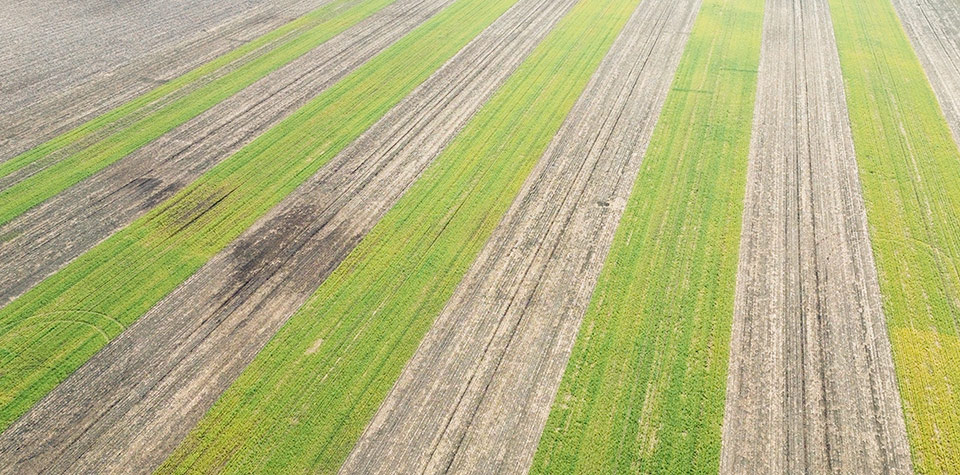
(Photo: Iowa Soybean Association / Alex Schaffer)
Improved cropping systems: Balancing yield and conservation
August 3, 2026 | Anthony Martin
Key Insights
- Increased cover crop growth can negatively impact cash crop yields but can be minimized with good management strategies.
- Tillage showed a yield benefit in both corn and soybeans, but farmers should consider if the relative benefit pays for additional passes across the field.
- Nitrogen inhibitors show promising corn yield benefits; additional work is being done to further quantify these results.
The Improved Cropping Systems project
Although most work conducted by the Iowa Soybean Association is looking at single products or practice changes, these are only a piece of the overall cropping system.
Making a single change may affect yield, but implementing multiple changes to the crop system can further improve yield or provide significant non-yield benefits.
The Improved Cropping Systems project began in the fall of 2023 to evaluate how combining several management changes compared to farmers' normal management practices. The management changes used in the project were provided by Iowa State University and local experts.
The practices recommended under the improved treatments were selected for the potential to increase profitability, improve soil health and protect water resources while also reducing soil and nutrient losses. The practices included cover crops, tillage and nitrogen inhibitors.
In 2025, the study included six farmer-led sites in year 1 and 15 sites in year 2 of the planned four-year project.
Across the first two years, average yield responses on both soybeans and corn were negative with the improved system. Cover crops were incorporated in the improved system at every site using a blend of triticale, cereal rye and winter camelina ahead of soybean, and triticale, hairy vetch and winter camelina ahead of corn. We used drones to plant the cover crops in early fall. On some of the sites, we planted the cover crop seeds via drill following soybean or corn harvest.
Cover crop growth
At the majority of locations, minimal cover crop growth was observed the following spring. Similar to the ongoing long-term cover crop study, NDVI and yield response comparisons were made on sites where only a cover crop comparison was implemented.
Consistent with past observations, yield was negatively affected with increased cover crop growth and biomass accumulation based on NDVI values.
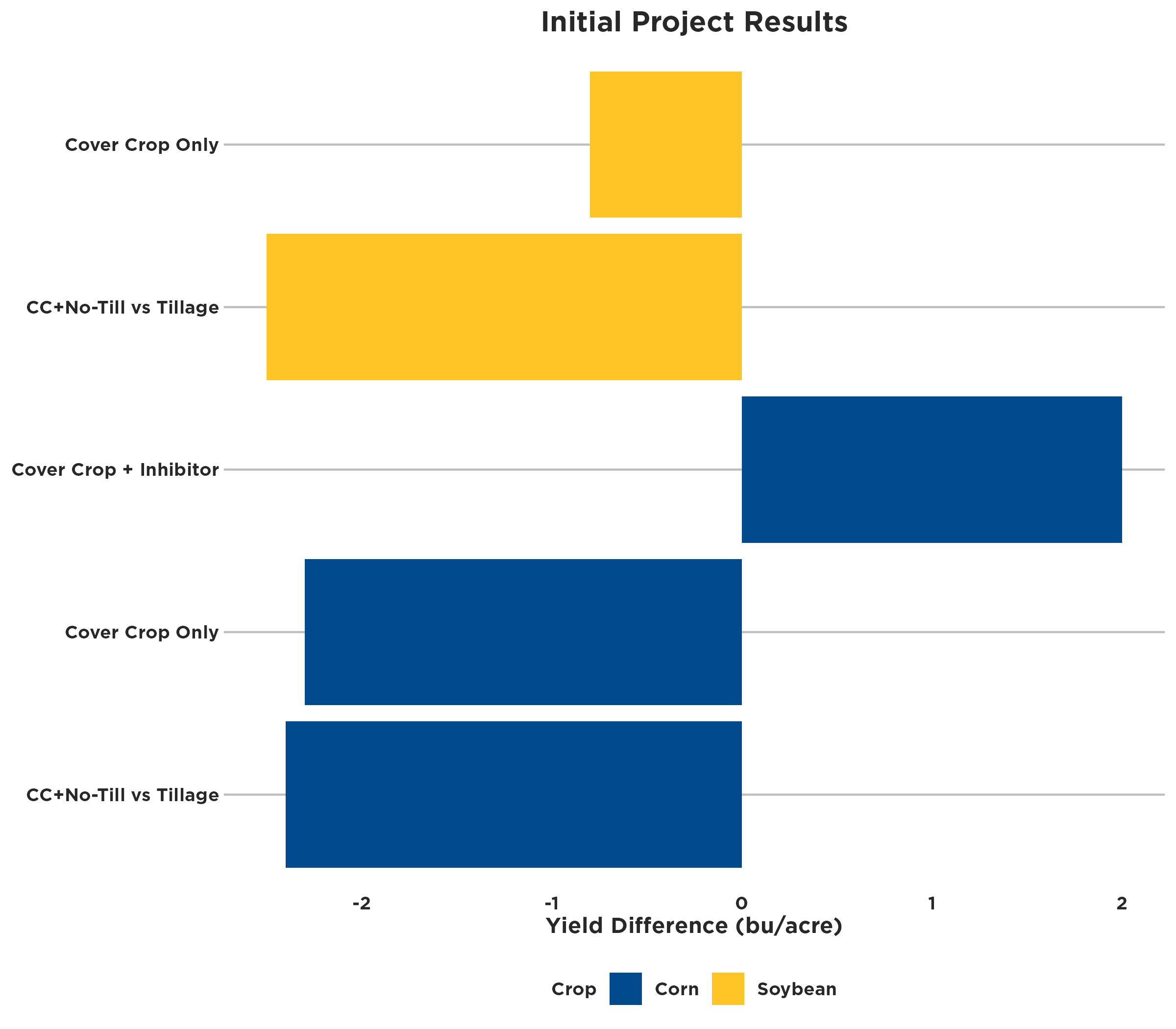
While termination date varied among the sites (from mid-April to mid-June), the negative impact was observed at locations that had higher biomass accumulation. Average crop yields with only a cover crop comparison were lower for both soybeans and corn, declining by 0.8 bushels per acre and 3 bushels per acre, respectively.
Developing and implementing a successful management strategy helps minimize yield losses seen with increased cover crop growth.
Tillage and nitrogen
In the first two years, four sites used a nitrogen inhibitor ahead of their corn planting and realized an average yield increase of 2 bushels per acre. These fields also incorporated cover crops ahead of the cash crop, so a direct correlation with the inhibitor can’t be made.
Additional nitrogen inhibitor work is currently being conducted separately from this project to determine crop and nutrient response to these products alone.
Farmers were also given the option to incorporate a tillage pass within the farmers’ standard practice compared to no-till in the improved system. Tillage types included conventional, strip-till and vertical tillage and were used on six corn sites and three soybean sites.
At these sites, yields were higher under tillage than under the no-till cover crop system, increasing an average of 2.4 bushels per acre in corn and 2.5 bushels per acre in soybeans. However, farmers should weigh those gains against the additional cost of implementing tillage.
Looking long term
Soil samples were collected prior to this research, at planting and following harvest each year at 0-12 inches and 12-24 inches.
Samples collected at planting showed average nitrate concentrations were lower under the improved system, regardless of depth, at more than half of the sites. Given differences in management practices, additional samples over the next few years will continue to be collected and analyzed to better understand how changes in practices may be impacting soil and nutrient concentrations.
Initial results show little to no differences when looking at organic matter, phosphorus or potassium levels.
As observed in other studies conducted by ISA’s Research Center for Farming Innovation and participating farmers, many of the positives and negatives of these practices come down to the farmers’ short- and long-term goals.
For some farmers, the trade-off between maximum yield and the potential benefits from a conservation standpoint is fine. Yield losses are an important consideration but can be overcome with funding programs providing cost-share opportunities.
We will continue to share results as we move closer to the conclusion of this project.
For more insights into this project and others, check out our cross-site report.
Written by Anthony Martin.
Back