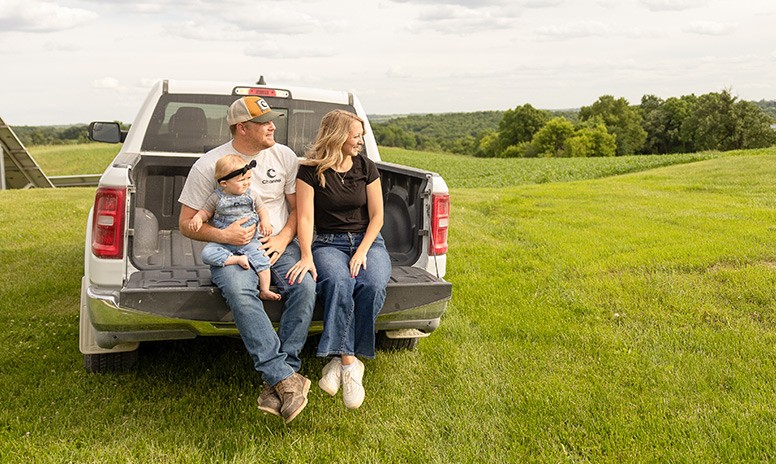
Morgan Herold with her parents, Mitch and Amanda, on the family farm. (Photo: Iowa Soybean Association / Joclyn Kuboushek)
A place on the farm: Mitch Herold's journey back
August 2, 2026 | Kriss Nelson
For many young farmers, the path back to the farm doesn’t happen overnight.
For 28-year-old Mitch Herold of Fort Atkinson, it has been a gradual process built on generations of family history, years of off-farm experience and a commitment to keeping the operation moving forward.
“I grew up with it my whole life,” Mitch says. “I always knew I wanted to be involved in agriculture.”
Family legacy
The roots of the Herold farm date back to when Mitch’s grandfather traded a career in trucking for life on the farm. After purchasing the home place, he called Mitch’s father, Alvin Herold, and asked him to help run it — setting the stage for a lifelong partnership. “My dad and grandpa farmed together for more than 30 years,” Mitch says. “Then Grandpa stepped back, and Dad continued the operation.”
Growing up just a mile from the farm, Mitch spent his childhood around agriculture. But rather than stepping directly into the operation after high school, he gained experience elsewhere first.
He completed internships with agricultural cooperatives while attending Iowa State University and went on to build a career in the ag industry. Mitch worked for Nutrien Ag Solutions and Farmers Win before joining Bayer Crop Science, where he currently works on the Channel seed side of the business.
While he grew in his career, he continued to be involved on the farm. With a degree in agronomy and a career in the seed industry, Mitch is often the go-to when questions arise about crop management, inputs and agronomic decisions.
“There are things I might otherwise ask my agronomist about, but now I can have those conversations with my son,” says Alvin. “He’s a great resource for me.”
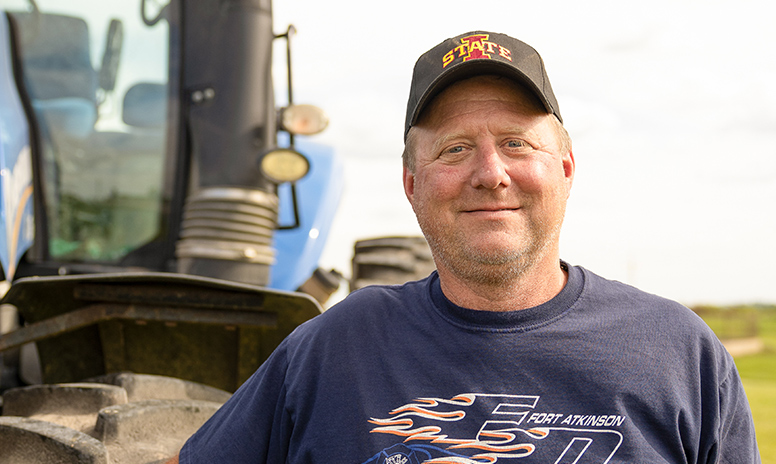
Involving Mitch in day-to-day decisions not only helps the operation today but also gives him valuable experience for the future.
“It gets him involved in the operation and helps him see everything that goes into it,” Alvin says. “He’s learning the business side while also bringing new ideas and perspectives back to the farm.”
Today, Mitch is taking gradual steps into a larger role within the family operation.
Rather than making an immediate transition, he and his family are focused on finding opportunities that allow him to slowly expand his involvement. Recently, he began farming some of his grandfather’s acres.
Additional rented acres could provide future opportunities as the transition continues.
“It’s baby steps,” Mitch says. “I’m not ready to fully dive all in yet. I’ve always wanted to make sure I could do it on my own first.”
Diversification
To diversify beyond row crops, the family finishes feeder pigs and raises cattle. This livestock mix provides additional stability as the family prepares to welcome another member of the next generation. Mitch’s younger brother, Jacob, 23, works in ag retail while helping out on the farm. Alvin says Jacob’s off-farm experience brings another valuable perspective to the operation — one that will shape the farm’s future as transition planning continues.
“We want to create opportunities for both of our sons,” Alvin says. “The goal is to get them involved now so they’re prepared when the time comes to take on larger roles.”
A leg up
While the path into farming remains challenging for many young producers, Mitch says creative arrangements can help make the transition possible.
One example is the agreement he has with his father regarding labor and equipment.
Rather than paying equipment costs, Mitch contributes labor to the operation. The arrangement helps him keep more working capital available for rent, inputs and other expenses as he builds his farming business.
Without those types of opportunities, he says entering farming would be significantly more difficult.
“You need a leg up somewhere,” Mitch says. “People have to find someone they trust and be willing to help create opportunities. That’s what makes it possible for young farmers to get started.”
Creating those opportunities requires farmers to start succession planning earlier than many realize, Alvin says.
Having experienced a slow transition into farming himself, Alvin made a conscious decision to involve his son in management and business decisions before retirement became part of the conversation.
“I farmed with my father-in-law, and while he let me take care of the farm, it took a long time to get financially involved,” Alvin says. “I want to create those opportunities for my sons.”
Today, Mitch farms a small number of acres of his own while using family equipment and participating in decisions related to inputs, marketing and management.
Alvin encourages farm families to start small but start now.
“You’ve already waited too long,” he tells other farmers who are thinking about succession planning. “Time goes by fast. The sooner you can get them involved, even on a small scale, the better they’ll be. They’re learning how to market commodities, buy inputs and make business decisions before the big responsibility gets dropped on them.”
Find ways to let the next generation participate, Alvin says. Maybe that means helping a son or daughter farm a few acres, sharing family equipment, or inviting them to engage in management discussions.
“I’m the same as any other farmer. I don’t want to give up this or give up that,” he says. “But it’s easier to give up a little bit and let them get a foot in the door. Once they get started, opportunities begin to open up.”
Future generations
Today, Mitch lives on the farm where he grew up, continuing a family legacy that began long before he was born.
The recent birth of his and his wife, Amanda’s, first child, Morgan, has only strengthened his commitment to the farm and its future.

“That’s what motivates me,” Mitch says. “I’ve seen the hard work, time and dedication that’s gone into this farm, and I don’t want to be where it ends.”
He wants to create opportunities for future generations, just as his grandfather and father did for him. “I want it to continue for years,” he says. “That’s what drives me every day.”
Back