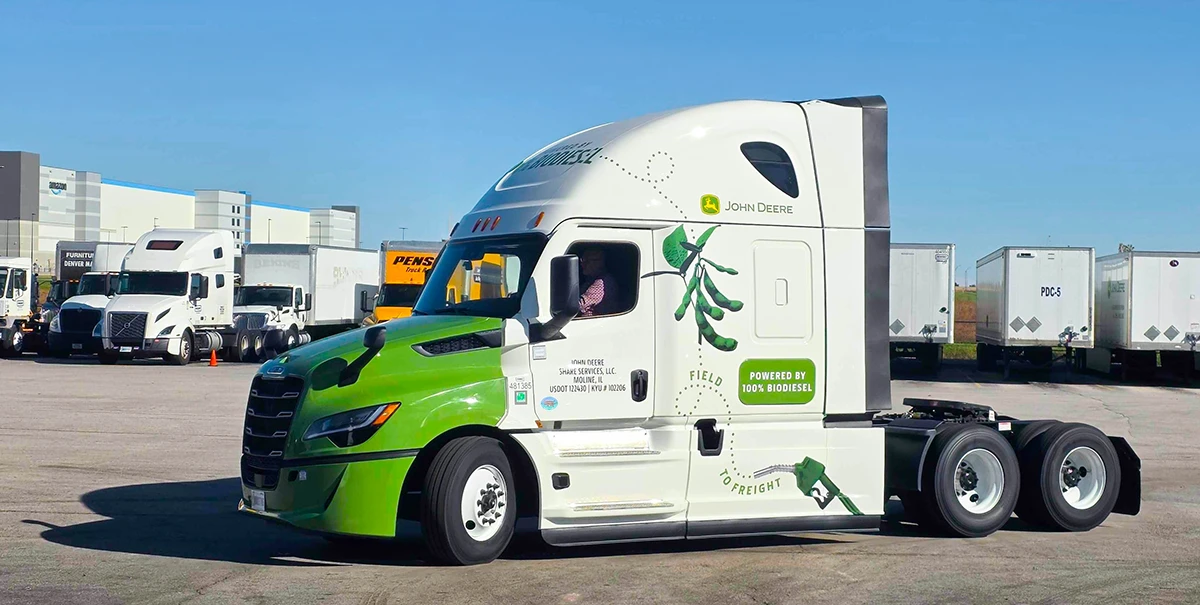
(Photo: Courtesy of John Deere)
Deere’s 'Field to Freight' highlights soy-based biodiesel
November 12, 2026 | Bethany Baratta
Biodiesel blends have proven successful in John Deere tractors, so the company is putting 100% biodiesel (B100) to work within its heavy-duty freight operations.
John Deere, in collaboration with Optimus Technologies and Penske, launched its Field to Freight program at its North American Parts Distribution Center in Milan, Illinois, today.
The initial six-month deployment will put five new 2027 Freightliner Cascadia semi-trucks into service across Midwest routes throughout Illinois and Iowa. The semis are outfitted with Optimus Technologies’ Vector System. The dual-tank system allows standard diesel engines to operate primarily on B100 while retaining the ability to use petroleum diesel when needed. The truck starts on conventional petroleum diesel, uses engine heat to warm the B100 tank, and switches over to 100% biodiesel during operation before flushing lines back with diesel prior to shutdown. The system can also automatically switch to diesel if B100 isn’t available.
Utilizing renewable fuel
Demonstrating leadership in renewable fuels is one of three core pillars supporting John Deere’s renewable fuel initiative, says Nate Green, biofuels director for John Deere. Following recent milestones—including approving B30 blends across Tier 4 engines and testing an ethanol-powered E98 tractor—this demo expands pure renewable fuels into the company’s logistics network.
“We wanted to see how we could go essentially to the max and really demonstrate a solution within our own operations that utilizes pure renewable fuel,” Green says.
Deere’s nationwide logistics network consumes nearly 4 million gallons of diesel fuel annually across a fleet of 400 semi-trucks moving parts between distribution centers, dealerships and farms. Using fleet heat mapping, project leaders identified routes originating from the Milan facility where trucks return daily, enabling on-site B100 fuel storage infrastructure, according to Green.
“We looked at those 400 trucks as an opportunity to utilize increasing amounts of renewable fuel in our own operations” he says.
Over the course of a year, the five upgraded trucks are projected to:
- Travel more than 700,000 miles.
- Consume more than 85,000 gallons of B100 fuel.
- Utilize feedstock equivalent to 60,000 bushels of soybeans.
- Reduce lifecycle carbon emissions by up to 85% compared to petroleum diesel.
Chevron supplies the fuel from its Seneca, Illinois, facility following a competitive bidding process. The plant refines biodiesel using primarily local soybean oil and distiller’s corn oil, sourced in part from Illinois crush plants and Marquis Energy, an ethanol facility in Hennepin, Illinois.
Building demand
Field to Freight captures complete agricultural circularity while helping build long-term market demand for Midwest-grown soybeans and corn, Green says.
“It all starts with the farmer in the field producing corn and soybeans as the feedstock,” he says. “Those feedstocks go to local processing, then to Chevron in Seneca to become biodiesel. A truck delivers that fuel to our distribution center in Milan, fills our fleet with B100, and those trucks haul parts to dealerships and ultimately back to the farmer who started the circle. By using B100 in our own fleet, we're demonstrating the viability of higher blends and building demand for the renewable fuels our customers help produce.”
Written by Bethany Baratta.
Back