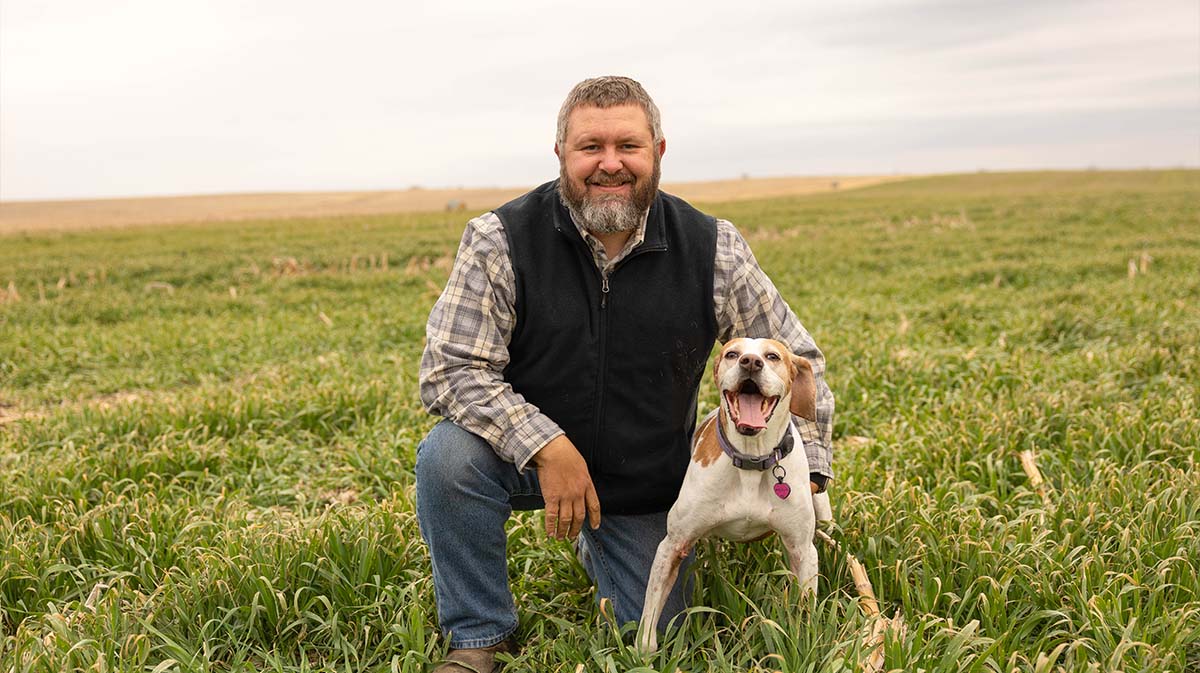
(Photo: Iowa Soybean Association / Joclyn Kuboushek)
More working days and better soil
March 31, 2026 | Mickayla Jordan
The Helland family has farmed north of Des Moines near the junction of Polk, Boone and Story counties since 1861. The family’s seven generations have worked to conserve and protect its precious soil and water resources ever since.
“We want to be able to hand this farm off to the next generation and we want it to be in the best shape possible,” says Nick Helland, the seventh generation farmer on the land. “So that means taking care of what we see as our best resource in the best way possible.”
It’s a lesson he’s learned farming with his dad, uncle and cousin on the family farm. And it’s the legacy he continues on the farm today, 150 years since the farm’s establishment.
The Iowa Soybean Association (ISA) recognized that commitment in December, when Helland received the 2026 ISA Environmental Leader Award. Sponsored by Agri-Drain, the award recognizes an ISA member who is committed to practices that improve environmental performance through work with the ISA Research Center for Farming Innovation (RCFI), Soil and Water Outcomes Fund (SWOF) or Iowa Agriculture Water Alliance (IAWA).
Good things take time
“Our journey in sustainability really began with a transition to no-till soybeans in the mid-90s,” Helland says. “We didn't have any yield penalty on the soybeans, and it enabled us to spend our time and effort on some other things.”
After seeing the benefits of no-till, Helland and his family began looking into additional conservation practices that could benefit the farm without decreasing their productivity.
“In 2012, we started to incorporate cover crops and have found there are some benefits to the cover crops that we like to have,” explained Helland. “The cover crops helped rehabilitate some soils to be more like the texture of our long-term no-till fields, and it helped mellow out the soil and give it a firmer texture.”
Cover crops with fibrous roots, including cereal rye, decrease field oversaturation during early spring rains by allowing the soil to absorb more water. This increased water infiltration means spring rains don’t always put a stop to planting progress.
“I think it's opened a wider window for working days on some fields,” Helland says. “If it's wet, we've been able to get in sooner than those fields without cover crops.”
Beyond the field
While cover crops and no-till practices improve soil quality and reduce erosion in the field, some conservation practices have no impact on production acres.
In some cases, that’s the goal. Edge-of-field conservation practices act like filters that slow down water as it leaves the field and remove nitrates.
“Saturated buffers and the bioreactors treat water without affecting the tile lines and cropping acres, which is actually a good thing,” says Helland. “We’re doing these practices without having any negative effects on our crop acres.”
Across the family farm, Helland has installed eight bioreactors and saturated buffers along the field edge to continue to filter water before it enters the Des Moines Watershed.
In 2024, Helland restored a two-acre wetland near Big Creek. The wetland serves as a critical last stop for water leaving the field and heading toward Des Moines. It also provides additional habitat for wildlife and native plants.
“I enjoy the outdoors, and it's also a great way to increase habitat,” Helland says. “If you have better habitat, the whole system benefits.”
Later this year, he will restore a multipurpose oxbow, adding yet another edge-of-field practice to his farm. With assistance from ISA’s conservation team, Helland will remove built up sediment from an old stream meander to restore natural flood water storage and Topeka shiner habitat.
“I like to say we're getting close to having the bingo card full,” he jokes.
Sharing the conservation story
With a full card of conservation practices, the Helland Farm has become a go-to destination for farmers and consumers to see conservation in action.
Helland has partnered with the Iowa Agriculture Water Alliance, Polk County Soil and Water District and other local organizations to host field days on his farm that allow local farmers to see practices in action and ask questions.
“I'm a big believer in telling people, ‘Hey, this is what's worked and this is what hasn't,’ ” Helland says. “Being able to have honest conversations is key.”
Positioned close to the metro, Helland and his family have also welcomed urban neighbors, including legislators and representatives from Central Iowa Water Works, to see how environmental practices connect to life on the farm.
“I want to show them what the reality is on the farm,” he says. “These are what the practices they may have heard talking points about really look like on the farm.”
Making conservation work for you
Conservation isn’t a “one-size-fits-all” approach.
Talking with neighbors about their experiences with specific conservation practices is the first step, according to Helland. While every field is different, your neighbors can provide insight into practices that may or may not be compatible with your area.
“Not every practice will work on every acre,” Helland says. “Understanding the practices and what your goals are will help you determine which practices will fit the acres you’re targeting.”
Written by Mickayla Jordan.
Back