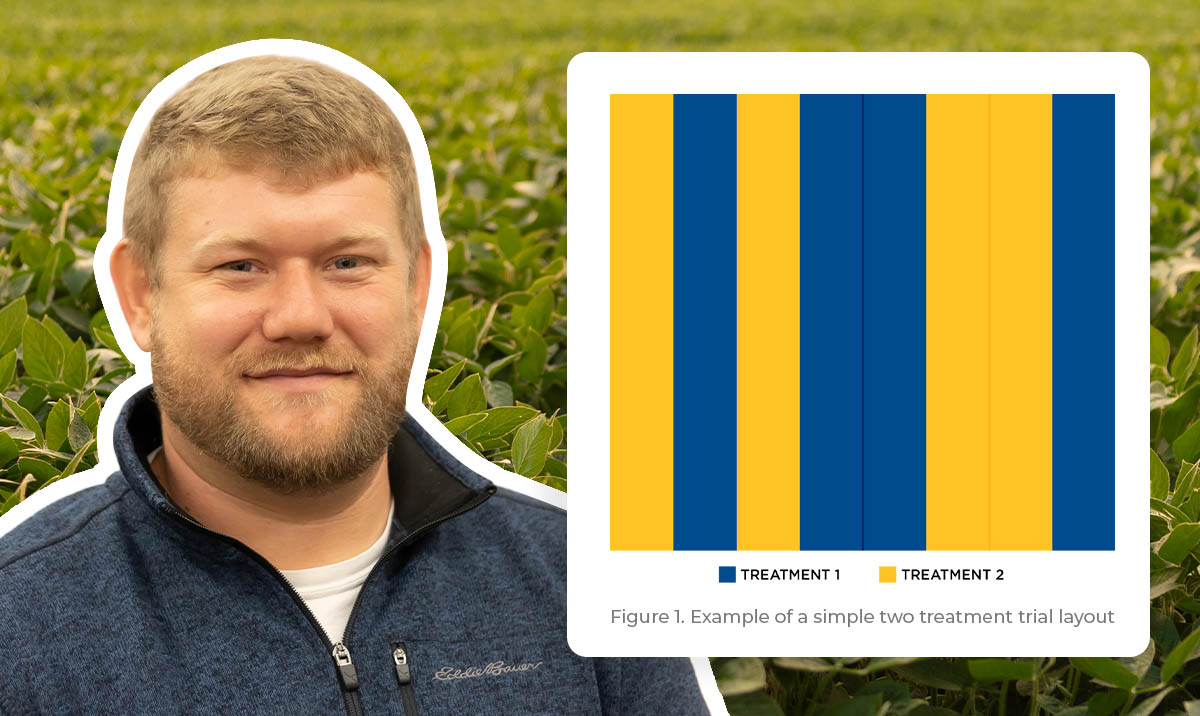
(Photo: Iowa Soybean Association / File Photo)
Five steps to better on-farm trials
May 1, 2026 | Anthony Martin
Key insights:
- Keep trials simple to ensure they answer your original question.
- Randomizing and replicating treatments will help minimize unreliable results.
- Wide strips help ensure usable data post-harvest.
Implementing field trials doesn’t need to be complicated or require a statistical background to be done correctly. Small changes and simple adjustments can help farmers derive meaningful results and answers to questions about products or field management practices. Especially in times when farmers are looking to minimize or remove unneeded inputs while also being sold on new product offerings, field trials are a good way to identify where they could benefit from an investment or find potential savings.
At the Iowa Soybean Association’s Research Center for Farming Innovation, we’ve been working with farmers to set up and conduct on-farm research trials for more than 20 years. Over this time, we have found several things that help improve or hinder the results of these trials. Here are some of those findings:
1. ‘Early’ proper planning prevents poor performance
Sans an additional P, we’ve all probably heard this phrase before, and it is especially true when setting up field trials. Early planning can, and likely will, prevent getting results that are useless to answering the questions we want to answer. Planning trial comparisons and layout before getting to the field helps minimize issues from insufficient replications or area, layering trials over each other, or simply overcomplicating the trial with unnecessary changes. Aside from the trial comparisons, keeping all other management decisions consistent across the trial area is important to maintain clean results.
2. Choosing the right comparisons
Understanding the product or practice and what it promises to do or improve is a good starting point for determining which comparisons should be included. Simply applying a product in strips can work, but some products may require changing rates of additional inputs to check results. A product offering to fix additional nitrogen, resulting in lower nitrogen needs, should have an accompanying strip of reduced nitrogen to see if this is true and if yield remains constant. If we maintain the same nitrogen rate and are already at the high end of what the crop needs, determining whether the product worked is difficult. For this example, a more complete design would include strips of the product with normal and reduced nitrogen rates.
3. Select the correct field and layout
Especially for products aimed at targeted diseases or pests, selecting a field that has had presence in the last few years is more beneficial than a field with no history. For example, a crop protection product aimed at controlling white mold should be applied in a field with a history of white mold.
Plan strips based on your current equipment setup. A good rule of thumb is to shoot for a treatment width that is at least two times the width of your harvest pass if you are planning to harvest with the row. This ensures at least one clean harvest pass through treatments, no matter where or who is in the combine. For soybeans, if the plan is to harvest at an angle, treatments should be at least three times the width of your harvest pass, or wider, to account for the combine moving between treatments.
4. Replication and randomization
One key way to help minimize outside effects from field variability that may influence yield beyond the treatments themselves is by replicating and randomizing the trial layout. We recommend at least three replications, or paired treatments, for the trial layout but more replications are better. In addition, randomizing the treatments within each replication is recommended. For two treatment trials, flip a coin for each replication in the field to determine which treatment comes first, or if you have more than two treatments, use an online tool like Google Spinner to determine the order. Whichever method you choose, record the layout to reference during application and harvest operations.
5. Maintaining records through harvest
Maintaining good records should always be a goal but needs additional attention in tracking in-field trials. With current technology, this should come easy for many farmers, but keeping a physical journal with detailed notes will also work. Labeling application passes and loads during field operations as they relate to the trial makes analyzing the final yield data simple. Precise calibration of the combine prior to and during harvest is essential to ensure that the recorded yield differences reflect actual treatment effects rather than sensor drift or machine variability. Following harvest, most data management tools can generate average yield comparisons between loads or user-selected areas of the field and make looking at treatment yields simple.
While this is a quick guide to develop and conduct a research trial on your own, our team can assist you with questions along the way. Reach out to your regional agronomist for more information about our current trial offerings or for help setting up your own research.
Written by Anthony Martin.
Back