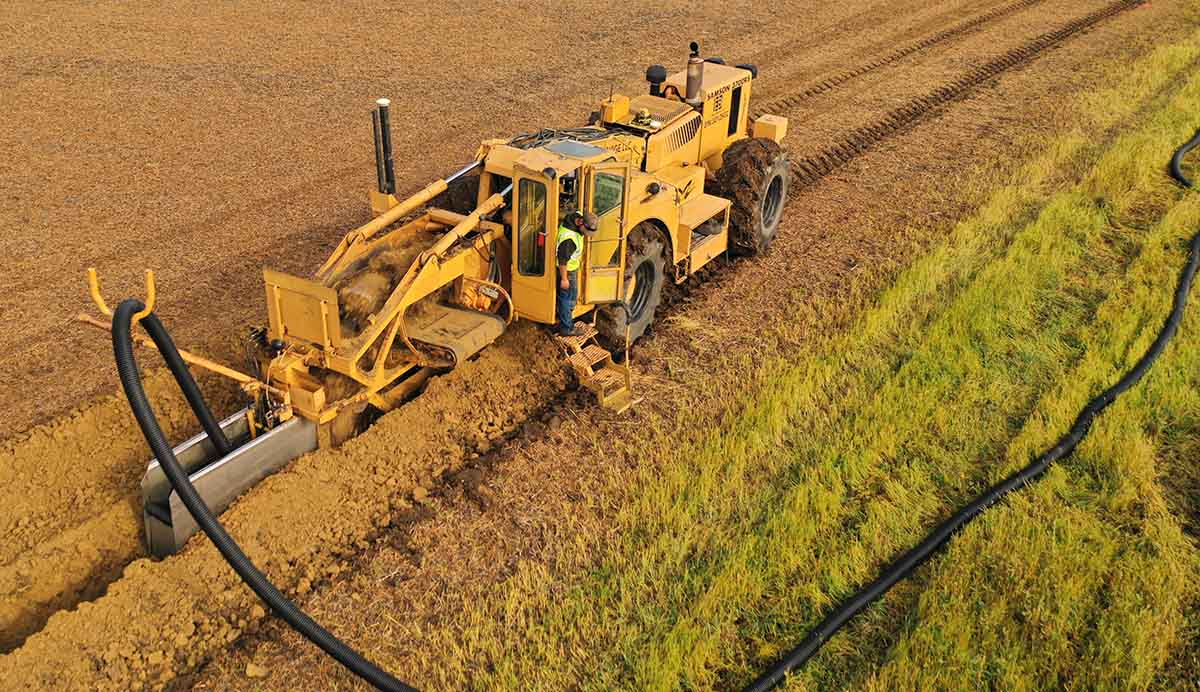
(Photo: Submitted by ADS)
Managing water, not just moving it
March 31, 2026 | Kriss Nelson
Farmers do not invest in drainage to lose nutrients or send money downstream. Today’s tiling companies focus on helping farmers protect their investment while improving water quality by using systems designed to manage water more precisely, not simply moving it faster.
Josh Shuler, technical product and business development manager with Agri-Drain, says proper water table management is one of the most effective ways farmers can improve productivity and return on investment.
“If we can keep that water table at the proper depth, it promotes better root growth,” Shuler says. “We have less disease pressure, better yield and better drought tolerance.”
That consistency begins with the correct installation. Shuler stresses that tile depth must match soil type, crop selection and regional conditions.
“When tile is installed correctly, most people see about a 30 percent yield boost in the first year compared to before tile,” he says, noting results vary by field and soil type.
Return on investment
“For a lot of farmers, drainage tile is one of the first things they look at,” says Cole Rath, an Advanced Drainage Systems (ADS) territory sales manager covering western Iowa, Nebraska and southern South Dakota. “Is there already drainage out there? And if there’s not, how can we improve this piece of ground?”
Poor drainage, Rath says, often explains disappointing yields.
“There are so many instances where farmers are underwhelmed with their yields, and a lot of times it’s because the soil is waterlogged,” he says. “God only creates so much farm ground, and farming is becoming more difficult. So how are we going to utilize these dollars to improve the land that we have?”
From an investment standpoint, drainage consistently rises to the top.
“If we can improve the yield, besides fertilizer and some other practices, drainage tile is probably one of the biggest things farmers can do to improve their ROI and yield,” Rath says.
Early crop health
Tim Dahl, ADS regional sales manager covering Minnesota, North Dakota, South Dakota, Iowa, Nebraska, Kansas and Missouri, says the benefits of tile begin early in the crop’s life cycle.
“If you think about the life cycle of a crop, if the field is saturated, that crop doesn’t have healthy roots, Dahl says.”
Water quality myths
Tile drainage often draws criticism in water quality discussions, Dahl acknowledges.
“A lot of people will say tiling is causing the issues because we have these direct flows into a watershed, with water running out of an 8-inch pipe straight into a river,” he says.
But that perspective, Dahl notes, misses what happens underground.
“That water has gone through three to four feet of the soil profile, where nutrients are used up and the water is actually pretty clean,” he says. “Without tile, a heavy rain leaves saturated fields shedding nutrients, silt and fertilizer across the surface and into the watershed.”
He compares soil to a sponge.
“What tile does is keep that sponge in a state where it can accept more water,” Dahl says. “If it’s already full, water stays on the surface, picks up fertilizer and sediment and moves it into the watershed.”
Evolving drainage systems
Shuler says modern water management is no longer about draining water as quickly as possible.
“It’s not your grandpa’s tile anymore,” he says.
Agri-Drain offers water control structures installed on main tile systems, but Shuler says those structures are part of a broader effort to enhance traditional drainage.
“We’re not replacing tile,” he says. “We’re just enhancing what tile does.”
With controlled drainage, farmers can adjust how much water is held in the soil profile depending on crop growth stage.
“We can take tile that normally drains 24/7, which definitely has benefits, and in some scenarios claw back another 5 to 15 percent more yield,” Shuler says. “That comes from controlling the water table and holding water during drought periods when we need it.”
From a water quality standpoint, holding water in the field longer, when it can be done safely, is one of the most effective strategies available.
“That’s where it naturally breaks down,” Shuler says. “It doesn’t get into waterways where nitrates and phosphates can cause other issues.”
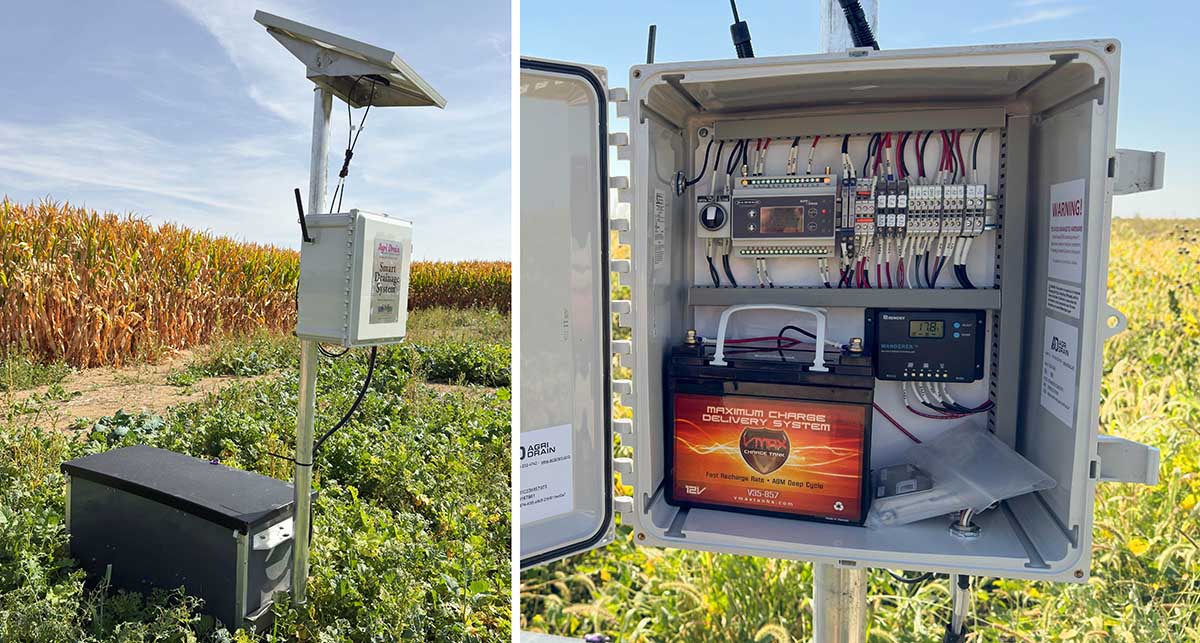
Controlled drainage structures allow farmers to adjust water levels within tile systems, holding water in the soil profile when crops need it and reducing nutrient movement to downstream waterways during heavy rain events. Photo submitted by Agri-Drain.
Looking ahead
Water control structures can be managed manually or automated, helping farmers match water levels to crop needs throughout the season.
As farms grow larger and more complex, Dahl says automation will be critical.
“Manually managing dozens of control structures isn’t realistic,” he says. “So the question becomes, how can we monitor this, control it and automate it?”
Both Rath and Dahl see water management as the next major frontier for agriculture.
“I think water management is the space for the next 10 to 20 years,” Rath says. “How can we hold water back during drought? How can we get rid of it during extreme rain?”
Even in regions where tile has been used for generations, Dahl says system design continues to matter.
“Tile isn’t cheap,” he says. “So how do we maximize that investment? A lot of that comes down to design.”
Despite long-standing drainage history, resistance remains.
“The attitude is often, ‘I spent all this money to get rid of water, why would I stop it?’ ” Dahl says. “That’s the story we need to continue to tell.”
For Shuler, that story is rooted in flexibility, economics and research-backed performance.
“There’s a lot of research that backs up the ability to convert from 24/7 drainage to controlled drainage and the benefits that come from it,” he says. “That’s really what we want to hammer home.”
And for farmers facing increasingly unpredictable conditions, Rath says the motivation is simple.
“If there’s a way farmers can control the uncontrollable,” he says, “they’re going to try to do it.”
Written by Kriss Nelson.
Back