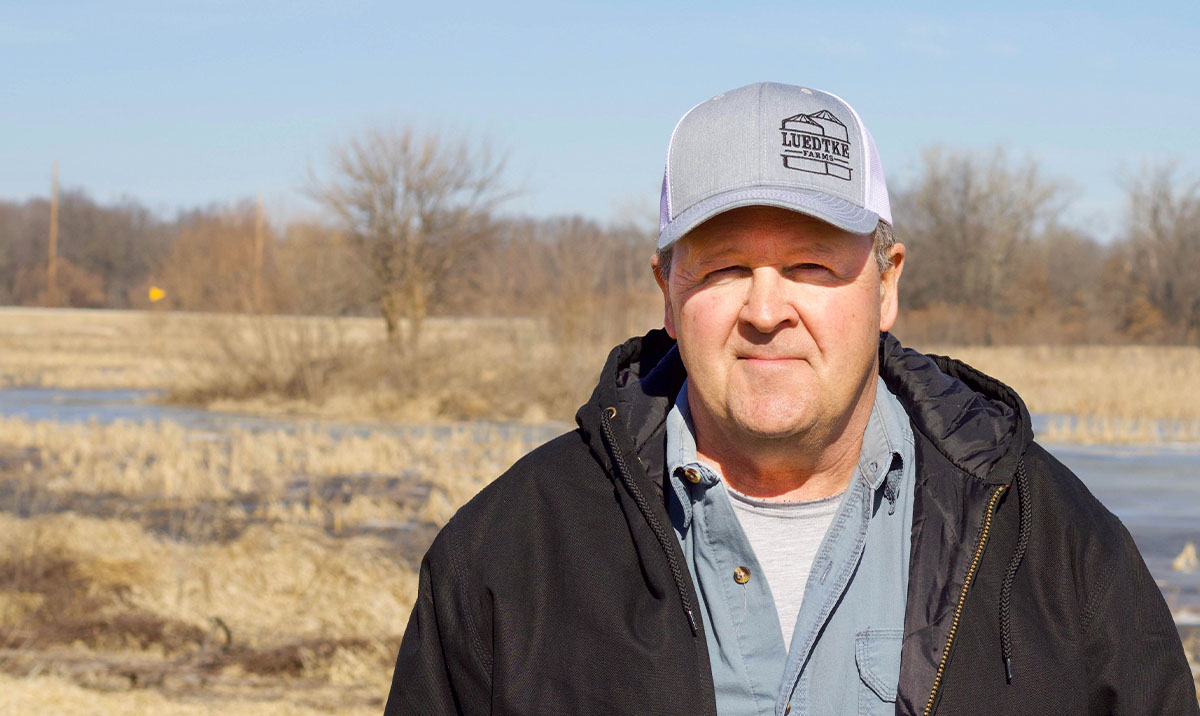
Kevin Luedtke farms near Chariton. He’s a member of the Rathbun Land and Water Alliance, which was formed to protect Rathbun Lake. (Photo: Iowa Ag Water Alliance / Rebekah Jones)
How farmers safeguard Iowa's drinking water
March 31, 2026
When you pull into the Lucas County Conservation Office in Chariton, mud-splattered pickup trucks line the lot. It’s a visible sign of farmer collaboration that’s been growing for 33 years in this part of southern Iowa.
Kevin Luedtke is one of those farmers. On his soybean and corn farm, he uses terraces, cover crops, prescriptive tillage and nutrient application among other conservation practices that prevent sediment and nutrient loss.
“Around 2012, we got rid of the cows and grew crops on a few of the acres where the cows had been grazing,” Luedtke says. “But I kind of felt guilty because it wasn’t really ideal crop ground, so that’s when we started cover cropping.”
It started with 50 acres. Noticing how the tractor ride wasn’t as bumpy due to the improved soil structure that his rye cover crop provided, he continued to add more. Now he plants covers on nearly all of his acres.
But Luedtke’s stewardship extends far beyond his own farm. He’s been a member of the Rathbun Land and Water Alliance nearly since it’s 1996 beginning.
The Alliance was formed to protect Rathbun Lake, a drinking water source to 18 counties in southern Iowa and northern Missouri. In 2004, the Alliance began implementing a watershed plan for the area.
Brian DeMoss, a project coordinator for the Lucas County Soil and Water Conservation District, says the fact that farmers drink the water they personally impact, plus the visibility of erosion in that area has led to one of the longest standing and most successful conservation plans in the state.
“Producers in this part of the state can see the issues,” DeMoss says. “If we have a good rain, there’s going to be some ruts out there and they want to fix it.”
Since 2004, more than 600 landowners have applied best management practices to more than 42,000 acres in the Rathbun Lake Watershed area. This has reduced annual sediment and phosphorus loading by an estimated 82,000 tons and 301,000 pounds, respectively. That’s the equivalent amount of soil of 2,000 dump truck loads.
Understanding source water
Surface water
Rathbun Regional Water customers are part of only 20% of the state that drinks surface water — water that comes from above ground. The rest of the state — about 80% — gets its water supply from aquifers underground.
Surface water is particularly vulnerable to pollution from runoff and subsurface drainage (for example, tile or stormwater drainage).
Rathbun Lake’s biggest challenge is sediment loading which carries phosphorus with it. Utilities that pull from rivers often have to worry more about nitrates.
Other examples of surface water utilities include Spirit Lake Waterworks which pulls from Big Spirit Lake, Des Moines Water Works which uses the Raccoon and Des Moines Rivers, and Creston Water Supply which sources from 12-Mile Lake and 3-Mile Lake.
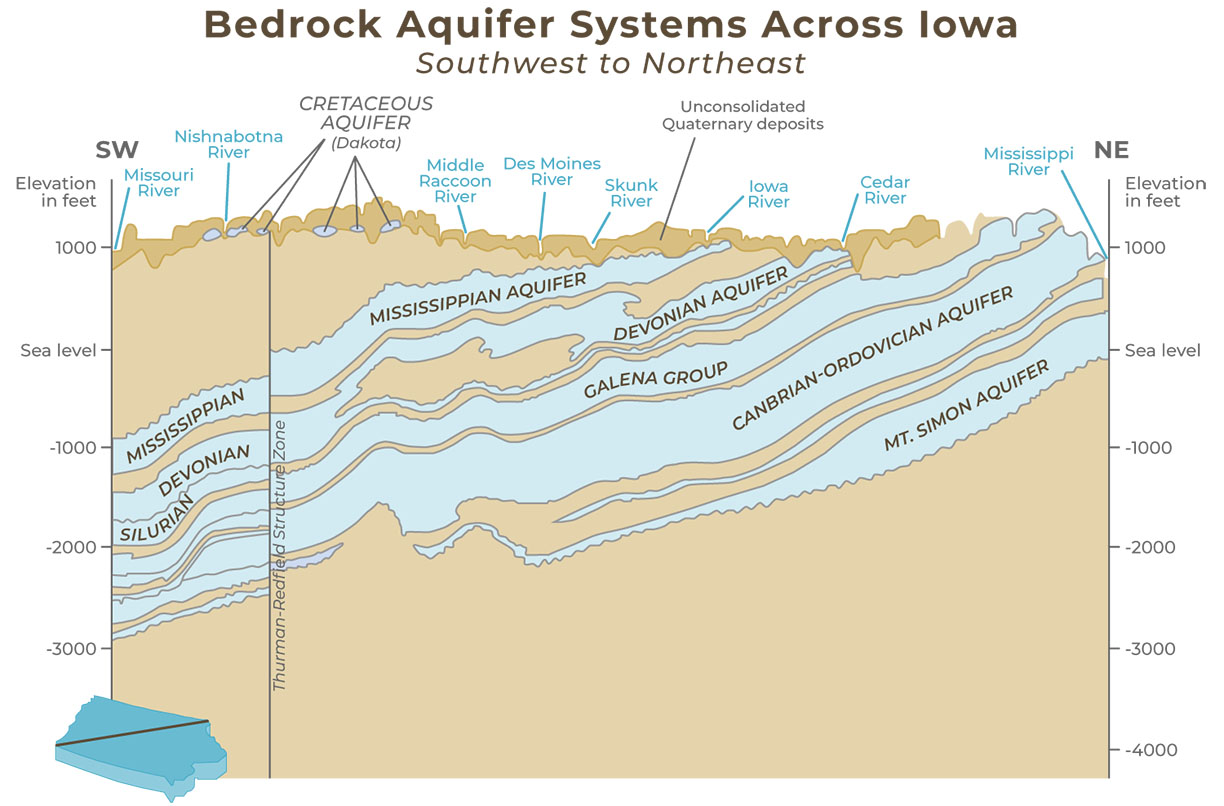
It's easiest to map aquifers not from cardinal directions on a map, but by depth. This image shows the depths of aquifers across a diagonal slice of Iowa. The deeper the aquifer, the longer it takes to refill. Shallow aquifers are more prone to surface contaminants. Many aquifers are named after the geological age of the rocks they're composed of.
Aquifers
Beneath Iowa’s black soil lies a long history written in stone and sand. Tens of thousands of years ago, when wooly mammoths still roamed, Iowa was covered in miles of ice. Glaciers crept slowly across the land, grinding bedrock into sand and gravel. They carved valleys that now cradle streams. They whittled potholes that hold wetlands.
The glaciers scraped, ground, carried and deposited rock and soil wherever they traveled. Those deposits became aquifers — pancakes of sand and stone with millions of tiny spaces for water to settle safely within the earth. The ancient water filtered by geography and time waits under corn roots and prairie grasses.
The Jordan Aquifer — used by Dubuque, State Center, North Liberty and others — is between 70,000 to 180,000 years old. The water rising through the well may have last seen sunlight when mammoths grazed where cornfields now stand.
The Jordan Aquifer is a finite resource because recharging (the process of water flowing back into it) takes thousands of years.
As you move across the state from northeast to southwest, the ceiling of aquifers gets gradually deeper, making it harder to tap as a source.
“Iowa’s groundwater is not evenly distributed,” says Keith Schilling, Iowa’s State Geologist. “So depending on where you are, you have different source water issues.”
Alluvial aquifers: vital sources, vulnerable foundations
Alluvial aquifers are shallow and run along major rivers. Utilities that draw from alluvial aquifers include Cedar Rapids, Iowa City, Muscatine and Pella.
Because they are less than 100 feet deep and recharge quickly, they are also impacted by pollution at the surface.
That’s why in Cedar Rapids, the utility pulls from 51 different wells, blending the water to adapt to changing conditions like high nitrate loading in the spring. Cedar Rapids also works directly with producers to protect drinking sources by helping to pay for cover crops, wetlands and edge-of-field filters upstream.
“You hear a lot about urban-rural divide, but honestly when you sit down across the table with someone and have a conversation about what matters to all of us … farmers want to be part of the solution,” says Mary Beth Stevenson, the watersheds and source water program manager for the City of Cedar Rapids Utilities Department.
Private wells, personal responsibility
Shallow aquifers are one of the most common places for private wells to be placed.
Often a badge of honor for rural Iowans, (In casual conversation, it’s not uncommon to hear “I grew up on well water”) we shouldn’t be so quick to pride without knowing what exactly is coming from the well.
Only 5-10% of households with private wells test their water annually. It’s not mandated and it’s the responsibility of the well owner.
When Eric Miller, a fourth-generation farmer in Cascade, saw elevated nitrate in his family’s well, the numbers became more personal than news headlines. His son drinks from that tap. The same water brews their coffee and washes their clothes.
“It just really hits home,” he says. They installed a reverse osmosis system and continue to apply conservation practices.
In his area of the state, wells are more prone to high nitrates. The limestone and dolomite bedrock that creates northeast Iowa’s dramatic bluffs and hidden caves is riddled with fractures that carry water too quickly to filter. About 13% of private wells tested in Jones County had high nitrate levels in 2020 (the most recent year with publicly available data through the Iowa Department of Public Health). In nearby Delaware County, that number was 27%, the highest in the state.
Miller’s passion for improving his home’s water quality through soil health practices has turned into a business opportunity. His regeneratively-grown small grains are the core of his new brewery, “Crispy Boy.” For the brewery, they had to dig a deeper well safe from nitrates.
“It’s a win-win on both sides,” Miller says. “Where you’re improving your water quality, you’re improving your soil health, and improving your bottom line.”
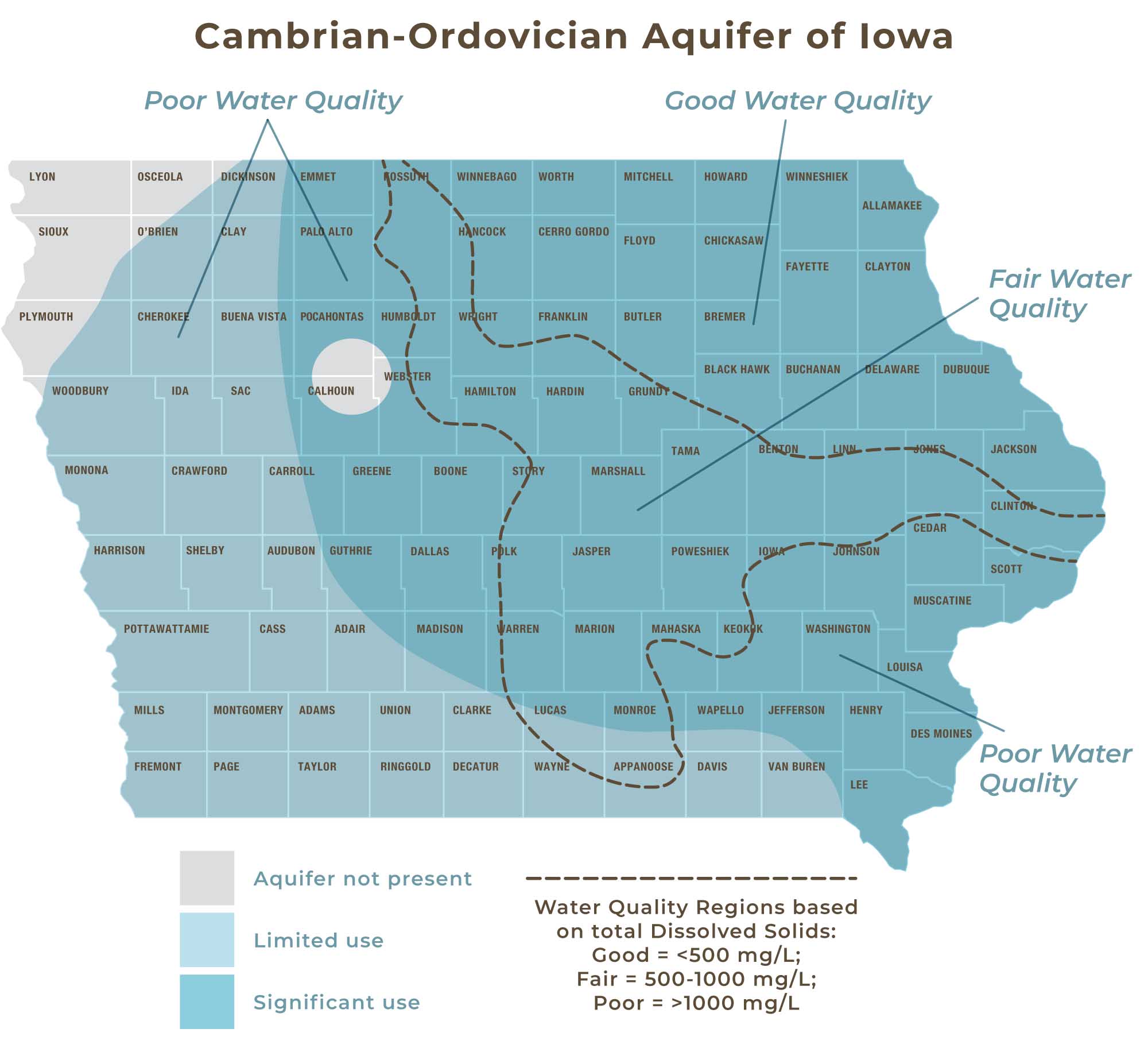
As you move from northeast Iowa to southwest Iowa, you have to drill deeper to access the aquifer. The deeper you go, the more solids (mostly minerals) it naturally has in it. On this map, poor, fair and good water quality distinctions refer to the depth and naturally-occurring minerals found within the aquifer. This means a utility would have to do much more to treat the water from the aquifer for its customers.
Farmers in action
Whether it’s groundwater or surface water, protecting and improving water quality requires similar approaches: planting cover crops, reducing tillage, applying varied and efficient nitrogen prescriptions, installing waterways and buffers, and more.
And it doesn’t have to be every practice on the list.
The Rathbun Lake Watershed Plan offers valuable lessons about how voluntary, farmer-led conservation can make meaningful impact.
The Alliance and partners focus on empowering farmers by providing financial and technical support. Since 2004, more than $40 million has been invested in Rathbun Lake protection efforts.
When Luedtke talks about what makes the Alliance work, one word persistently rises to the surface: trust. He says it four times in three minutes. He’s talking about the kind of trust that’s built over decades. The kind that comes from conservation staff who understand that your livelihood is in the land.
“I feel comfortable coming to them with a problem,” he says. “Because I know we’re on the same team.”
Written by Rebekah Jones. Rebekah is the communications director for the Iowa Ag Water Alliance. She can be reached at rjones@iowaagwater.org.
Back