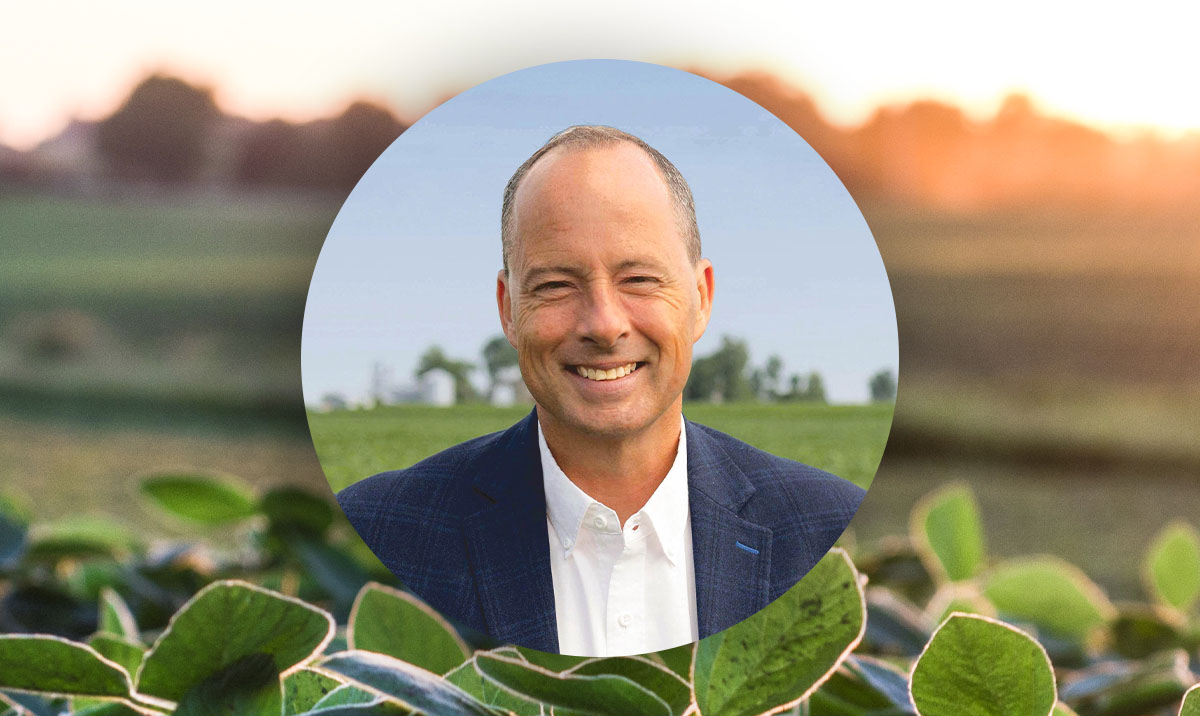
(Photo: Iowa Soybean Association / File Photo)
From nickel to impact
March 31, 2026 | Aaron Putze, APR
The invitation to visit with farmers about the soybean checkoff came from Suzanne Shirbroun of Farmersburg. The farmer, United Soybean Board director and past Iowa Soybean Association (ISA) president and her husband Joe, host a shop talk meeting each February for their Pioneer customers. They thought an update on the checkoff would be timely and well-received.
I circled the date on my calendar. Those responsible for investing checkoff resources in programs and activities are accountable to the soybean farmers who remit those resources (plus, I enjoy networking with farmers having been raised on a farm near West Bend and with family still actively involved in the profession).
The act establishing the checkoff was approved by Congress in 1990. Farmers marketing more than 250 bushels of soybeans annually remit one-half-of-one percent of the net market value of a bushel of soybeans. That’s a nickel for a bushel sold for $10. Half of checkoff collections fund ISA’s activities directed by its 22-farmer board; the remainder are remitted to the United Soybean Board.
In my shop talk remarks, I quickly pivoted from the history and mathematics of the checkoff to four present day examples of its return on investment. They are:
- Strengthening livestock markets. Checkoff funding helped ISA launch the Coalition to Support Iowa’s Farmers (CSIF). Since 2004, CSIF has worked with thousands of farm families to start or expand poultry, pork, and cattle operations — directly boosting local soybean demand. This work is increasingly important as new crush capacity across Iowa and the Midwest expands soybean meal supplies.
- Building demand through biofuels. The checkoff is aggressively promoting soy-based biofuels for use in trucks, locomotives, maritime shipping, and home heating, to name just a few. These efforts have driven record production and demand. Once considered a waste product, soybean oil used in biodiesel and renewable diesel now represents about 10% of the value of all U.S.-grown soybeans — roughly $1 of every $10 bushel.
- Competing in global markets. Demonstrating the value of U.S. soybean meal and oil in the face of greater global competition is critically important. The U.S. Soybean Export Council (USSEC), funded by ISA and other checkoff partners, expands market access for U.S. soy, differentiates it from the competition and elevates its preference among global buyers. USSEC programs reach more than 90 countries and provide a year-round voice for U.S. soy.
- Advancing farmer-focused research. Before a soybean can be sold, it must be grown. ISA’s Research Center for Farming Innovation (RCFI) puts farmers first when evaluating products and production systems. By involving producers directly in soybean-centric research, ISA ensures results are objective and practical. Public-private partnerships make checkoff dollars work harder, with every $1 invested attracting $1.90 in external funding — multiplying the impact of trials and science-based recommendations.
At a time when every dollar matters, the soybean checkoff remains directed by (and accountable to) farmers. It has the backs of farmers where and when you can’t be present (and trust me when I say few will go out of their way to do you and the industry any favors). While you’re farming, the soybean checkoff is strengthening domestic livestock markets, building biofuels demand, aggressively competing in the global marketplace and advancing farmer-centric research.
I welcome your questions and feedback about the ROI of your checkoff investment and programs and activities offered by ISA. Have a question? Contact me at aputze@iasoybeans.com or by phone/text at 515-975-4168. Thank you for your commitment to ISA and fellow soybean farmers and have a safe and timely planting season.
Written by Aaron Putze.
Back