(Photo: Iowa Soybean Association / Joclyn Kuboushek)
How infrastructure, trucks and rail shape ag costs
February 26, 2026 | Kriss Nelson
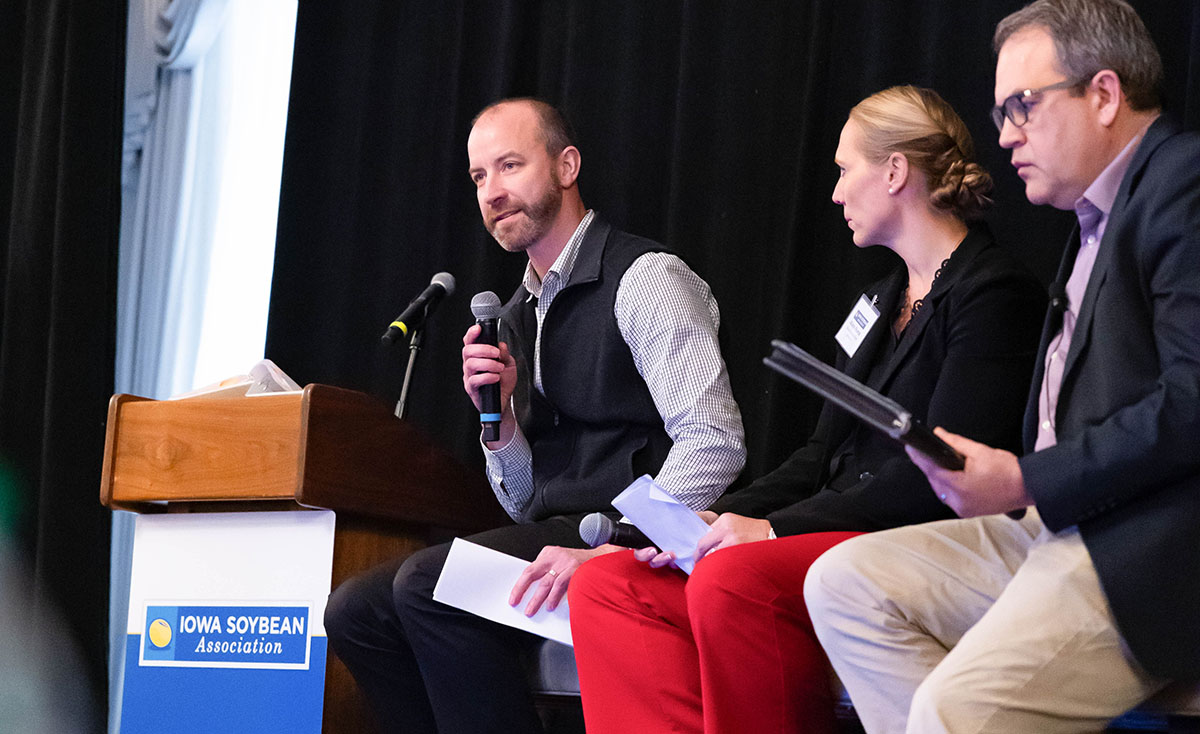
Aging infrastructure, shifting supply chains and long-term investment decisions are reshaping how U.S. agriculture moves from field to market. Those pressures were at the center of “Transportation Through Turmoil,” a panel at the Iowa Soybean Association’s annual Farm Forward conference in Des Moines.
The panel was moderated by Mike Steenhoek, executive director of the Soy Transportation Coalition.
Panelists included:
- Allison Rivera, vice president of government and legislative affairs for the National Grain and Feed Association (NGFA)
- Craig Pietig, vice president of AGP.
Steenhoek: If you had a magic wand and could enact any investment, regulatory change or other policy shift, what are two or three examples you’d point to that would help agriculture take an eraser to the per-bushel or per-ton cost of delivery?
Rivera: I’d start with further investment in inland waterways, especially modernizing locks and dams. That’s something NGFA has been working on for a long time, long before I entered this space. The last infrastructure bill did provide a lot of investment, but we have to push these projects forward. We have to stay on top of the Army Corps and work with them to make sure modernization continues and that the system is maintained. Dredging costs money, maintenance costs money. When the dollars are there, we’ve got to keep the pedal to the metal and keep projects on time.
Pietig: Keeping costs down is important. I’d say from the farm to the elevator, and then getting it into an export channel overseas, is where some work could be improved. There’s last-mile infrastructure and labor issues that affect getting trains where they need to originate, whether that’s a shuttle shipper, receiver, processing plant, ethanol plant and so on. It seems like once trains get moving, the railroads perform quite well. It’s the to and from that last mile.
If you can cut 24 to 36 hours off a train move, that’s a big deal for when it arrives at an export facility. Over time, a lot of our elements will get updated. As concerns become larger, we’re also trying to be good neighbors, cut down on dust, be environmentally friendly. That can slow things down. So we have to make sure we’re not constrained on loading product, even as expectations change. The industry is making advancements, but they don’t always happen quickly.
Steenhoek: Have we made progress on investing in inland waterways? And is the fix simply more money, or are there structural issues that need to be addressed, especially when projects go way over budget and way past the original delivery timeline?
Rivera: I’ll start with an example: Lock 25, which I know many of you are familiar with. The funding is in place and the project has started, but it has taken so long since funding was provided that now I’m being told there might be a need for additional funding because the marketplace looks different and things cost more. That was a shock to me, but it’s the reality. When things take so long, input costs rise and projects become more expensive.
There are opportunities with the next Water Resources Development Act and waterways reauthorization...Having the money is great, but we have to complete projects. We have to move forward.
We’re also talking in D.C. about how money can get moved around. Funding may be provided for one thing and end up somewhere else. So even when money is available, we have to make sure it’s actually used for lock modernization. We also have a lot of dams that need rehabilitation. That ties into national defense and protection of farmland and people. We have to make sure funding for dam rehabilitation comes from where it’s supposed to come from, and that dollars stay where they’re intended.
Pietig: I agree with everything Allison said. From our standpoint, we ship a lot of product west and south by rail, but we’re also active in river markets, especially with the expansion of crushing. Traditional lanes have changed and will keep changing as new entrants come in.
We’ve looked at alternatives further upstream. There are locations along eastern Iowa, around Davenport, that haven’t been used in a while but have rail access, for example CP or CN lines. We’ve also seen some investment on the Missouri side, but there are plants along the Missouri River that used to load barges and haven’t for years because the normal flow hasn’t been there. If we could move more product by water versus truck or rail, water usually has the advantage. It feels like there are deals to be made, but the system tends to crawl before it walks.
Steenhoek: In Iowa, you can have higher weight limits on state and municipal roads, but on the interstate system it’s limited to 80,000 pounds. Some western states have grandfathered in higher limits. Others, like Illinois, are limited to 80,000 pounds across the board. What’s the prospect of moving to a 91,000-pound, six-axle configuration?
Pietig: From our perspective, we’ve been a proponent of it. We have plants in Minnesota and South Dakota, and we see the difference. When we build or upgrade facilities to handle bigger trucks, it changes the scales and how things move.
We hear from members that in rural areas labor is hard to find and truck drivers are hard to find. Bigger loads mean fewer trucks on the road. Increasing payload is good for our business and good for our membership. It’s a way to move product to market more efficiently.
Rivera: Efficiency is the key. I’ve worked on this issue for a long time.
We’re talking about updating a regulation that hasn’t been updated since the 1980s. Roads are built differently now than they were then. Some of the arguments against increasing truck weights don’t hold water anymore. You’ll hear wear-and-tear arguments and bridge concerns. Some rural bridges do need work, but this is still a reasonable ask.
And to be clear, 91,000 pounds on six axles is different than 129,000 pounds on some local roads. The goal is to get trucks onto the federal highway system for the majority of their haul until the last mile. This is also a supply chain issue.
We need all three modes—truck , rail and water, to work efficiently. This is one big piece.
Steenhoek: The moral of the story is: if you want to reduce costs, reduce emissions, and increase safety, the data shows safety is more about the number of semis on the road than the weight of each individual semi. This is a common-sense approach that can deliver tangible benefits.
Steenhoek: Last summer, Union Pacific and Norfolk Southern announced their intent to create, for the first time, a true transcontinental railroad under one company. The application went to the Surface Transportation Board (STB) for review, and the STB rejected the application, so they have to re-submit it. The process will continue and we’ll be talking about it for the next year.
Pietig: From the AGP side, we support the project overall for a couple of reasons. First, it could create a new option to reach markets we traditionally haven’t served. AGP is more western-leaning. Norfolk Southern is more southeastern. If you combine those networks, does that give us another option to move products? Probably. Will it be 12 months a year? Not likely. But maybe three or four months a year when supply in our region gets tighter, it could let us move product seasonally into markets we couldn’t reach before.
Second, could it provide another avenue to reach export channels? Possibly. It might create alternatives along the East Coast, Savannah, Charleston, Norfolk, New Jersey, places western product hasn’t flowed efficiently before. If something happens in New Orleans, for example, alternatives matter. The opportunities may not be huge, but small things add up.
On the container side, that’s a big driver too. In the Midwest, we load a lot of containers and it often involves repositioning to bigger markets, then loading and moving west. Maybe this opens up bigger markets where containers can be repositioned differently.
It’s going to be complicated and messy. There are a lot of approvals, and merging systems of that size isn’t easy. Some people oppose it because it creates a very large railroad and could reduce competition. If they do 96 percent or 97 percent of things right, the 2 percent or 3 percent they get wrong can still affect a lot.
Written by Kriss Nelson.
Back