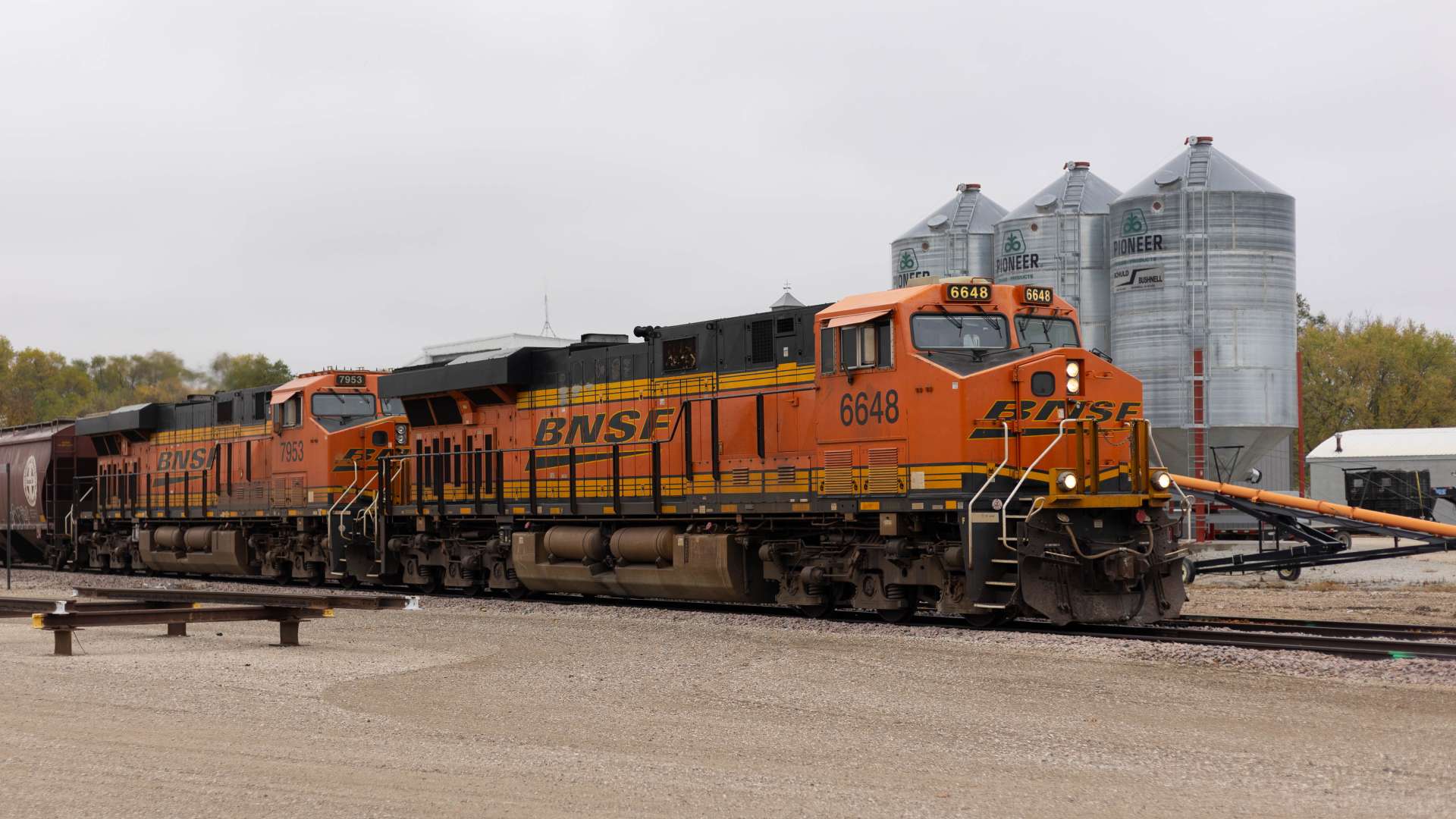
(Photo: Iowa Soybean Association / Joclyn Kuboushek)
Application oversight delays rail merger
January 22, 2026 | Bethany Baratta
The merging of Union Pacific Corporation and Norfolk Southern Corporation railroad companies is on hold as the Surface Transportation Board (STB) determined last week that the merger application was incomplete.
Announcement
The two companies announced the agreement to begin merger proceedings in July 2025, which would create America’s first transcontinental railroad. It would connect over 50,000 route miles across 43 states from the East Coast to the West Coast, linking approximately 100 ports and nearly every corner of North America.
What happened?
The STB determined that the application did not include sufficient analysis on the impact of the merger on competition. “The application does not contain future market share projections showing the combined effects of merger-related growth, diversions, and merger-influenced and other changes to market conditions that Applicants anticipate,” the STB said.
In their statement, the STB mentioned that the “Agreement and Plan of Merger” submitted by Union Pacific and Norfolk Southern did not provide the specific information that the STB will need to determine whether the merger would have a detrimental impact on competition.
So what?
The Code of Federal Regulations (49 C.F.R. § 1180.1(c), which provides guidance when reviewing railroad mergers, says the threshold needs to be met to allow a merger to proceed is not whether it will maintain competition, but whether it will enhance competition, notes Mike Steenhoek, executive director of the Soy Transportation Coalition (STC), who is closely monitoring the developments of the planned railroad merger. “Proving a merger will enhance competition is certainly a higher threshold to achieve,” he says.
Established in 2007, the Soy Transportation Coalition is comprised of 14 state soybean boards (including the Iowa Soybean Association), the American Soybean Association, and the United Soybean Board. The goal of the organization is to position the soybean industry to benefit from a transportation system that delivers cost effective, reliable, and competitive service.
Steenhoek says the proponents of the merger will also need to address how an actual merger will be the most effective way to increase rail network efficiency, rather than "other private-sector initiatives, such as joint marketing agreements and interline partnerships." Opponents of the merger contend that it is not necessary for a full and complete merger to occur to achieve a more efficient rail network. Rather, they believe increased efficiency can be achieved via greater collaborations and partnerships among existing railroads.
"Regardless of one's perspective on the Canadian Pacific merger with Kansas City Southern, the argument made by the two railroads at the time was that it would enhance competition by creating a new railroad – CPKC – that would have size and scale at greater parity to the other Class I railroads," Steenhoek says.
Revenue statistics from 2019—prior to the announced intention to merge – the Canadian Pacific and Kansas City Southern were by far the two smallest revenue-generating railroads of the seven Class I railroads. Even after merging, the combined revenues of the two railroads would still result in the CPKC being the smallest.
"The argument made by Canadian Pacific and Kansas City Southern was analogous to one explaining that there were five heavyweight boxers (i.e., the five largest Class I railroads) and two light heavyweight boxers (i.e., Canadian Pacific and Kansas City Southern). By allowing Canadian Pacific and Kansas City Southern to merge, the result would be a new sixth heavyweight boxer that could more effectively compete against the other five heavyweight boxers," Steenhoek says. "As a result, competition would be enhanced, not simply maintained."
Class I Railroad Annual Revenue (2019):
- BNSF Railway: $23.52 billion
- Union Pacific Railroad: $21.71 billion
- CSX Transportation: $11.94 billion
- Canadian National Railway: $11.42 billion
- Norfolk Southern Railway: $11.3 billion
• Canadian Pacific Railway: $5.97 billion
- Kansas City Southern Railway: $2.87 billion
Sources: 2019 annual reports of the above railroads
In contrast, annual revenue figures of the current six Class I railroads show how a merger of Union Pacific and Norfolk Southern would create a new company with annual revenue of $36.4 billion. To continue with the boxing analogy, Steenhoek says this would essentially create a new “super heavyweight” boxer that is significantly larger and at a competitive advantage to the remaining Class I railroads. The proponents and opponents of the merger will actively focus on the question of whether it will enhance competition or diminish it.
Class I Railroad Annual Revenue (2024):
- Union Pacific: $24.3 billion
- BNSF Railway: $23.4 billion
- CSX Transportation: $14.54 billion
- Canadian National Railway: $12.4 billion
- Norfolk Southern Railway: $12.1 billion
- Canadian Pacific Kansas City (CPKC) Railway: $10.4 billion
Sources: 2024 annual reports of the above railroads
NOTE: A Class I railroad has operating revenues of $490 million or more (Source: Federal Railroad Administration).
What about the rail shippers?
Some are supportive of the merger, some aren’t.
"Those who are supportive point to the prospect of increased fluidity and efficiency of rail service from one area of the country to the other as the rationale," Steenhoek says.
Agricultural shippers who oppose the proposed merger express how further consolidation in the rail industry will result in a reduction of competition among railroads and how this could result in increased rates and diminished service.
The fewer handoffs, the better
"Without question, it is a fundamental reality within supply chains that handoffs – whether between modes of transportation or providers of transportation – frequently result in additional costs. Freight does not like to be treated like a baton at a relay race. The fewer handoffs, the better," Steenhoek says. "Those who have long promoted consolidation between the eastern and western railroads have argued that eliminating these handoffs between one railroad and another will reduce costs and enhance marketing options for shippers. Certain agricultural shippers argue that eastern shippers will have augmented access to western markets and ports. Similarly, western shippers will have increased access to eastern markets and ports."
But competition is a good thing
"It is in the best interest of agricultural shippers to have as many transportation providers as possible – whether within a given mode of transportation or across modes – competing for their business," Steenhoek notes. "When the number of transportation providers decreases, the concern among many is that the balance between a railroad and rail customer will shift away from the customer and toward the railroad. The negotiating power of the rail customer, as a result, will diminish."
Now what?
The STB provided Union Pacific and Norfolk Southern an opportunity to respond by February 17 regarding whether they will refile the application. Union Pacific and Norfolk Southern are expected to do so. The revised application must be submitted no later than June 22, 2026.
"History also teaches that mergers and acquisitions within the railroad industry will inspire and motivate additional mergers and acquisitions," Steenhoek says. "This is an important context to view the potential negotiations between Union Pacific and Norfolk Southern."
He notes that if such a merger were to occur, the energy and momentum toward the remaining two U.S. based Class I railroads – BNSF and CSX – pursuing a merger would be considerable. This would ultimately result in two U.S. based Class I railroads with coast-to-coast service, he says. Many regulators, elected officials, labor unions, and railroad customers will regard this entire discussion as a “package deal” – i.e. the approval of one merger/acquisition among two railroads will inevitably result in the merger/acquisition of the other two. This will cause considerable concern among many rail customers.
"While BNSF has publicly expressed no intention to pursue a merger with CSX, pressure would undoubtedly increase for them, or another railroad, to pursue additional consolidation within the industry," Steenhoek says.
Written by Bethany Baratta.
Back