
(Photo: Iowa Soybean Association / Joclyn Kuboushek)
Get a head start on SCN management
October 29, 2026 | Kriss Nelson
As Iowa farmers wrap up a challenging harvest, soybean cyst nematode may not be top of mind. But fall is an ideal time to assess the pest and make management decisions for 2027.
“Fall is prime time for soil sampling,” says Greg Tylka, Iowa State University Morrill Professor and nematologist.
Despite the attention given to soybean quality concerns following a wet September, Tylka encourages farmers not to overlook SCN, a persistent threat to soybean yields.
“We don't want to forget SCN's out there. It's the Energizer Bunny. It's not going away. It's going to keep going and going,” he says.
Interestingly, September's wet conditions may have provided some relief. Tylka explains that SCN does not thrive in saturated soils, which may have limited activity and damage during the unusually wet month.
He recalls 1993, when widespread flooding contributed to declining SCN populations across much of Iowa. However, he cautions against assuming similar results this year.
“I'm not saying that's happened this year because it was really just September that was wet, but we probably suppressed a little bit of SCN activity and damage in September,” he says.
Sample now, plan for 2027
Tylka encourages farmers to sample harvested cornfields scheduled for soybeans next year.
Although sampling a cornfield for a soybean pest might seem counterintuitive, knowing SCN population levels before planting gives farmers time to select resistant varieties, evaluate seed treatments and consider rotation changes.
For fields with extremely high populations, Tylka says an additional year of corn may be worth considering.
He uses approximately 12,000 SCN eggs per half-cup of soil as a tentative threshold for considering that option, emphasizing that the number is his “educated guess” rather than an established cutoff.
Farmers can also sample harvested soybean fields this fall. Even if the fields are scheduled for corn in 2027, results of these samples may help explain disappointing soybean yields in 2026.
SCN is widespread but not present everywhere. Random surveys across three decades found the pest in about 70% of Iowa fields.
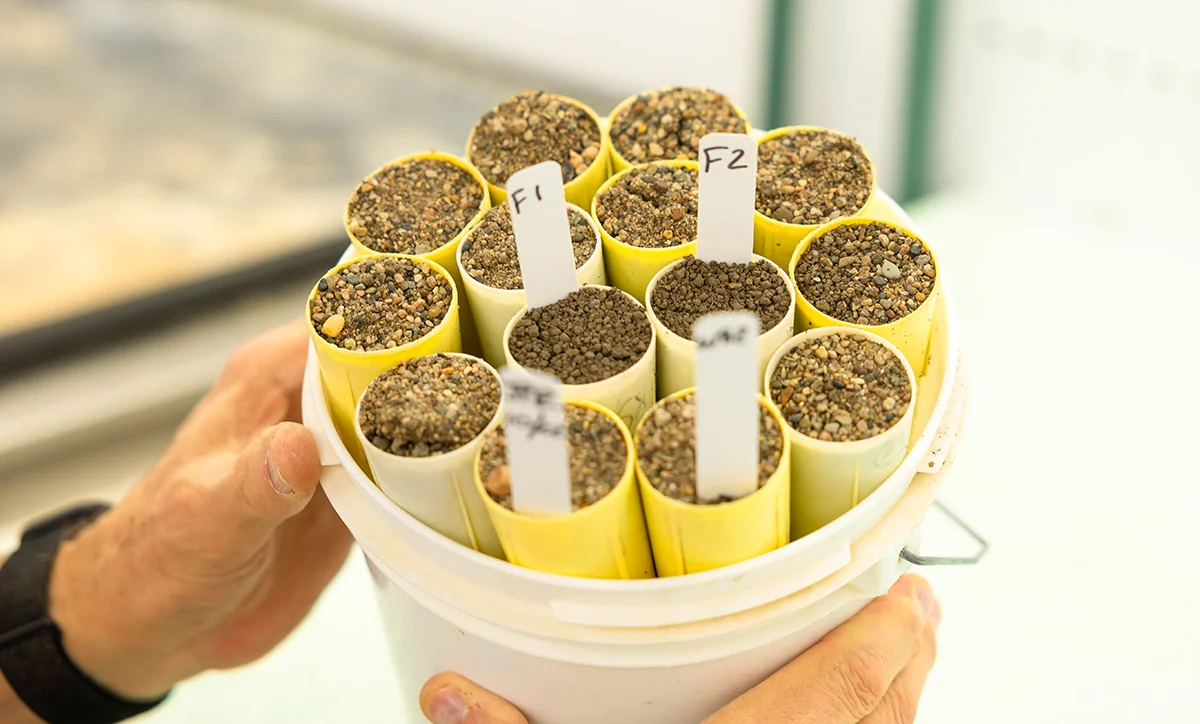
Soybean cyst nematode research at Iowa State University helps shape the recommendations in the updated SCN Management Guide, giving farmers research-based strategies to protect soybean yields and manage the pest.
“It's out there, but it's not everywhere,” Tylka says.
He encourages farmers to determine whether SCN is present and to monitor populations over time. For known infested fields, sampling approximately every third soybean crop can help evaluate whether management strategies are working.
“If it is present in the field, it's not a death sentence. You just got to manage it,” he says.
Farmers can submit samples to Iowa State University's Plant and Insect Diagnostic Clinic
or private soil-test laboratories. The SCN Coalition also maintains a state-by-state list of testing facilities.
An updated resource for farmers
Farmers have another tool available as they evaluate SCN management options: the sixth edition of the SCN Management Guide
The guide dates back to the late 1980s, when Tylka first encountered an early edition as a graduate student.
Since then, the resource has evolved through decades of soybean checkoff support. The latest edition received significant funding from the North Central Soybean Research Program and the United Soybean Board.
For Tylka, who has gone from studying the guide to helping write it, the evolution is particularly meaningful.
The sixth edition is the first available in both print and electronic formats. The digital version includes embedded videos, animations and links to additional resources, allowing farmers to explore topics in greater detail.
It also reflects changes in SCN research and management.
For decades, farmers relied primarily on crop rotation and soybean varieties with PI 88788 resistance. Today, varieties with Peking resistance provide another option.
Tylka maintains an annual list of SCN-resistant soybean varieties available in Iowa, supported by ISA checkoff funding. Approximately 22% of those varieties now offer Peking resistance.
The guide also expands its discussion of SCN seed treatments.
Tylka says seed treatments are an active area of product development, although ISA-funded research has demonstrated considerable variability in their performance.
He encourages farmers to learn about available products and evaluate how they perform under their own field conditions rather than assuming all treatments provide the same benefits.
Don't overlook winter annual weeds
Another topic receiving attention in the updated guide is the relationship between SCN and winter annual weeds.
Tylka says henbit, purple deadnettle and field pennycress can serve as hosts for SCN.
With some winter annual weeds becoming more common across Iowa and the Midwest, farmers may need to consider their potential role in supporting SCN populations.
Historically, cooler soil temperatures limited nematode activity during fall and early spring. Tylka says changing conditions make the relationship between these weeds and SCN worth monitoring.
That means weed control decisions could have implications beyond managing competition with crops.
Putting a price on SCN
The updated guide also connects farmers with the SCN Profit Checker.
SCN Profit Checker is an online calculator designed to estimate potential yield and financial losses associated with the pest.
The tool draws 23 years of data from approximately 35,000 research plots in Iowa, much of it funded by the Iowa soybean checkoff through ISA.
Farmers enter field-specific information, including SCN egg counts, soil pH and sand content. They can then add expected soybean yields and market prices to estimate potential financial losses per acre.
Tylka emphasizes that the calculator provides estimates, not precise predictions. However, it can help farmers better understand the economic implications of SCN and the value of managing it.
As farmers evaluate their fields this fall, Tylka says awareness remains the first step. Sampling provides the information needed to make informed decisions about resistant varieties, seed treatments and crop rotation.
Tylka says managing SCN requires attention, but that effort can pay off.
“It requires some attention, but the good news is you could reap some monetary benefits,” Tylka says.
Written by Kriss Nelson.
Back