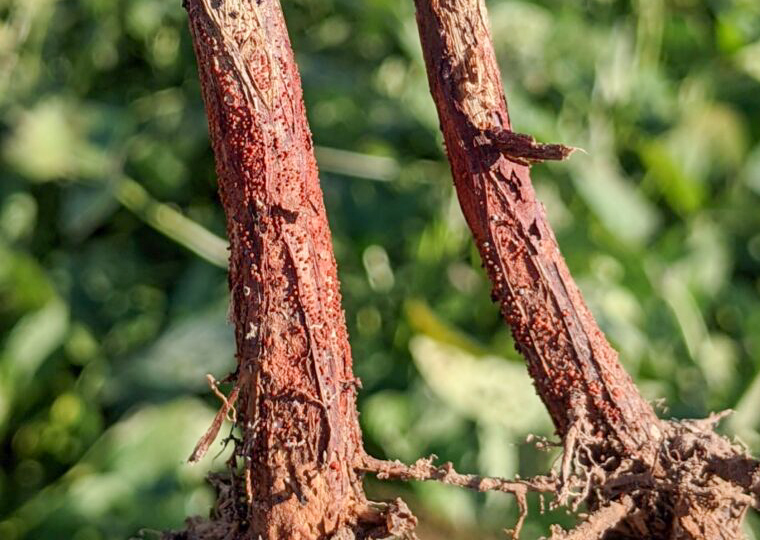
(Photo:Soybean Research & Information Network)
Could you mistake Red Crown Rot for SDS?
August 13, 2026 | Kriss Nelson
Red crown rot can reduce soybean yields by 40% to 60% under favorable conditions. Although the disease has not been confirmed in Iowa, researchers are encouraging farmers to learn about its warning signs and report suspicious plants.
Through a collaborative effort between the Iowa Soybean Association and the United Soybean Board, soybean checkoff dollars are helping farmers learn to identify the disease, report suspicious plants and stay one step ahead of an emerging threat.
“This is another example of how farmers’ checkoff dollars are being used to stay ahead of issues and prepare farmers,” says Joe McClure, chief officer of ISA’s Research Center for Farming Innovation. “We want to stay ahead of it, not react after it’s already here.”
Understanding RCR
Red crown rot is a soilborne fungal disease caused by Calonectria ilicicola that infects soybean roots, crowns and lower stems. Infection is favored by warm soil temperatures between 77 and 86 degrees and wet conditions during planting and early seedling development.
The disease has been confirmed in Illinois, Indiana, Kentucky, Minnesota, Missouri, Ohio and Wisconsin and has historically been present in the southeastern United States. Although it has not been confirmed in Iowa, researchers are still working to understand how it spreads, making early detection and reporting critical should it appear.
Farmers throughout Iowa, particularly in southeast Iowa because of its proximity to Illinois and Missouri, are encouraged to scout for the disease.
Look closer
One of the biggest challenges is that red crown rot closely resembles sudden death syndrome. From the road, symptoms in the field may look identical.
“Road scouting won’t work,” McClure says. “It looks like SDS, so farmers need to inspect plants, especially around the base of the stem. We want to identify it early and not assume it’s just another case of sudden death syndrome.”
Rather than relying on leaf symptoms alone, carefully dig suspect plants to preserve the roots and lower stem. Remove excess soil and inspect the crown near the soil line.
Look for tiny, brick-red, sphere-shaped fungal structures called perithecia on the lower stem near the soil surface and, occasionally, on the roots. Lower stems may also show maroon to brick-red discoloration. Because perithecia are not always present and can be difficult to see, laboratory testing is essential to confirm the disease.
Researchers encourage farmers to report suspicious plants. Every sample helps researchers better understand where the disease exists and how it may spread.
Collect a sample
If farmers suspect red crown rot, proper sampling is critical for an accurate diagnosis. Growers should collect whole plants and submit them for laboratory testing rather than trying to diagnose the disease in the field.
How to collect a red crown rot sample
When to sample: Scout fields from R1 through R6 when foliar symptoms first appear. Remember, the diagnostic red perithecia may not always be visible.
What you’ll need: A spade or soil knife, plastic bags (not paper), a permanent marker and shipping materials.
- Dig, don’t pull: Use a spade to loosen the soil to a depth of 6 to 8 inches around the plant, keeping the entire root system intact with soil attached.
- Collect three to five symptomatic plants from within or along the edge of the affected area.
- Document the field: Take photos of leaf symptoms, root discoloration and any visible red perithecia before bagging the plants.
- Bag samples loosely without adding water. Use one plastic bag per sampling area and remove excess air.
- Label each sample with the grower’s name, county or GPS location, collection date, soybean growth stage, variety and treatment history.
- Keep samples cool and ship promptly. Use ice packs if needed. Refrigerate overnight if necessary, but do not freeze. Ship samples within four days.
- Clean tools between fields and wash hands after handling samples to avoid spreading pathogens.
Get help
Farmers who suspect red crown rot do not have to identify it themselves.
ISA research agronomists can help inspect fields, collect samples and determine whether plants should be submitted for laboratory testing. Samples can also be sent directly to and confirmed through the Iowa State University Plant & Insect Diagnostic Clinic.
A completed submission form must accompany every sample. To preserve sample quality, avoid mailing samples on Thursdays or Fridays to prevent weekend delays. Photos of affected plants are encouraged and may be emailed with the submission.
For assistance or to submit a sample:
Contact Alex Schaffer, ISA research agronomy lead, at aschaffer@iasoybeans.com or 815-274-2998.
Or contact Daren Mueller, Iowa State University professor and extension plant pathologist, at dsmuelle@iastate.edu. Samples may also be delivered or mailed to the ISU Plant & Insect Diagnostic Clinic in Ames. The clinic accepts samples from 8 a.m. to 4 p.m., Monday through Friday, excluding university holidays.
“There is no need to panic,” McClure says. “Let’s keep ahead of it. Let’s look for it, but there’s no need to change your seed treatment program at this stage if you don’t have a problem.”
Written by Kriss Nelson.
Back