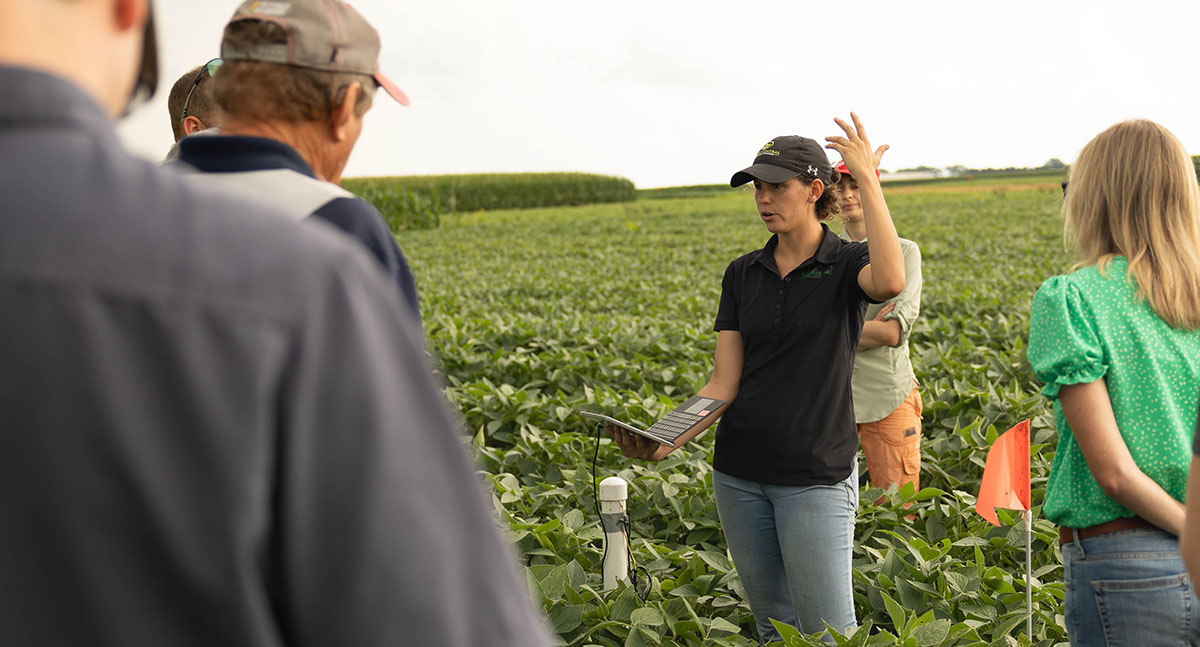
(Photo: Iowa Soybean Association / Joclyn Kuboushek)
Continuous soybean study challenges assumptions
May 14, 2026 | Kriss Nelson
Farmers and agronomists have largely viewed soybeans following soybeans as a system that carries a yield penalty compared to a traditional corn-soybean rotation. But early results from the Iowa Soybean Research Center in Ames suggest the penalty may be smaller than expected, or in some cases, not present at all.
Researchers recently provided an update on a multi-year continuous soybean project that is challenging long-held assumptions about soybean production systems.
The Iowa Soybean Association is a major funder of the Iowa Soybean Research Center through soybean checkoff dollars, supporting farmer-focused research tied to profitability, sustainability and production challenges.
ISA farmer leaders say the research center plays an important role in connecting farmers with the latest findings from checkoff-funded research.
“It is good to get updates on the products of Iowa Soybean Association-funded research,” says Jack Boyer, ISA at-large director.
The project is examining ways to optimize continuous soybean production while maintaining profitability and environmental performance.
Sotirios Archontoulis, Ph.D., ISU agronomy professor and lead investigator on the study, says the project started by asking about the potential yield penalty of continuous soybeans.
Now we don’t see a penalty, and we’re trying to understand why,” Archontoulis says.
Trial design
The research began in 2023 at ISU research farms near Boone and Sutherland following soybean production in 2022. Researchers compared multiple systems, including a standard corn-soybean rotation, continuous soybeans in 30-inch and 15-inch rows and continuous soybean systems incorporating cereal rye cover crops and manure applications.
ISU graduate researcher Carolina Freitas says the project was driven by shifting market conditions and changing economics on the farm.
“The expansion of soybean crush capacity across Iowa and the Midwest, combined with periods of high nitrogen fertilizer prices and lower corn profitability, created interest in whether soybeans could become a lower-cost alternative in certain years,” Freitas says.
Freitas noted that literature suggests continuous soybean systems incur a yield penalty of 7% to 13%. But, after four years of data collection, researchers have yet to find statistically significant yield losses in the Iowa trials.
“We were surprised,” Freitas says. “So much is said about the penalty and the expectation of increased disease pressure after planting soybeans after soybeans, but we really have not observed that.”
ISA At-Large Director Jack Boyer says the findings stood out to him as well.
“I thought it was interesting they were not finding a significant yield drag and disease prevalence,” he says.
In some cases, researchers observed slight yield advantages when narrowing row spacing or incorporating cereal rye cover crops and manure into the system.
System impacts
Researchers also monitored soybean cyst nematode populations, which were expected to be one of the largest contributors to potential yield loss in continuous soybean systems.
While SCN counts increased somewhat in continuous soybean plots, ISU Nematologist Greg Tylka, Ph.D., says levels remained relatively low overall.
“The encouraging thing is that the numbers (of SCN populations) didn’t continue increasing over the years of the study,” Tylka says.
The project also evaluated environmental impacts, including soil moisture dynamics and nitrogen losses.
Researchers found little difference in seasonal water use between continuous soybean systems and corn-inclusive rotations. Nitrogen losses, however, were significantly lower in continuous soybean systems, especially when cover crops were included.
“When we included cereal rye, we were able to reduce nitrogen losses even further,” Freitas says.
Profitability picture
Using simulation modeling and Iowa product cost data, researchers found the traditional corn-soybean rotation still generated the highest overall profitability under average conditions.
However, continuous soybean systems offered lower production costs and could become more competitive during years of elevated nitrogen prices or tighter corn margins.
“The strength of the system is really the lower cost structure,” Freitas says. “In difficult years, planting soybeans a second or even third year may help some farmers manage through tougher margins returning to rotation.”
Challenging assumptions
Archontoulis says the findings are prompting researchers to revisit some long-standing assumptions within agronomy.
“I think it’s healthy to question some of the standards we’ve accepted for years,” he says. “Management has improved. Genetics have improved. And may continuous soybean systems are not as risky as we once believed.”
Researchers caution that long-term concerns remain, including possible declines in soil organic matter and weed management challenges associated with repeated herbicide use.
For now, researchers are not suggesting farmers abandon corn-soybean rotations entirely. Instead, they see continuous soybeans as a possible short-term management option during periods of difficult economics.
“Farmers shouldn’t necessarily be thinking of 10 straight years of soybeans,” Freitas says. “But in tighter financial years, this system may provide another tool to help maintain profitability.”
The continuous soybean project is currently funded through 2027.
Written by Kriss Nelson.
Back