(Photo: Iowa Soybean Association / Joclyn Kuboushek)
Can an autonomous sprayer save time and reduce inputs?
August 3, 2026 | Kriss Nelson
As labor challenges, rising input costs and efforts to optimize crop protection product use continue to shape agriculture, a new trial in eastern Iowa is evaluating whether autonomous technology can help farmers do more with less.
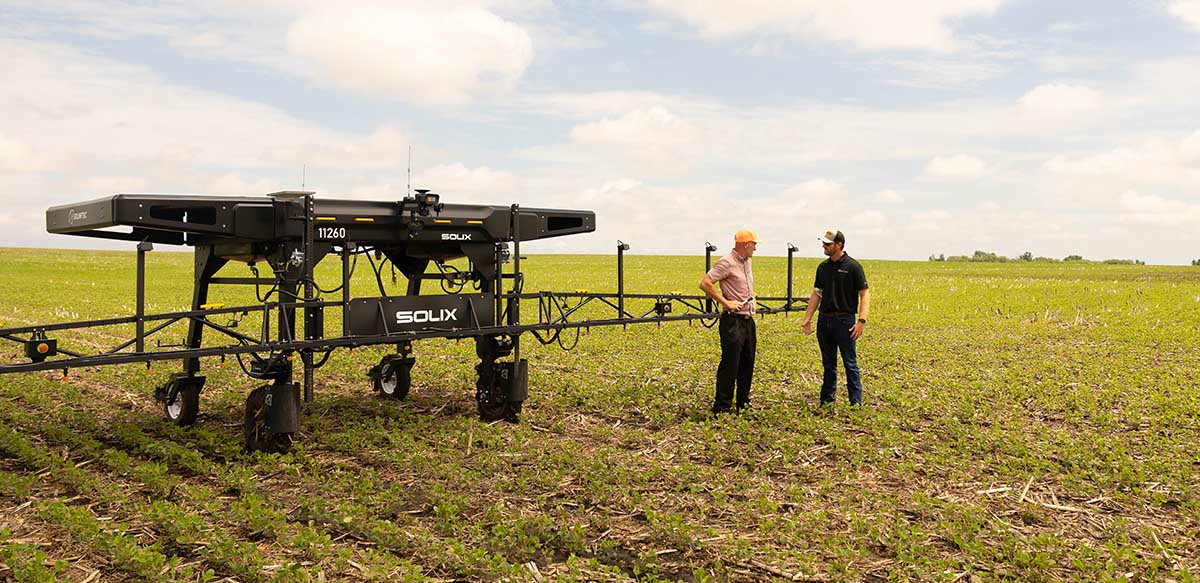
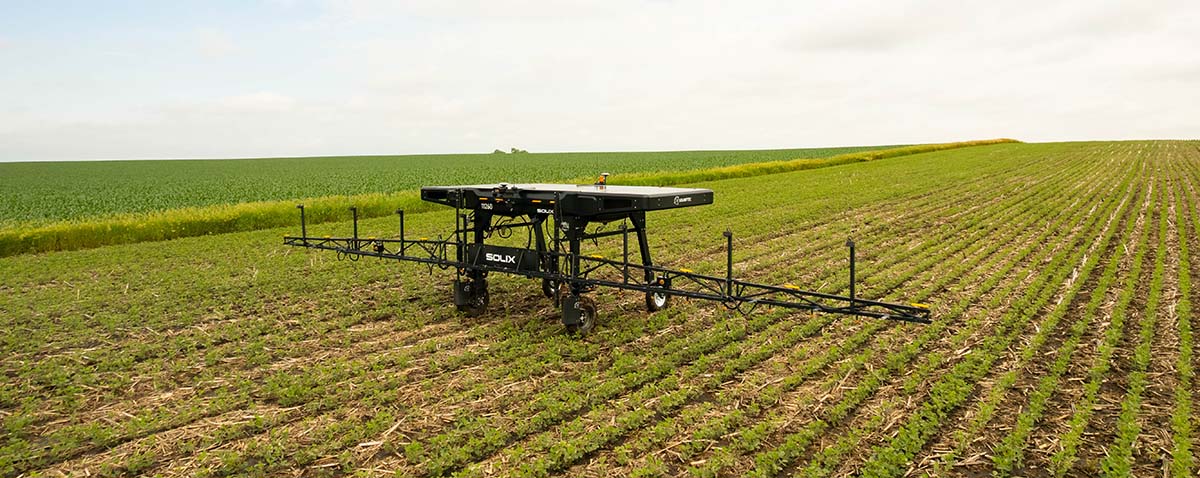
The Iowa Soybean Association’s Research Center for Farming Innovation is partnering with Solinftec and the Dierickx family near DeWitt to evaluate the Solix autonomous sprayer, a solar-powered platform capable of scouting fields, identifying weeds and making targeted herbicide applications.
Saving time
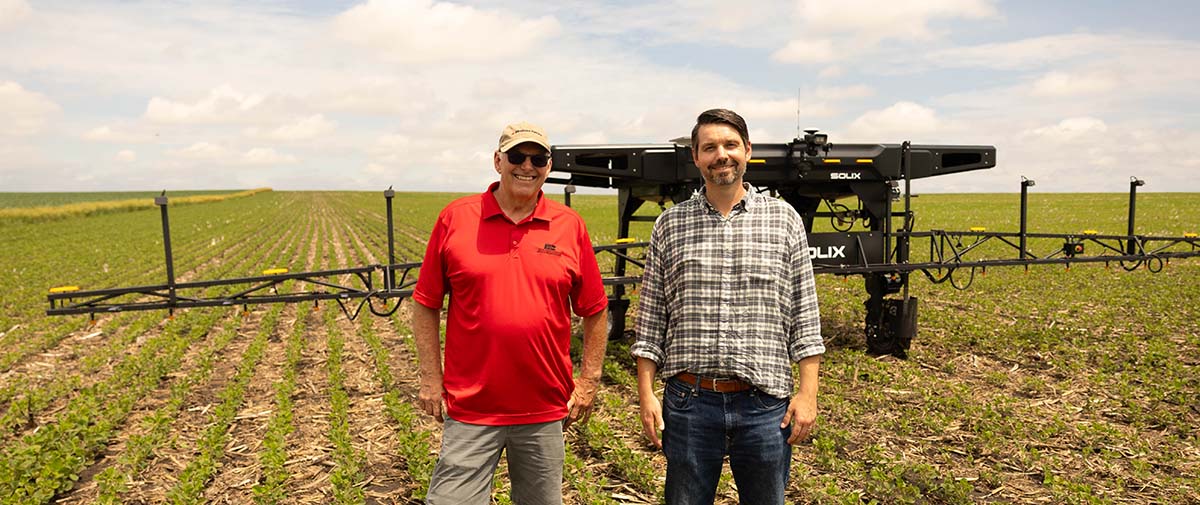
For ISA Farmer Member Scott Dierickx, the trial offers an opportunity to explore technology that could help address one of his biggest challenges: time.
As a young farmer balancing a full-time job, a growing farm operation and family responsibilities, Dierickx says efficiency is critical.
“I don't have a large enough farm base to farm full time right now, so I’m splitting my time between my job, farming, my wife and our four children,” Scott says. “If a technology like this can help save time while I’m at work, that’s something I’m interested in.”
In the trial, Solix will be compared with the farm's conventional spraying program. Researchers will evaluate chemical use, weed control and crop yields throughout the season.
“If this can help save time and reduce chemical usage, that’s a win,” Scott says. “I’m excited to see how much product can be reduced compared to our conventional strategy.”
One unexpected benefit has been the amount of scouting information generated by the system. Equipped with cameras and artificial intelligence, the platform continuously monitors crop development and field conditions.
“Having the system out there collecting information on plant emergence and growth is something we’ve never really tracked before,” Scott says. “It's helping provide data that can be useful as we continue to fine-tune planting populations and management decisions.”
Putting it to the test
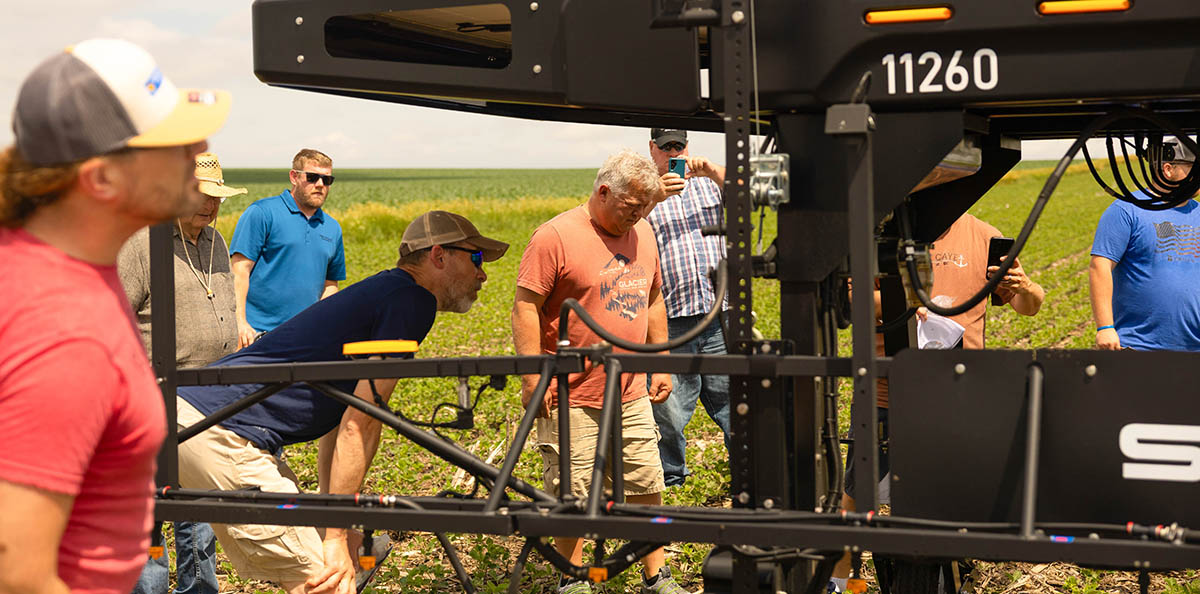
The trial is taking place in a 150-acre soybean field. While the Solix platform scouts the entire field, approximately 50 acres arranged in four strips are being managed by the autonomous system for weed control.
Using cameras and AI, the platform identifies weeds and applies herbicide only where needed. Lucas De Bruin, ISA research agronomist, says ISA’s role is to independently evaluate the technology under Iowa growing conditions.
“We’re ground truthing what the system is reporting,” De Bruin says. “We're looking at the stand counts, weed detection and scouting reports to make sure it’s performing as expected and providing accurate information to farmers.”
Preliminary observations have been encouraging. Through midseason, the system had treated only a small percentage of the targeted acres while maintaining weed control. Early data indicated reductions in herbicide use of 90% to 95% compared with a conventional broadcast application, though final results will be evaluated after harvest.
More than spraying
For Scott's father, Joe, the trial represents another step in a long history of adopting new technology on the farm.
Joe was among the early farmers selected to test AutoTrac guidance systems when John Deere first introduced automated steering technology. What he once said that seemed revolutionary is now commonplace across agriculture.
“Look at how widely adopted it is today,” says Joe. “People hardly farm without it anymore.”
That experience gives him confidence that autonomous equipment could follow a similar path.
“I can see a lot of potential in what the Solix robot-scout sprayer can do,” says Joe. “The exciting part is there will be uses we haven't even thought about yet.”
Joe also sees potential for the technology to address concerns about pesticide use by applying products only where they are needed.
“Farmers are under a lot of scrutiny when it comes to chemical use,” he says. “This is a tool that could potentially reduce the amount of chemistry applied per acre, and that's something consumers can appreciate while still allowing us to use the tools we need to grow crops.”
From scouting to spraying
The Solix platform itself evolved from conversations with farmers, according to Taylor Wetli, U.S. commercial and business development manager for Solinftec.
“The first Solix robots were designed as autonomous scouting units that could live in the field and continuously monitor crop conditions,” Wetli says. “As the technology matured, growers began asking, ‘If the robot can find the weeds, why can’t it treat them too?’ ”
That question led to the development of the Solix autonomous sprayer, which was unveiled in 2022, piloted commercially in 2023 and expanded into broader commercial use in 2024.
Wetli acknowledges that some farmers remain cautious about autonomous equipment but says skepticism is common when new technology is launched.
“Farmers are still making the agronomic decisions,” Wetli says. “Solix simply handles repetitive tasks like scouting and targeted spraying, allowing the operation to cover more ground with less labor and fewer inputs.”
De Bruin sees potential for the technology to improve efficiency while collecting valuable field data throughout the season.
He notes that current limitations remain, particularly around acreage capacity and broadcast applications. However, he sees autonomous systems as another tool farmers may eventually add to their management toolbox.
“I don't think this replaces everything,” De Bruin says. “But for targeted herbicide applications and collecting field data throughout the season, there's a lot of promise.”
Looking ahead, Wetli envisions autonomous platforms performing a growing number of field tasks while collecting data throughout the season.
“Instead of managing fields acre by acre, we’ll increasingly manage them plant by plant,” he says. “Solix is helping move agriculture in that direction.”
Written by Kriss Nelson.
Back