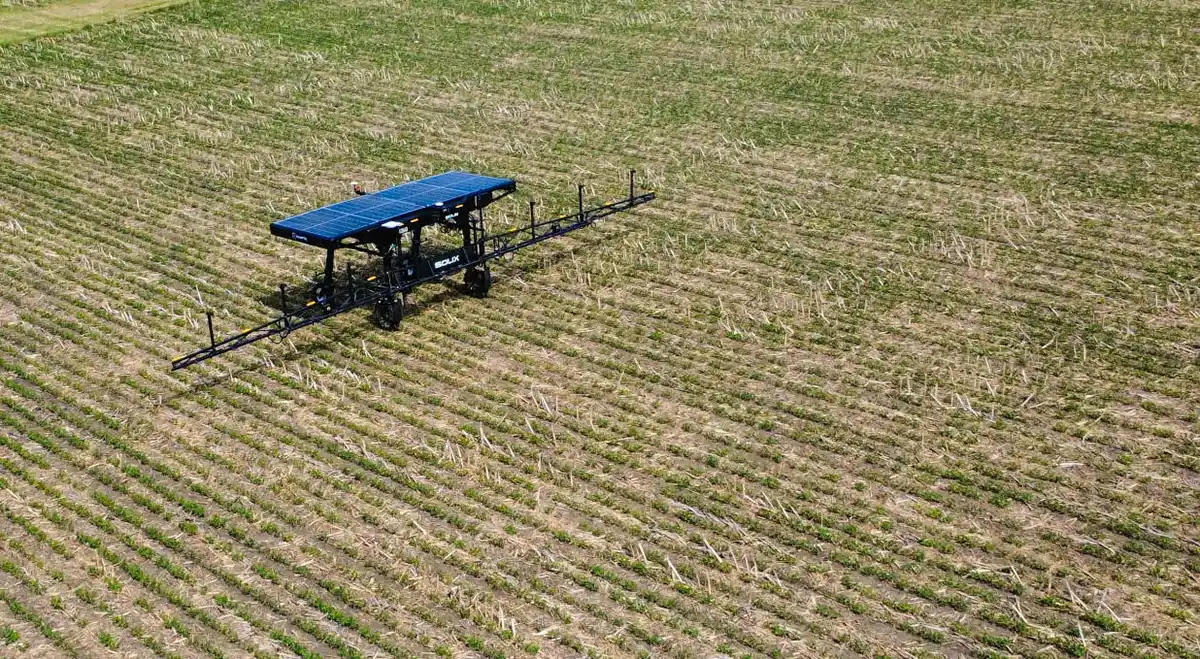
(Photo: Iowa Soybean Association / Lucas De Bruin)
Walking Rows: Weeds, nitrogen and crop progress
June 4, 2026 | Kriss Nelson
Warm temperatures and mostly favorable field conditions have crops growing rapidly across Iowa, but Iowa Soybean Association research agronomists say now is not the time to get complacent.
As farmers wrap up planting and replanting efforts, attention is shifting to sidedress nitrogen applications, postemergence weed control and scouting for early-season insect pressure.
From managing residual nitrogen and herbicide performance to monitoring moisture conditions and weed escapes, ISA research agronomists say timely decisions in the coming weeks could have a significant impact on crop performance throughout the season.
Alex Schaffer – Central Iowa
Crops across central Iowa are moving fast, and growers are making the most of this dry weather to knock out early-season fieldwork.

Here in district 5, corn is sitting between the V1 to V4 growth stages, and the furthest along soybeans are currently opening their third trifoliate. Soil moisture remains in a good spot, and with rain in the forecast, there isn't much to complain about.
Maximize your nitrogen
Late-season nitrogen testing is critical.
Right now, regional focus is shifting toward sidedress nitrogen and post-emergent herbicide applications on corn, while gearing up for post-emergent applications on soybeans.
If you are trying to manage your N supplies right now and want the most bang for your buck, I would highly recommend running a Late Spring Nitrate Test (LSNT) before making your sidedress application.
Two major factors make the LSNT a massive opportunity to save on input costs this year:
- High soil mineralization: thanks to warm temperatures and ample soil moisture, we are on track to see high N mineralization rates from the soil. You can monitor N mineralization here.
- High residual levels: residual soil nitrogen levels from last year were both high and highly variable from field to field.
Because fields vary so drastically this season, blanket recommendations won't cut it. Getting a real-time snapshot of plant-available nitrogen right now will prevent you from overapplying and burning money. For a deeper dive, check out the ISU Extension LSNT Guide.
Soybean post-application best practices
As you gear up for soybean post-emergence applications, maintaining high efficacy is all about management. I teamed up with my colleague at Iowa State University, Wes Everman, to put together this quick checklist of best practices to keep in mind before you head to the field:
1. Weather is Key
- Beat the heat: hot, dry weather makes post-herbicide applications much more challenging. Target weeds when they are still small and tender.
- Humidity is your friend: high humidity drastically improves control, which is especially true when running glufosinate.
2. Resistance management
- Mix and layer: use multiple modes of action. PPO herbicides remain highly effective against waterhemp in our area.
- Never skip the residual: if a field is currently clean, you can save some money on your contact herbicides—but do not cut the soil-applied residual. Remember: the easiest weed to kill is the one that never emerges.
3. Mixing order, adjuvants, and surfactants
- Condition water first: hard water will negatively impact your herbicide's efficacy. Always condition your water before adding product.
- Use a surfactant: utilize a crop oil or surfactant, especially during hot, dry stretches. Extreme heat causes weeds to develop a thick, waxy cuticle that is incredibly difficult to penetrate without a surfactant.
4. Application timing
- Avoid peak heat: spray early in the morning or later in the evening to reduce crop stress and ensure weeds are actively taking up the herbicide.
- Don't wait for a second flush: aggressive weeds like waterhemp grow rapidly. If you wait around for the next flush of weeds to emerge, the ones already standing will get too large to kill effectively.
- Watch the label: if you are applying Dicamba on soybeans, strictly follow all regional and calendar label restrictions.
Shane Beck – Northeast/Northern Iowa
It is beginning to feel a lot like summer with the much-needed heat over the last week or so. The crops are really starting to grow and take on a nice green color.

The early-planted soybeans are anywhere from V1 to V4, with some of the later-planted ones approaching V4. The corn is anywhere from V2 to V6, depending on when and where it was planted. I have noticed some variable emergence in both the corn and soybeans across the region.
With the crops beginning to take off, so are the weeds. I have been in several fields over the last week where a significant number of little weeds are beginning to emerge through our preemergent herbicide.
With most of the preemergent being applied 4-6 weeks ago, we are now starting to see the end of their effectiveness.
As the post-pass occurs over the next couple of weeks, it is important to scout for the weeds most prevalent in your fields before applying herbicides, in case any changes are needed before that application.
The most prevalent weeds I have observed so far have been velvet leaf and some grass species. As we get deeper into June, we will see more waterhemp emerge, as that weed emerges a little more slowly.
Craig Woods – Northwest/West Central Iowa
Last week, with plenty of growing degree days, corn that established well should be off to a great start and should help out replants that need a bit more help, provided they still had enough moisture. Most corn I have seen is at the V3-V4 stage, with most beans at the V1-V2 stage, depending on planting date.

My biggest concern has been the weeds taking advantage of the same GDD as corn. While out scouting, I saw some redroot pigweed and some green foxtail.
As for insect pressure, I personally saw very little; however, Iowa State's ICM Blog has been tracking black cutworm moths in Plymouth and Buena Vista counties, so scouting will still be your best tool to inform management decisions before yield reductions start adding up.
Recently, I saw a lot of post passes go down when the wind cooperated. Post-emergence and targeted applications, along with good conditions, will pay dividends later in the season.
Most post-emergence applications perform best around 65 to 85 degrees. Most weeds can be managed effectively with post passes, provided they are under 4 inches in height.
After weeds become more established, they often develop more growing points or store more reserves to aid in survival. Spraying during temperature inversions also increases the likelihood of spray drift, especially. Iowa State has published material on pesticide label temperature inversions to help identify possible clues and conditions.
This upcoming week is expected to have hit-or-miss rain, which might help fields in northwest Iowa, which are still abnormally dry. Keeping an eye on the weather and conditions will be a key factor in the efficacy of your herbicide this spring.
Lucas DeBruin – Southeast/Eastern Iowa
Crops across much of my area continue to progress; however dry conditions are beginning to affect some fields. Early-planted soybeans are generally at the V3 to V4 growth stage, although development has slowed in some areas as soil moisture becomes more limited. A timely rain would help support continued crop growth and development. Most planting and replanting activities have wrapped up. Replant situations were largely tied to challenging conditions earlier in the season, including rainfall shortly after planting, followed by less-than-ideal emergence conditions.

Weed pressure is becoming a growing concern as temperatures warm and crops continue to emerge. Stay ahead of postemergence applications and avoid letting weeds become too large before treatment. Timely applications remain critical for effective control and protecting yield potential.
For growers using Liberty-based herbicide programs, environmental conditions play a major role in performance. Warm temperatures, bright sunshine and adequate humidity are important for maximizing activity. Agronomists often recommend following the "150 rule" for Liberty applications, meaning the air temperature and relative humidity should combine to total at least 150 for optimum performance.
Light insect feeding is beginning to appear in both corn and soybean fields. While feeding levels remain relatively minor, farmers should continue scouting and monitoring fields to identify developing pest issues before populations reach economic thresholds.
Outside of row crops, first-cutting hay progress has been favorable in many areas. Dry weather around Memorial Day allowed for good curing conditions, resulting in high-quality hay for many producers.
Join us next Tuesday, June 9, for the autonomous sprayer field day, from 10:30 a.m. to noon at the Joe Dierickx Home Farm, 2352 220th Street, DeWitt, IA 52742.
You will hear about an on-farm research trial using the Solinftec Solix autonomous sprayer, as well as a discussion with the ISA Research Agronomy Team and the Solinftec team about other opportunities on your farm.
Avreeanna Tweedy – Southwest/South Central Iowa
Planting is largely complete across southwest and south-central Iowa. However, a few growers have recently wrapped up replant acres after stand evaluations identified areas affected by emergence issues, ponding, and other field-specific challenges.

Recent stretches of drier weather have allowed producers to make good progress on post-emergence herbicide applications, sidedress nitrogen applications and other field activities.
Over the past couple of weeks, I've spent much of my time conducting stand counts and scouting research trials throughout the region. Overall, crop stands have looked good, but variability persists in areas that experienced prolonged wet conditions, crusting or other emergence challenges.
Soybean growth stages range from VE-V2, while corn growth stages generally range from V1-V5, depending on planting date and location.
With warmer temperatures over the past week, crop growth has noticeably accelerated across much of the region. Many growers have been taking advantage of favorable field conditions to complete herbicide and fertilizer applications before the next round of rainfall expected later this week and into early next week.
As crops continue to develop, stand counts are helping provide a clearer picture of establishment and emergence across fields following a spring marked by variable weather conditions.
This is also a good time for growers to scout fields for early-season disease, insect activity, and weed pressure as crops continue to progress.
Compiled by Kriss Nelson.
Back