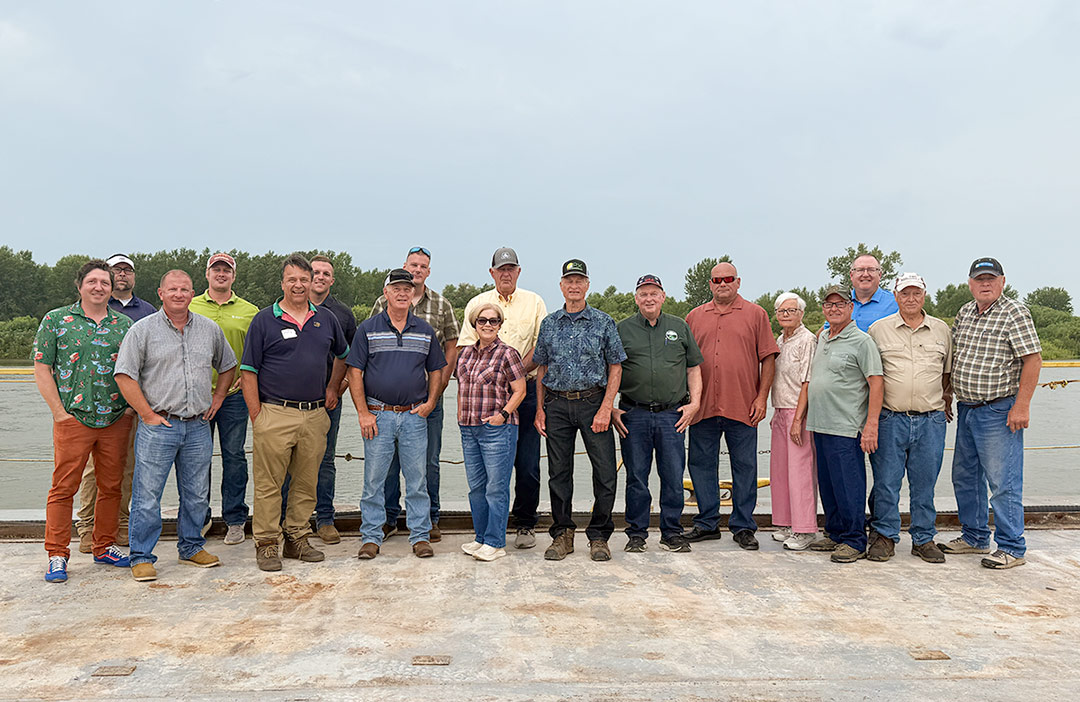
Experience Class 2026 Participants at the NEW Coop Port of Blenco (Photo: Iowa Soybean Association / Emma McGathy)
Iowa farmers went behind the scenes of the soybean industry
August 6, 2026 | Kriss Nelson
Before climbing aboard the bus for Iowa Soybean Association's Experience Class, Jayson Edge thought he had a general understanding of the association.
Three days later, after seeing firsthand how farmer investments support research, conservation, communications, transportation and renewable fuels, the Humboldt farmer left with a much broader understanding of the organization's work on behalf of Iowa soybean farmers.
“It truly was a first-class event,” Edge says. “Overall, I was just really impressed with the organization as a whole more than any one stop.”
Giving farmers an opportunity to see their investment at work is exactly what Experience Class is designed to accomplish.
Behind the scenes
Held each summer, the three-day program gives ISA farmer-members an inside look at the people, partnerships and projects supported by their soybean checkoff.
“The Experience Class provides farmers with a behind-the-scenes look at how their checkoff investments are put to work,” says Emma McGathy, ISA producer services coordinator. “By connecting with industry leaders and learning more about the soybean value chain, participants leave with a better understanding of where their checkoff dollars go and the impact it has.”
The tour began at ISA headquarters, where participants heard from former ISA president Rob Ewoldt and current ISA president Tom Adams about serving on the ISA Board of Directors and representing Iowa farmers at the national level.
Matt Herman, ISA chief officer of demand and advocacy, followed with a discussion about advocacy efforts and how farmer input shapes ISA priorities.
From there, the group traveled to Syngenta, where participants learned about seed technology and breeding and saw how industry partnerships support soybean research. Syngenta serves on the Industry Advisory Council for the Iowa Soybean Research Center, which ISA co-leads with Iowa State University, to help guide farmer-driven research priorities.
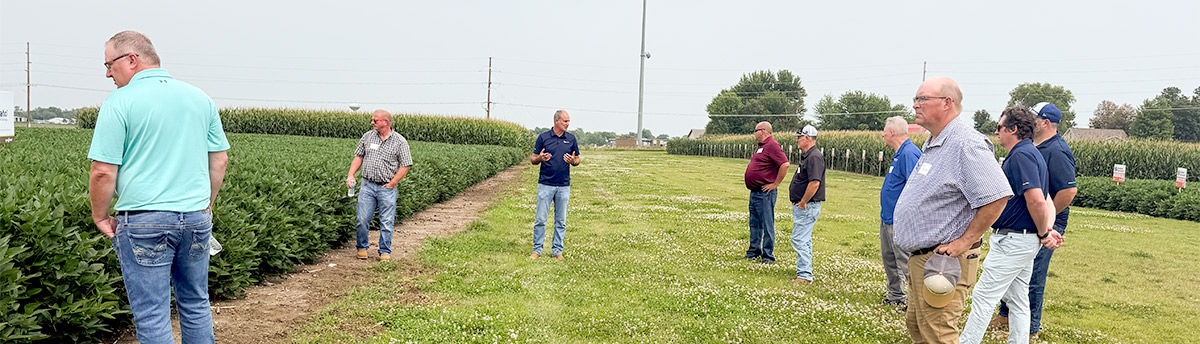
(Photo: Iowa Soybean Association / Emma McGathy)
Edge says the stop offered a behind-the-scenes look most farmers never experience.
“The technology they're bringing into their seed production is pretty interesting,” he says.
Beyond the bus
The following day demonstrated just how broadly soybean checkoff investments reach.
At Sigler Printing in Ames, participants watched the production of publications such as the Iowa Soybean Review and Fresh Pickings, gaining a behind-the-scenes look at how ISA shares research findings, policy updates and farmer stories with producers across the state.
At ISU’s Veterinary Diagnostic Laboratory, they learned how soybean checkoff investments extend beyond crop production.
ISA supports partnerships that strengthen Iowa's livestock industry through animal nutrition research, market development and new uses for soybean meal.
“As a former livestock producer, that one really stuck out,” Edge says.
Field perspectives
One of the tour's most impactful days brought participants to Nick Helland’s farm near Madrid, where a wetland served as the backdrop for an ag broadcasting and conservation field day featuring longtime WHO Radio farm broadcaster Bob Quinn, ISA CEO Kirk Leeds and ISA conservation and research staff.
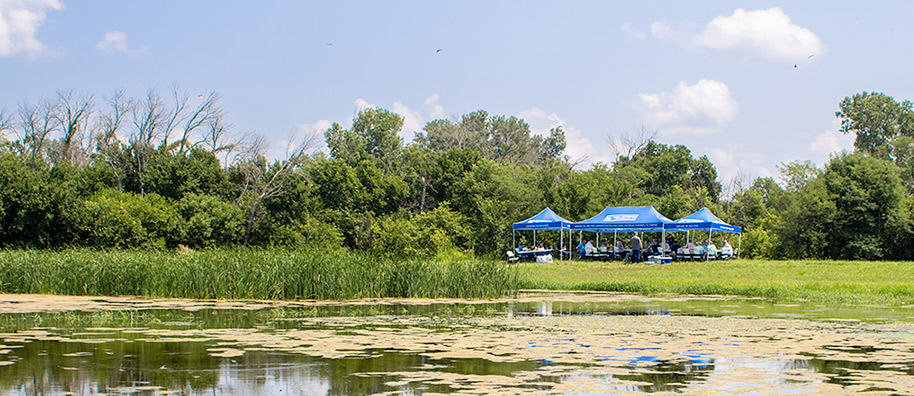
(Photo: Iowa Soybean Association / Rebekah Jones)
Quinn encouraged farmers to become better storytellers and advocates for agriculture.
“A lot of times the reporters just don't know what to ask,” Quinn says, reminding participants that sharing their experiences helps consumers better understand modern farming.
Participants also heard from ISA conservation services manager Brandon Iddings and research agronomist Shane Beck, who used the Helland family's decade of experience with cover crops and strip-tillage to demonstrate how farmer-driven research and conservation practices can improve profitability while protecting natural resources.
Leeds challenged farmers to think beyond today's crop and consider agriculture's role in improving water quality, emphasizing that ISA has worked alongside farmers for decades to identify practical, science-based conservation solutions.
“As much progress as we have made over the last few years, the reality is that we must do more,” says Leeds. “There are things that every farmer can do to help us make progress and ISA is here to help.”
That practical approach resonated with Edge.
“Some of the conservation practices farmers can implement can be very extreme or very, very easy,” he says. “It was nice having that explained.”
Just as important for Edge was learning how ISA conducts research. What impressed him most was ISA's commitment to independent, farmer-driven research.
“They're going to publish the data, good, bad or ugly,” he says. “That's really hard to find.”
That philosophy reflected what participants saw throughout the day at Helland Farm, where years of on-farm experimentation have helped shape conservation decisions based on experience rather than assumptions.
McGathy says that realization surfaced repeatedly in participant feedback.
“A lot of people don't necessarily know about the vast network of research agronomists we have at ISA,” she says. “Several participants shared that they planned to reach out to their area agronomist after learning more about the expertise and support available to help inform decisions on their farms.”
Driving demand
The tour also highlighted the partnerships that help move soybeans beyond the farm gate.
At the Port of Blencoe, participants learned how investments in river infrastructure improve transportation efficiency and strengthen export opportunities for soybean meal.
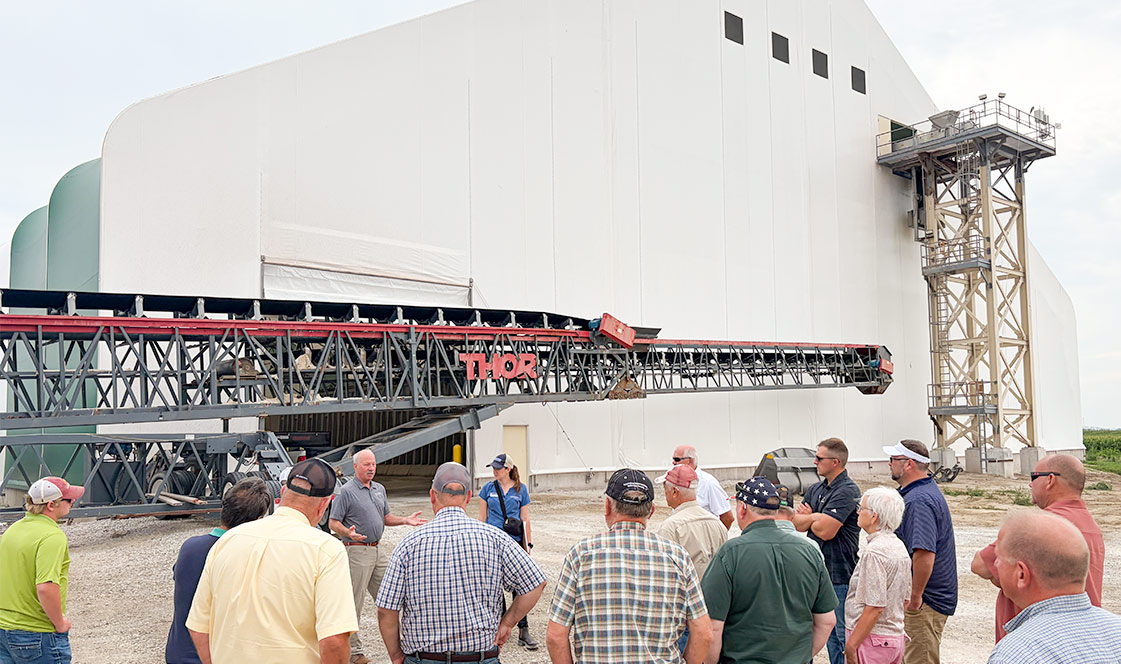
(Photo: Iowa Soybean Association / Becca Ahrendsen)
The final stop at Western Iowa Energy connected those markets to renewable fuels.
Participants toured the biodiesel facility while learning how soybean oil creates additional demand for Iowa soybeans and how organizations like the Iowa Biodiesel Board, founded in part by ISA, continue expanding biofuel opportunities.
Edge acknowledged that the discussion around biofuels and tax policy became technical at times, but he appreciated seeing how expanding crush capacity, soybean meal exports and renewable fuels fit together.
Building connections
The networking was another unexpected benefit. Farmers exchanged ideas throughout the trip, discussing agronomy, conservation practices and management decisions while building connections that continued well beyond the bus ride.
“It was great to meet them and hear their practices,” Edge says. “We got to bounce different ideas off each other.”
For McGathy, that's another measure of the program's success.
Beyond helping farmers understand where their soybean checkoff dollars are invested, Experience Class equips them with relationships, resources and knowledge they can take home to their own operations.
For Edge, it also changed how he views the organization representing Iowa soybean farmers.
“I've never seen anything like that,” he says. “I'm really interested in becoming more involved with ISA.”
Written by Kriss Nelson.
Back