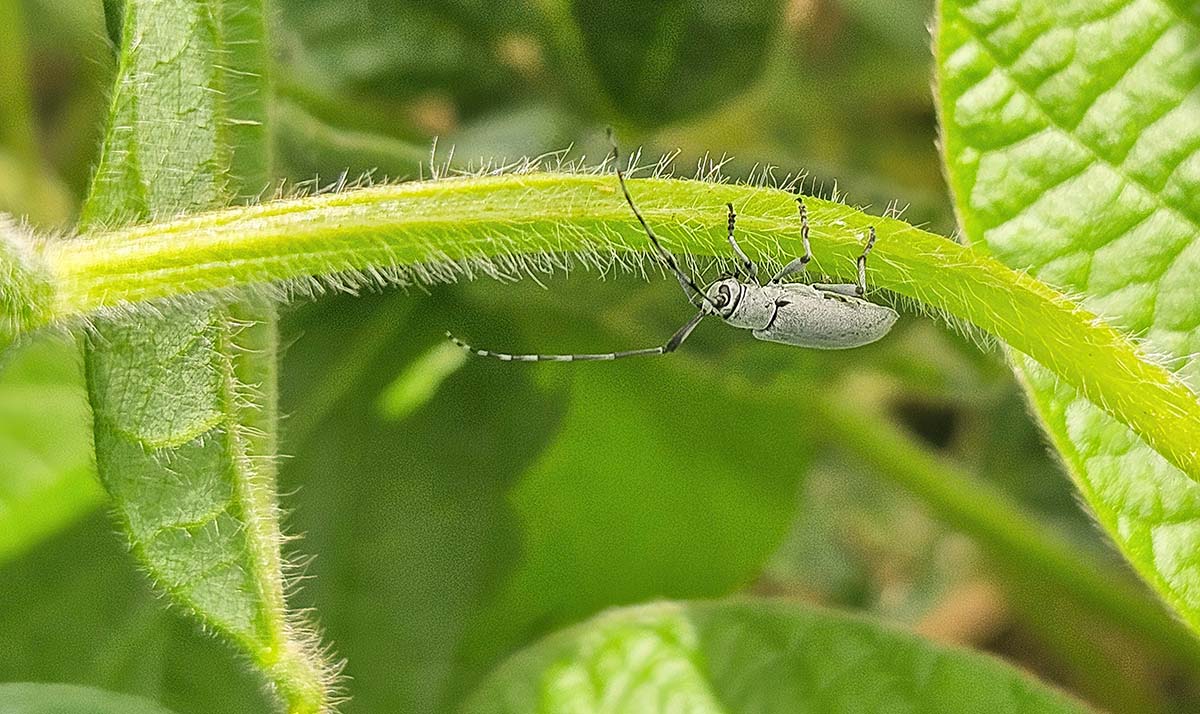
Dectes Stem Borer (Photo: Iowa Soybean Association / Craig Woods)
Walking Rows: Scouting pays off
July 16, 2026
With corn and soybeans rapidly transitioning into critical reproductive phases across Iowa, early signs of disease and insect pressure are beginning to emerge. Iowa Soybean Association agronomists stress the importance of scouting fields right now to ensure any costly fungicide or insecticide applications are economically justified by actual field conditions.
Alex Schaffer – Central Iowa
Corn and soybeans in central Iowa are quickly transitioning into the reproductive phase. The coming weeks are the most critical window for your investment. The goal right now is keeping a healthy canopy to capture sunlight while managing any pests or diseases that want to steal the resources your crop has worked hard to produce.
With corn at R1 across much of District 5 and soybeans nearing R3, we are at the critical window for fungicide and insecticide decisions.

Before you pull the trigger on an application, scout your fields. Our research at the Iowa Soybean Association shows an average yield response of 2 bushels per acre when a fungicide/insecticide is applied in the absence of disease. With $10 beans, you need 3.5 bushels just to break even on the product and application cost. Scouting ensures you only spray when the pressure justifies the expense.
What to scout for right now
- In soybeans: Check for spider mites, aphids, Frogeye leaf spot, and Septoria brown spot.
- In corn: Watch for gray leaf spot, northern and southern corn leaf blights, and tar spot (though the current hot, dry weather should reduce tar spot risk).
- A note on Southern rust: While there is some chatter about it, remember that this pathogen does not overwinter in Iowa. It must blow up from the south every single year. Having a problem with it last season does not mean you are at a higher risk this summer. Keep an eye out, but don’t panic. Southern rust also prefers wetter conditions than what we are experiencing right now.
The Crop Protection Network has some great tools available to help farmers and agronomists make more informed decisions when it comes to making pesticide applications. They offer regional crop disease reporting, disease severity estimation tools, and a localized crop risk tool. I find these resources incredibly helpful when trying to think objectively about whether a fungicide and/or insecticide application will pay off. You can find them here.
Bottom line: With tight margins, every input needs to earn its keep. Protecting the canopy is vital during reproductive stages, but making a defensive application without scouting is a tough way to chase a profit. Keep your boots in the dirt this week and spray only where the pressure justifies the cost.
Shane Beck – Northeast/Northern Iowa
Weather continues to be an issue across the state with heavy rains and strong storms causing problems to some fields. The large amount of rain that was received last week has caused flooding and erosion issues across central and northeast Iowa. Some fields especially along flooded rivers have will not recover from the excess water in the field for a significant period.

As we get into the reproductive phases for both corn and soybeans, this is a critical time to be scouting for diseases in both corn and soybeans. There have been several drones and helicopters that I have seen spraying corn last week. We’ll continue to see more as we progress through the growing season. The optimal times to spray corn are the VT to R1 stage whereas on soybeans it is optimal to spray at R3. Soybean disease scouting is critical due to the lack of disease presence year to year and the lack of significant plant health benefit. Results from last year’s research shows no significant difference in yield between untreated and fungicide plots when no disease pressure was present in a field. In fields where there was disease pressure present, we did see some positive yield results due to a fungicide application.
Last week, I also had an opportunity to dig some roots in one of our soybean seed treatment trials. In this trial we are comparing Syngenta’s new seed treatment product called Victrato. This trial compares this product against the farmer’s standard seed treatment.
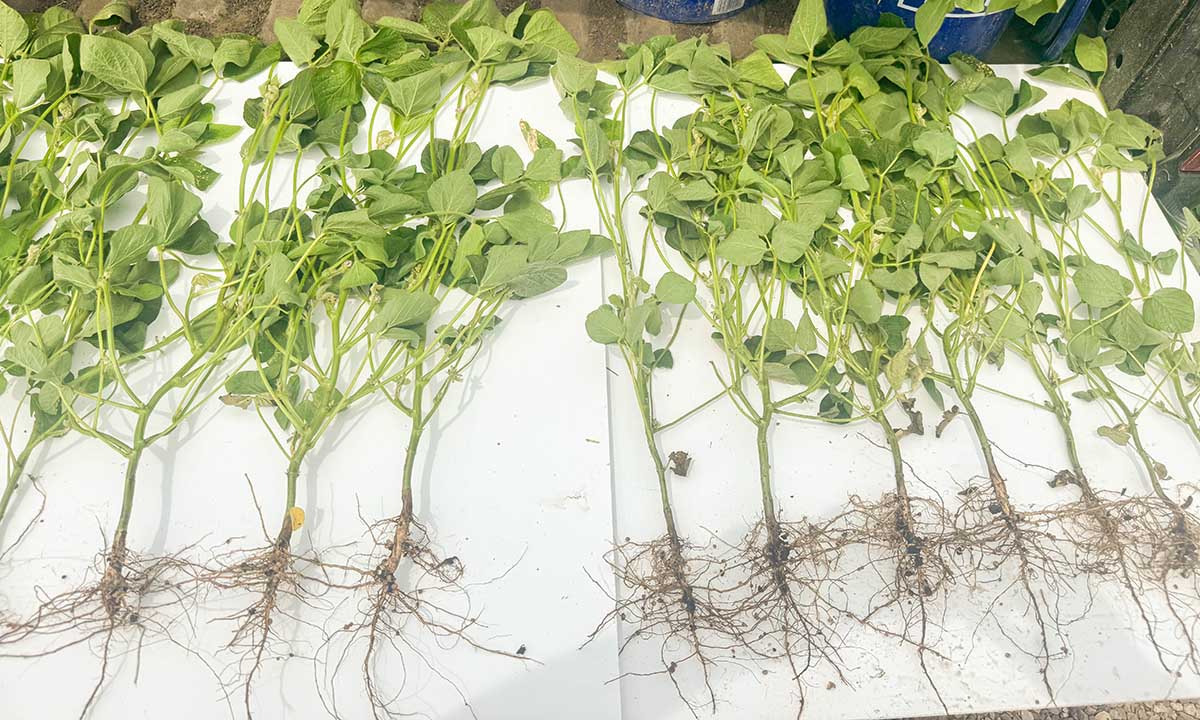
Standard Treatment (left) and Victrato Treated (right)
After looking at the roots comparing the two treatments, I did see some differences in the roots. The Victrato treated plants did have more root hairs than the non-Victrato plants did. We will see if that translates to yield, and how fields in this trial fare with disease pressures, especially SDS, as the season progresses.
Craig Woods – Northwest-North Central Iowa
Soybeans and corn are developing well with plenty of sunshine. Currently soybeans are around the R1-R3 stages and canopies are beginning to close if they haven’t already. Corn ranges from the Late V stages to R2 and is certainly enjoying this warm and sunny weather. Currently getting consistent and timely rains is a large concern going forward especially as we get into grain fill.

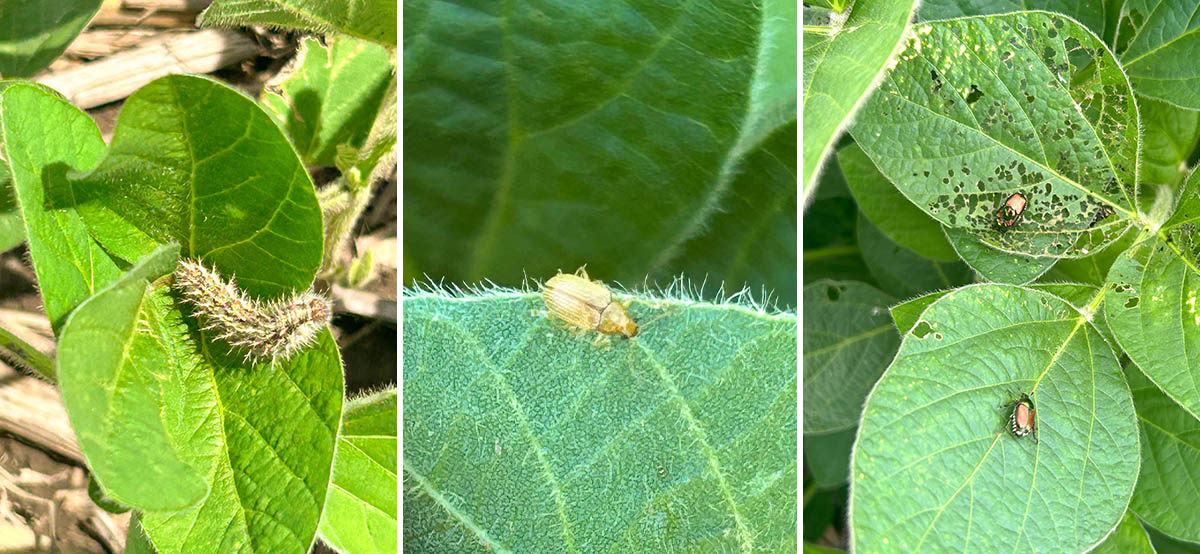
This week I saw plenty of planes and ground rigs applying fungicide and insecticide. While pressure has been relatively light, scouting will be the best way to catch a population early before it reaches economic threshold. The main pests that I’ve seen have been Japanese beetles, dectes stem borers, and colaspis beetles. While some of these insects don’t reach economic injury level, often it is still treated on a case-by-case basis.
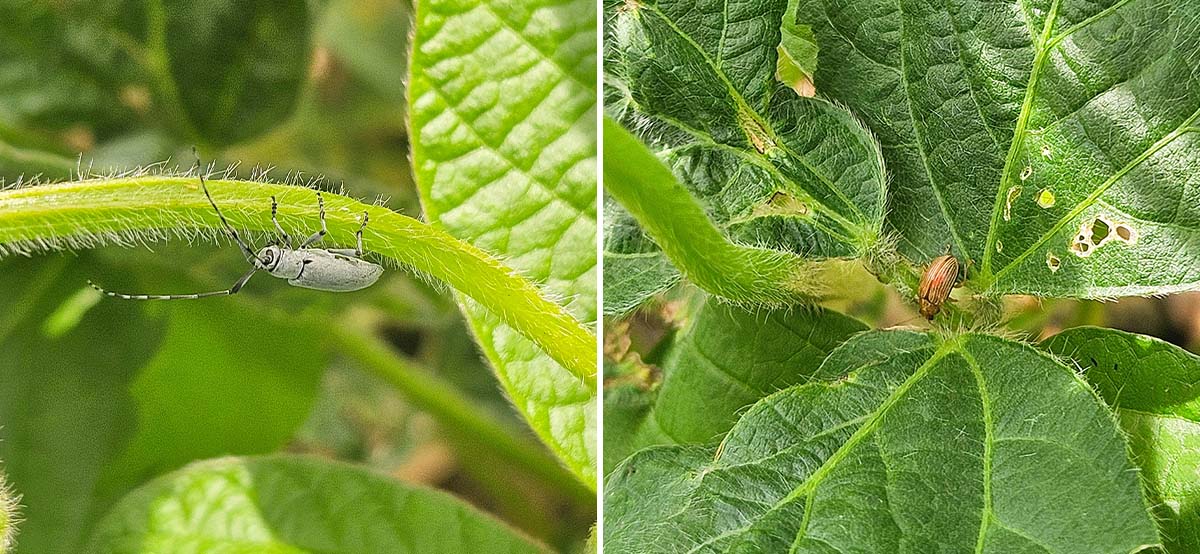
Dectes Stem Borer (left) and Colaspis Beetle (right)
When it comes to fungicide applications it is important to consider disease pressure and susceptibility of the variety as it is possible that applying a fungicide might not pay on a resistant variety. While fungal and disease pressure has been relatively low, we are still early in the season and there have been reports of tar spot, northern corn leaf blight, and bacterial leaf streak in D1 and D4. While out scouting it will be important to recognize what pathogen is causing an issue and what methods of control will work as using a fungicide on a bacterial disease will have no effective control.
Evan Brehm – Southeast/Eastern Iowa
Traveling last week in various areas I noticed the first tasseled field of corn in central Iowa. That same day, a yellow biplane startled me flying over Highway 30 in Tama County. Corn in Eastern Iowa varies in staging, especially low-lying areas and along the river corridors. Some of this was replanted back in late May and have struggled with the excess moisture and now more recently nitrogen deficiency. Overall, we are reaching late vegetative stages and now entering VT and/or R1.

Growth stages on soybeans have been noted from V8-R1 with two early planted fields at R3. With the rainfall this season, large pockets of yellowed soybeans indicate wetter soils which could drag down top end yield potential. However, now with hot and humid conditions, these yellow pockets have turned for the better. However, this can also present potential disease pressures.
We cannot control Mother Nature, but what we can manage is the health of our row crops from now until harvest. This comes in the form of scouting your fields.
Pests
Japanese beetles have been reported but nowhere near the 20% defoliation threshold. The main area I have noticed them is while doing water routes and along fence rows. Continue to monitor them going forward. Spider mites enjoy hot and dry weather. Although we haven’t had the “dry” part of that yet, these hot conditions can change that quickly.
Diseases
Tar spot has been in Districts 6 and 9 for the past 7-8 years. I have had ag retailers report tar spot as early as last week. Southern rust was an issue in 2025 and caused yield drag. Many seed dealers this past winter encouraged planting resistant varieties. No Southern rust has been reported that I am aware of. But it will be something to keep an eye on.
Cover crops
We continue to see the benefits of cover crops in terms of better herbicide efficacy and even reducing the amount of money for that application. I see this on the post emergent programs as crops, specifically grass species (cereal rye/winter wheat) reducing waterhemp pressure by year 2 or 3.
Cover crop termination is gaining traction of later applications. The reason is for moisture retention, longevity of the cover crop itself to maximize the full soil health benefits and weed suppression. Earlier terminated cover crop fields are showing flushes of waterhemp and giant ragweed. Although, soybeans are a full stage ahead of soybeans that were planted green. Later terminated cover crop fields have two things growing out there: soybeans and slowly dying cover crops.
I am sure this has happened in the past, and I’d love to hear your results, but for the first time on their operations, two long term cover crop farmers mowed off cereal rye as a form of termination. One of them followed up with an herbicide application a few days later while the other farmer waited two weeks. I have yet to notice a significant difference between the two fields in District 6. What I can say is that stand emergence wasn’t hindered compared to their other fields. Mowing was used as they were concerned with the wet weather this early season. Weed pressure is little to none.
We had a great turnout in Buchanan County for one of two “Shop Talks” in the area. Area farmers and ISA were welcomed to Sean Dolan’s shop where a town hall style meeting was held. Area farmers and ag retailers attended. Sean discussed his farming operation and how cover crops are planted on 100% of his acres. Sean serves as the current Conservation Districts of Iowa president and is an ISA member. Thanks, Sean for hosting! There will be another “Shop Talk” in Homestead at Amana Farms on July 21. RSVP today!
Conservation in Action was a self-guided tour in both East and West Central Iowa. Although it has concluded, these fields are still available if you’d like to see various methods of adding conservation to your acres. Let Alex or Evan know if you’d like to see what cover crops this time of year look like in corn/soybeans or edge of field practices. Be sure to visit Big Grove Brewery in Cedar Rapids for “Beer for Water” as they are donating $1/pint sold to the Iowa Agriculture Water Alliance! They have supported our Eastern Iowa Conservation in Action tour along with hosting a future event in 2027.
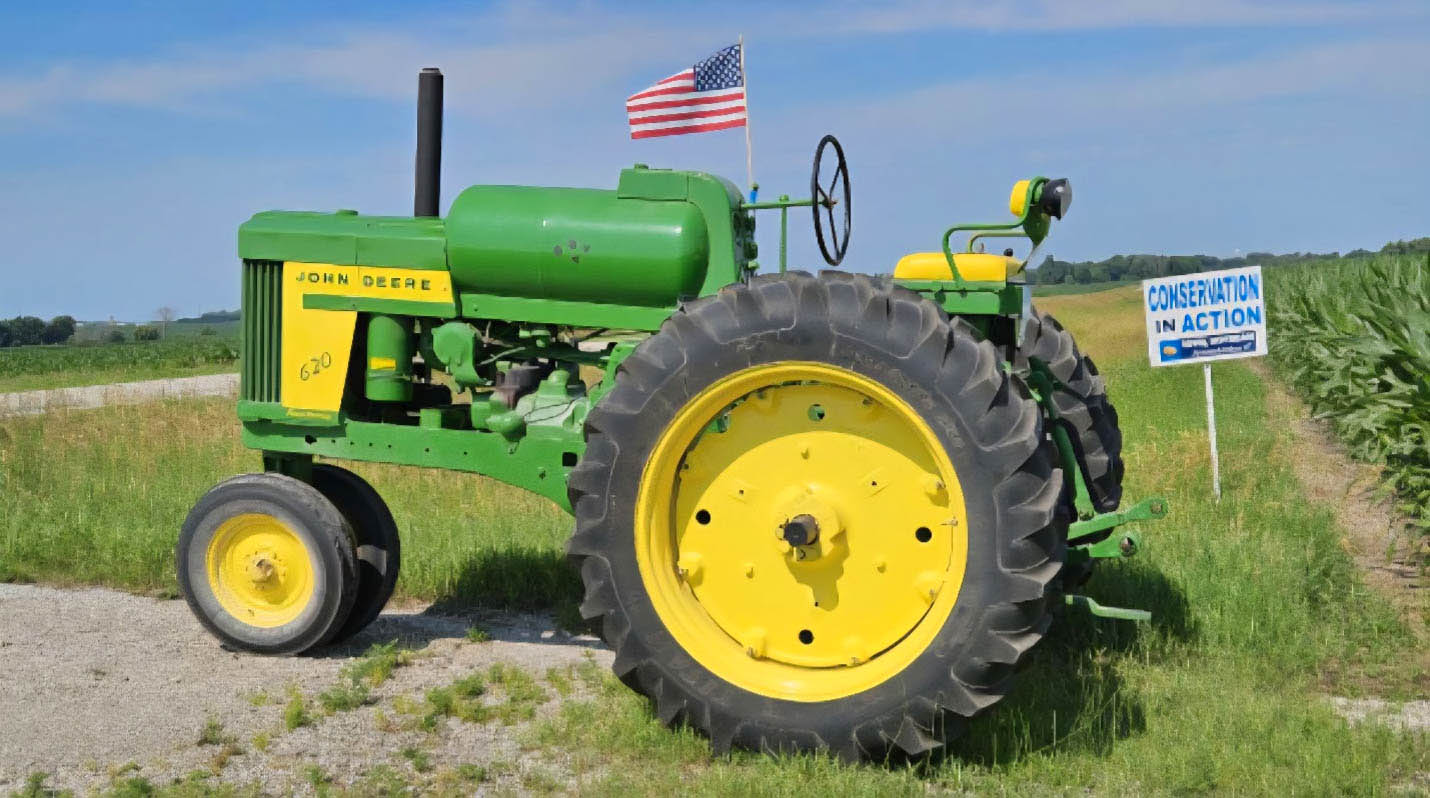
John Deere tractor sits next to a Conservation in Action field site on July 4 in Benton County
Avreeanna Tweedy – Southwest/South Central Iowa
Field activity across southwest and south central Iowa has shifted fully into in-season crop management as corn and soybeans continue to progress rapidly. Corn ranges from the late vegetative stages into R2, with some growers beginning early fungicide applications. Soybeans are generally between R1 and R3, while most post-emergence herbicide applications have wrapped up except in later-planted fields.

With recent warm temperatures and adequate moisture, now is the time to prioritize field scouting. As crops continue to develop, I'm beginning to see more disease activity in the field. Bacterial leaf streak, northern corn leaf blight, and gray leaf spot have all been observed in corn, while Septoria brown spot and bacterial blight have been found in soybean fields. Disease pressure has generally remained low, but continued warm, humid conditions could favor further development, making routine scouting important.
Insect activity has also increased across southwest Iowa. Japanese beetles are becoming more common, grasshopper populations are increasing, and both western and northern corn rootworm beetles have emerged. Isolated thistle caterpillar feeding has also been observed in soybean fields, though overall insect pressure has remained low, with minimal defoliation observed in most fields.
What to watch: Scouting is key right now. Take the time to walk fields, dig plants to evaluate root health, and monitor for insect feeding and disease development. Conditions can vary significantly from field to field, making routine scouting one of the most valuable management tools this time of year.
Compiled by Bethany Baratta.
Back