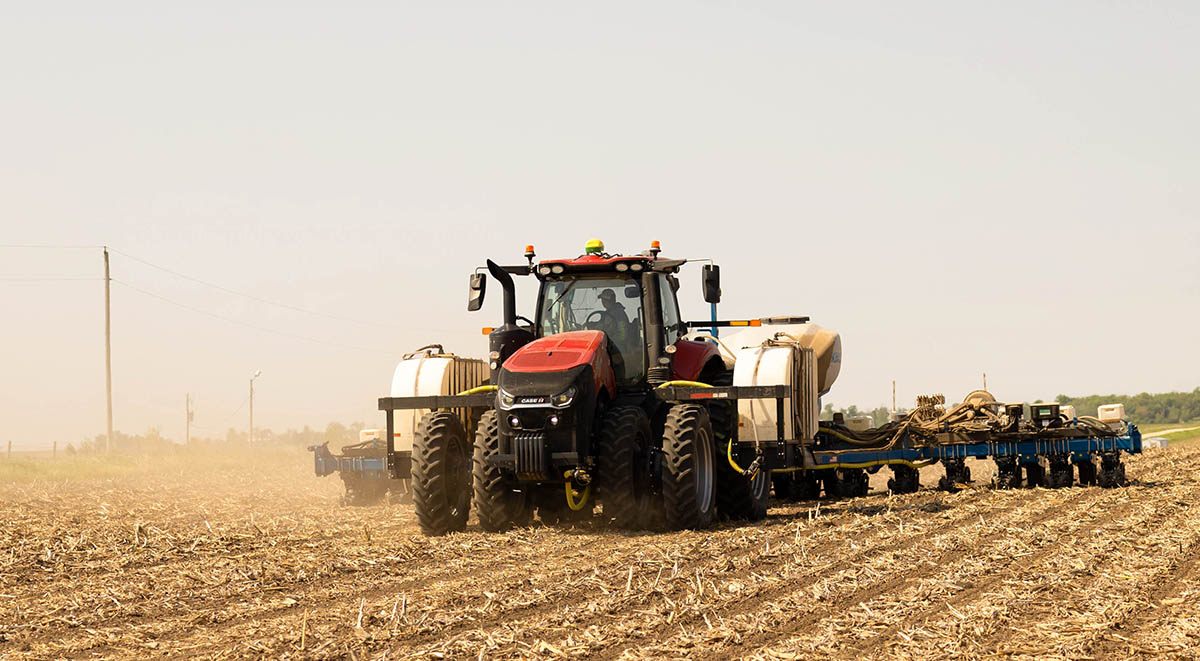
(Photo: Iowa Soybean Association / Joclyn Kuboushek)
Victory in Europe: Parliament blocks measure penalizing U.S. soy
July 9, 2026 | Bethany Baratta
U.S. soybean farmers aren’t tearing out rainforests in favor of growing soybeans. That’s a fundamental difference between soybeans sourced here and soybeans sourced in other areas of the world. And it’s one of many factors that ought to be recognized when the European Parliament decides how it values and sources soy of various origins to meet its renewable energy targets, the Iowa Soybean Association noted in comments with the American Soybean Association and the U.S. Soy Export Council on an EU proposal recently.
Industry groups push for region-specific ILUC standards
The comments urged the European Parliament to consider the regional differences in soybean farming as it sought to classify soy as a “risky” feedstock for biodiesel due to its perceived indirect land-use change (ILUC) score. The EU is the third largest export market for U.S. soybeans, importing $2.12 billion in U.S. soy in 2025, according to the USDA’s Foreign Agricultural Service.
“Country-level data on soy expansion into high-carbon-stock land in the Phase 2 report show that the vast majority of expansion is concentrated in South America, with Brazil accounting for 53%, Argentina 23%, Bolivia 17%, and Paraguay 5%. Together, these countries represent 98% of total expansion, leaving only 2% attributable to the rest of the world,” the groups said. “This distribution clearly illustrates that ILUC risks for soy are highly region-specific and underscores the need for regional differentiation rather than a global crop-based classification.”
Lumping global soy production together asserts that soybeans are grown on the same landforms using the same methods for planting, growing and harvesting and therefore should be assigned the same carbon intensity score. This simply isn’t the case, the groups added.
European Parliament rejects high-risk soy classification
The European Parliament acted on these concerns. In a 388-248 vote earlier this week, the European Parliament rejected an act that would have classified soy as a high-risk feedstock due to its ILUC score, which would have effectively phased soybean oil out as a biodiesel feedstock as the EU seeks to meet its renewable targets by 2030.
“The vote is an important outcome for U.S. soybean farmers and the broader soy industry, helping preserve market opportunities for soybean oil while reinforcing the importance of science-based policies that recognize the sustainability of U.S. soybean production,” says Josh Rahm, ASA director of government affairs.
Flawed methodology overlooked U.S. farming practices
The act would have been detrimental to U.S. soybean farmers and value chain operators, the groups said. It would also have had negative consequences for European soybean production and crushing industries.
Additionally, the groups noted, the science and methodology used to assess the various feedstocks were flawed. A review of the methodology revealed that improvements in production efficiency (like growing more soy on fewer acres) would not have lowered the calculated ILUC score due to the fixed productivity factors used in the draft assessment.
“Their analysis against soy was typical and flawed. It failed to account for what was going on in the U.S. and assumed all soybean production (and expansion) looked like Brazil,” says Matt Herman, ISA chief officer of demand and advocacy.
Decision builds momentum for future sustainability policy
U.S. soy’s engagement in this issue paid off and builds momentum for making the case for soy in other programs in the EU, United Nations and North America, Herman notes.
“This is the first time crops have had a victory in European biofuel policy in a long, long time. The EU sets the tone globally on sustainability issues, so what happens there tends to ripple outward.”
Written by Bethany Baratta. Brock Johnston contributed to this article.
Back