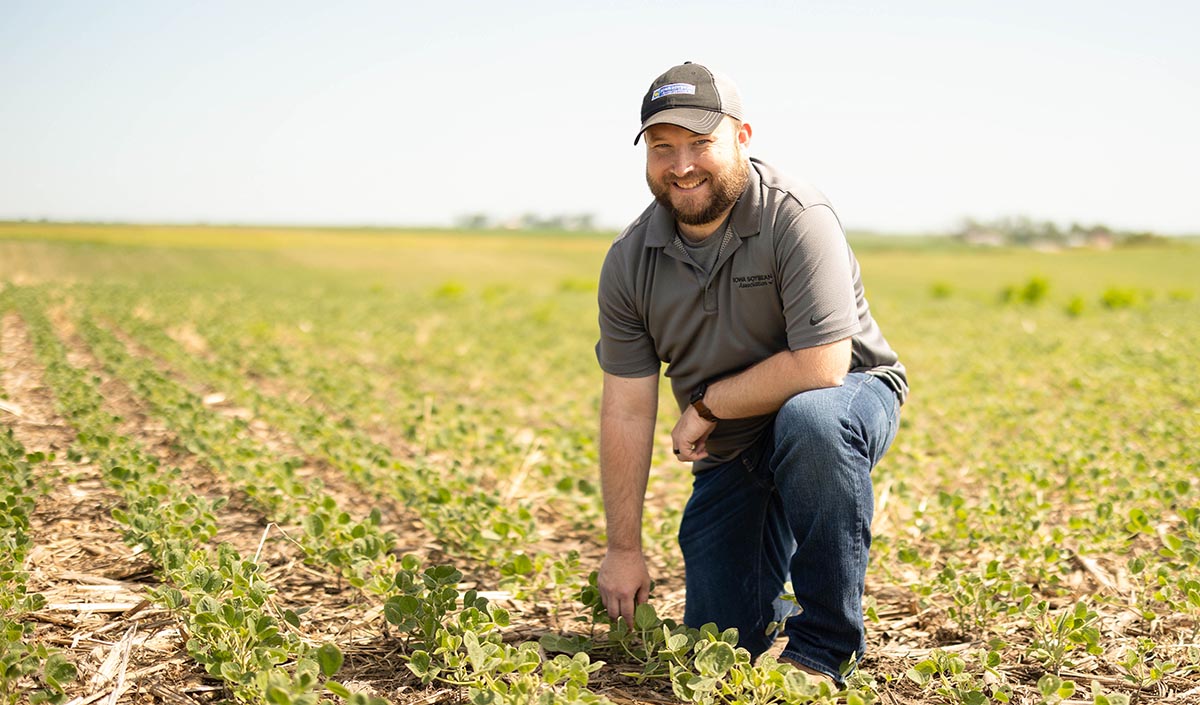
Shane Beck, ISA Research Agronomist. (Photo: Iowa Soybean Association / Joclyn Kuboushek)
Testing nitrogen efficiency across Iowa
April 2, 2026 | Kriss Nelson
Field trials across Iowa in 2026 and 2027 will test how nitrogen-fixing microbes can supplement farmers’ existing nitrogen programs while replacing a portion of their synthetic nitrogen use.
The project, conducted in partnership with the Iowa Soybean Association (ISA) and Pivot Bio, centers on Pivot Bio’s Proven G3, a nitrogen product applied as a seed treatment. Nick Lefler, territory sales manager for west central Iowa, says the product is designed to complement traditional nitrogen sources already used on the farm, adding another form of nitrogen intended to improve overall efficiency.
Statewide trials
The trials will take place on multiple Iowa farms and evaluate several nitrogen strategies. Treatments include substituting portions of a standard nitrogen program, ranging from 40-pound reductions to smaller additions of 20 pounds on top of a grower’s typical practice. The goal is to understand how the product performs within a full-season nitrogen plan, not as a standalone solution.
All rate adjustments follow established best management practices developed through years of in-field experience, ensuring changes are made responsibly and align with sound agronomic principles.
Lefler says the intent is to show how the product can strengthen a nitrogen plan by adding a consistent source with precise placement on corn acres. Applied at planting, the product is designed to attach to the root system and supply nitrogen continuously from germination through key vegetative growth stages, helping fill availability gaps that can occur with traditional nitrogen sources.
For ISA research agronomist Shane Beck, the focus is ensuring the trials deliver credible, farmer-relevant results under real-world conditions. That starts with trial design.
“Conducting replicated strip trials takes out a lot of the variability that exists in fields,” Beck says. “The more replications that can be conducted in a field, the more reliable the outcome will be.”
ISA’s trials are randomized across four different nitrogen rates and paired with seed treated with and without Proven G3. Beck says that level of replication and randomization helps remove unintended bias and increases confidence that differences seen in the field are tied to the treatments themselves.
“This gives us the greatest confidence in the data being accurate,” he says.
Lefler says working with ISA adds an important layer of credibility.
“By working with the Iowa Soybean Association, we are able to provide growers with reliable and trusted third party data that demonstrates how Pivot Bio products can fit into their operation and help improve overall efficiency and profitability,” says Lefler.
Measuring performance
While yield remains the primary driver in evaluating success, Beck says ISA’s role extends beyond measuring bushels.
“That is an important factor when determining if a product is right for the farm or not,” he says. “We are also collecting stand counts and vigor to note any problem areas in the field or differences in treatments.”
ISA is also collecting seed samples to verify that the biological component of the treatment remains active and capable of performing as intended. Beck says ISA works directly with participating farmers to design and execute the trials, while also gathering in-season observations that add context to the final yield data.
In addition to agronomic performance, the trials are structured to evaluate profitability across nitrogen rates. The work aims to help farmers determine where the product fits within their budgets, whether through reducing input costs at lower synthetic nitrogen rates, protecting yield at standard rates, or generating additional return at higher rates. The broader objective is to build a nitrogen program that is more efficient, resilient and profitable across varying Iowa growing conditions.
Looking ahead
While trial locations for 2026 are already set, Beck says ISA is looking ahead to the second year of the study.
“This is a two-year project,” he says. “Although the trials for 2026 are closed, we will still need interested farmers to participate this fall.”
ISA is seeking farmers who apply fall anhydrous and can apply variable-rate nitrogen, ensuring the trial captures a range of real-world management scenarios.
Written by Kriss Nelson.
Back