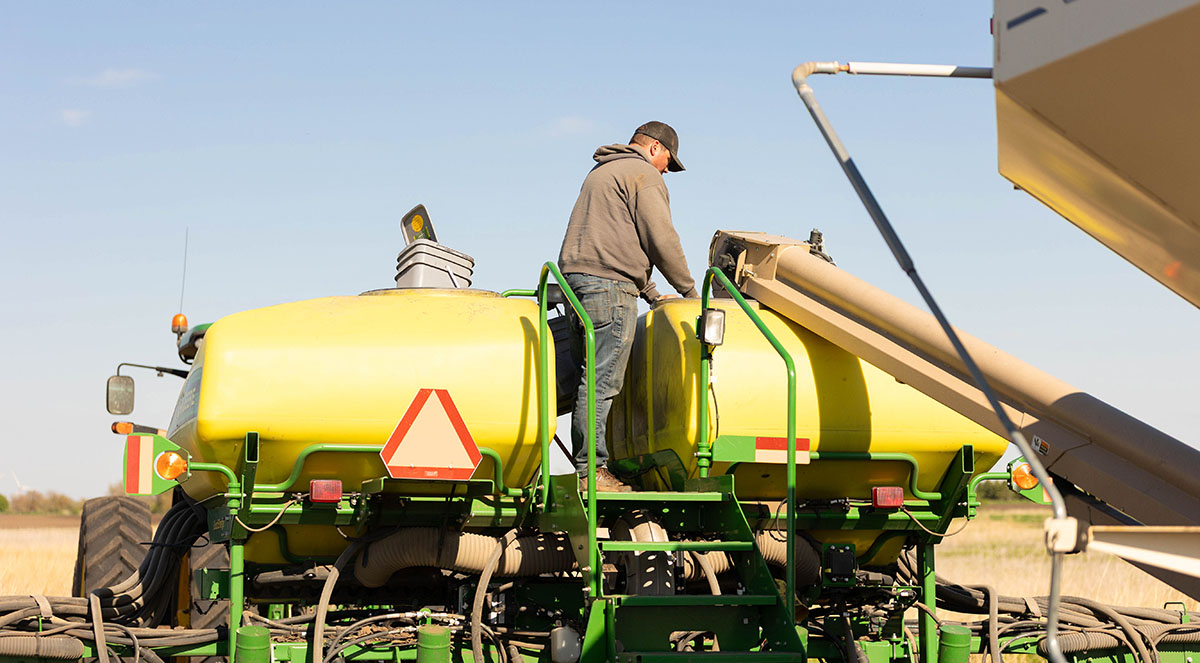
(Photo: Iowa Soybean Association / Joclyn Kuboushek)
Taking Yogi Berra’s advice: Farmers urged to scrutinize whole-farm operations
March 12, 2026 | Aaron Putze, APR
Legendary baseball player Yogi Berra was fond of saying, “If you don’t know where you’re going, you might wind up someplace else."
The Hall of Famer’s quotable line is more than just a humorous play on words. It’s a reminder to plan and prepare so the future is guided more by deliberate actions than by chance.
As the economics of row crop agriculture tighten, Chad Hart, Iowa State University Extension economist, says farmers must scrutinize every aspect of their operations. A good place to start, he says, is understanding what you’re spending—both on and off the farm.
“During the last upturn, we were able to do some things we wanted to do, not just what we needed to do,” Hart said during remarks to farmers and agricultural lenders March 4 in Charles City. “When things go down, it takes a while to adjust. It’s the struggle we had 10 years ago and it’s the struggle we’re having today.”
Knowing lifestyle and production costs, evaluating returns on every acre and pursuing additional revenue streams are always important.
Hart, speaking at an ag seminar sponsored by First Security Bank & Trust, said those steps become even more critical when margins tighten.
The difference between farms that thrive and those that struggle, he said, often comes down to a relentless focus on the details: understanding expenses, managing production costs and identifying opportunities to diversify income.
“I’ve seen farmers lose money when market prices were high and I’ve seen farmers make money when prices are low,” Hart said. “It’s all about controlling costs and keeping them in line with what you want and need to do.”
Knowing your numbers
Tools like the online Ag Decision Maker resource from Iowa State University Extension and Outreach can help farmers analyze their costs of production.
By entering expenses such as machinery, labor, seed, chemicals, fertilizer and land, the tool allows producers to evaluate different yield scenarios for cropping systems such as corn following corn, corn following soybeans and soybeans following corn.
“Most of you needed 221 bushels of corn to cover costs last year, and our state average was 210,” Hart said. “In 2024, we needed 214 and that’s exactly what we got. This year, you’ll need 224.”
For soybeans, per-acre yields needed to break even were 67 bushels two years ago and 64 last year. In 2026, Hart estimates producers will need at least 66 bushels per acre to cover costs.
Farm expenses under pressure
Several major cost categories continue edging higher, including labor, livestock inventories, interest, property taxes, fees and cash rent. Fertilizer costs could also increase due to geopolitical tensions in the Middle East. Meanwhile, feed, seed, pesticides and fuel are seeing modest declines.
“We are truly in global markets for agriculture for all commodities, and not just corn and soybeans,” Hart said.
As countries like Brazil and China expand corn production, their demand for fertilizer also increases.
“Since we don’t produce a lot of the fertilizer we need, we’re having to buy it on the global market at a time when there’s greater demand,” Hart said. “Prices also don’t come down as fast. Just because we might struggle to produce a crop doesn’t mean other parts of the world are.”
The United States produces about 90% of the nitrogen used for crop production domestically. Potash, however, is a different story.
“That number drops to about 3 percent,” Hart said. “That means we’ll always be in the market for potash. Fortunately, a lot of it comes from our neighbor to the north. Unfortunately, we have trade issues with Canada, too.”
Do the math
For corn following corn, Hart estimates production costs at about $960 per acre to produce 193 bushels—resulting in a per-bushel cost of roughly $4.97.
For soybeans following corn, he estimates $680 per acre to produce 61 bushels, putting the cost of production at about $11.13 per bushel.
“Take a hard look at what you’re doing,” Hart said, “because now is not the time when you can afford taking a flyer. You need to scrutinize expenses and make sure they make sense while ensuring the crop insurance coverage you select meets your needs.”
On-farm grain storage can also be an overlooked expense—or an undervalued asset. A 100,000-bushel bin filled with corn represents more than $400,000 in value.
“How often do you check that bin?” Hart asked. “What if it held a suitcase with $400,000 in it? Now how often would you check that bin? Heck, I’d have a cot out in front of it.”
Soybean markets watching China
Soybean markets continue reacting to developments in Brazil and diplomatic discussions between President Donald Trump and Chinese President Xi Jinping.
Brazil is on track for another record crop, increasing global competition for U.S. producers. Meanwhile, attention remains focused on China’s buying patterns.
“We are well below average on our exports because our top market is only halfway into its historic purchases,” Hart said.
Last marketing year, the U.S. went six months without selling a bushel of soybeans to China, contributing to a sharp drop in soybean prices ahead of last fall’s harvest.
Since October, however, China has returned to the market—though not at historic levels.
“So they’re in the market, just not as heavy as they usually are,” Hart said. “Despite that, China remains our largest customer and they may still buy more.”
Land values remain resilient
Strong farmland values continue to provide stability during periods of lower crop prices, Hart said.
The nominal value of Iowa farmland averages $11,549 per acre, up slightly from a year ago. Adjusted for inflation, that value is about $8,475 per acre.
Higher land values typically lead to higher cash rents, which can pressure farm profitability.
“Is this the time to walk away from a parcel?” Hart asked. “Maybe. Perhaps you need to reconsider farming a 20 that’s 20 miles out of the way and not making money.”
Even so, farmland remains a strong long-term investment for both farmers and outside investors.
“Both like to buy land,” Hart said. “And for many farmers, their retirement package is in the soil.”
Looking ahead
Agriculture has weathered downturns before, Hart noted. In fact, the average farmer experiences significant price declines several times during a career.
“They’re going to feel unique, but they are similar,” he said.
Hart compared today’s environment to the downturn that began in the mid-2010s.
“In fact, it’s strange how much things line up,” he said. “The question is whether we stay there again for a while like we did in 2014? This one feels a bit deeper because of how high prices got in 2022.
“But I’d argue the seeds of improvement in our markets have already been sown and things are starting to get better. It’s just going to take us a while to climb out of the hole.”
One bright spot is the livestock sector. Strong global demand for protein—including beef, pork, poultry, eggs and dairy—supports feed demand for corn and soybeans.
“Global demand for protein is strong and it’s beginning to rebuild the engine,” Hart said. “Many countries around the world will need feed grains to produce that meat.”
As incomes rise in developing countries, consumers typically move up the “protein ladder,” starting with plant proteins and poultry before increasing consumption of pork and beef.
“Many in the international marketplace are climbing that protein ladder,” Hart said.
One of Hart’s biggest concerns is the lack of a strong government safety net for farmers.
“For the past 100 years we’ve looked to the farm bill,” he said. “But that structure has fallen apart. The open question is whether it will be rebuilt?”
Additional takeaways
Hart also shared several observations about key agricultural trends:
- The U.S. beef herd is at its smallest level in more than 50 years.
- Pork production continues to grow thanks to productivity gains. “You don’t need as many sows—we’ve gone from an average litter size of nine to 12,” Hart said. “We can produce more pork with fewer sows.”
- Corn yields continue increasing by about two bushels per acre annually. “Even if we change nothing, we’ll produce about 180 million more bushels of corn each year,” Hart said. “We’re always going to produce more, so we need to find people to use more.”
- In 2026, Hart expects corn demand to exceed production. “Demand will remain strong and we’ll use more than we produce,” he said. “Where do you get that demand the fastest? The export market.”
Written by Aaron Putze.
Back