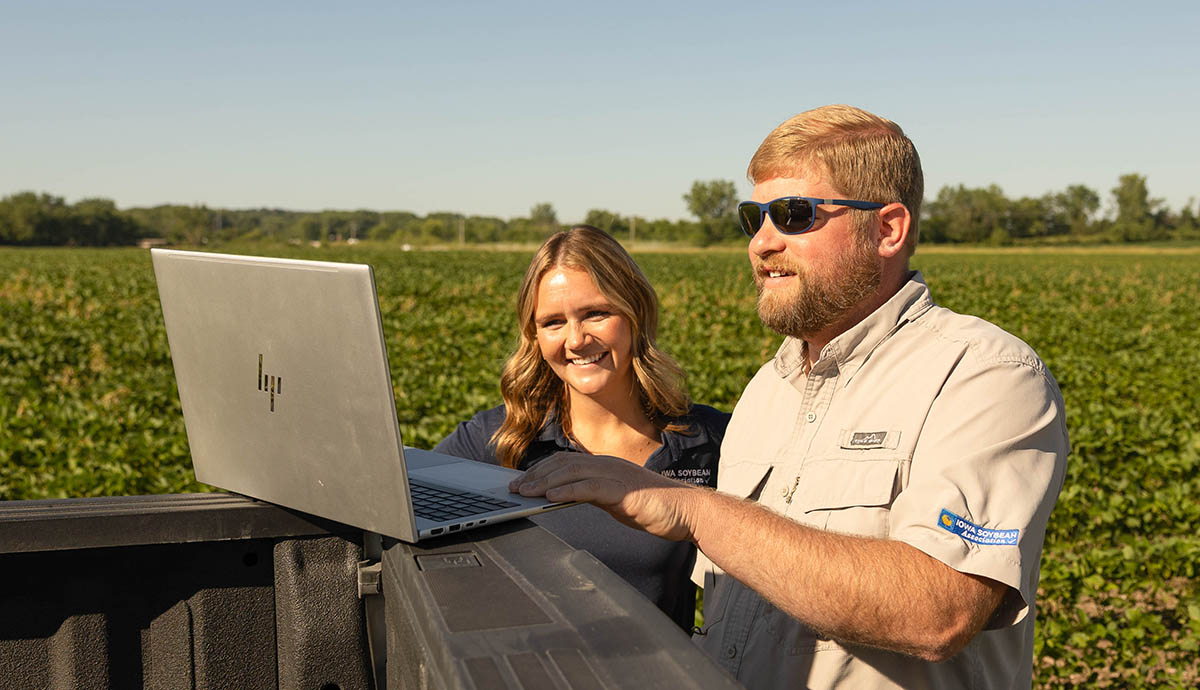
Alex Schaffer, Iowa Soybean Association research agronomist lead, and Avreeanna Tweedy, Iowa Soybean Association research agronomist, evaluate an on-farm research trial. (Photo: Iowa Soybean Association / Joclyn Kuboushek)
Soybean research results in easy-to-read summaries
July 9, 2026 | Kriss Nelson
With tight margins, rising input costs and continued uncertainty in the farm economy, every management decision matters.
That's why the Iowa Soybean Association's Research Center for Farming Innovation continues to invest in on-farm research designed to answer practical questions facing Iowa farmers. But generating the data is only part of the process. Just as important is making sure those results are accessible and useful to farmers making real-world management decisions.
To help accomplish that goal, ISA compiles research findings from multiple on-farm trials across Iowa into easy-to-read research summaries. Dive into those summaries here our though the button below.
On-Farm Research Summaries
"We do probably 150 individual location trials each year across Iowa," says Matt Carroll, ISA science and analytics lead. "The goal is to summarize what we're seeing across the state so farmers don't have to track down 10 or 20 individual reports and compare them themselves."
Cross-site insights
Many of ISA's research projects are conducted across multiple farms and growing environments. While a product or practice may show promise at one location, Carroll says evaluating results across numerous sites provides a better understanding of how consistently that practice performs.
By combining data from multiple locations, ISA can identify trends that may not be apparent from a single field trial and provide farmers with greater confidence when considering management changes.
The summaries, often referred to as cross-site reports, are designed to simplify complex research findings. Each report includes a "Project Insights" section near the beginning, highlighting key takeaways for farmers who want a quick overview before diving deeper into the data.
"We try to make them pretty straightforward," Carroll says. "If you read nothing else, the Project Insights section gives you the key takeaways from that project."
What pays?
The reports also help farmers evaluate return-on-investment potential for various inputs and management practices.
For example, ISA's seeding-rate research has consistently shown that soybean populations can often be reduced without sacrificing yield, potentially lowering seed costs. Across multiple years of research, Carroll says many farmers planting 140,000 seeds per acre or more may be able to reduce populations and increase their profitability.
Other projects have evaluated fungicide and insecticide applications, sulfur fertility, nutrient management strategies and a variety of agronomic practices.
One recent fungicide and insecticide summary found that while applications sometimes provided a slight yield advantage, the return on investment was often marginal. In many cases, fungicide applications made without disease pressure did not consistently pay for themselves.
Similarly, sulfur fertility research in soybeans has shown increased sulfur uptake in some situations, but that response has not consistently translated into higher yields.
Carroll says those findings are especially valuable as farmers begin planning fall input purchases and evaluating next year's crop budgets.
"We try to be as focused on return on investment as we can be," he says. "With current margins, it's worth taking the time to think about your input passes and whether they really pay in today's economic climate."
Written by Kriss Nelson.
Back