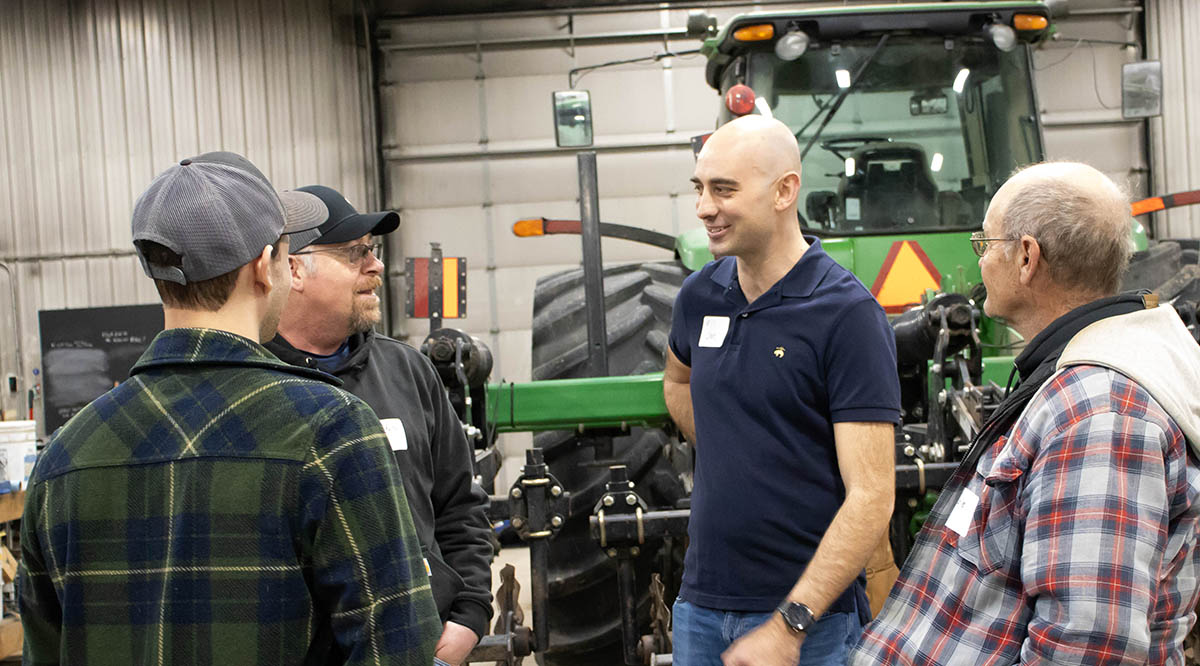
Will Jones, center, Sioux Rapids farmer and host of the Iowa Soybean Association Shop Talk held last week, visits with farmers during the event, sharing experiences on cover crops and management practices. (Photo: Iowa Soybean Association / Kriss Nelson)
Shop Talk brings farmers together for real conversations
March 19, 2026 | Kriss Nelson
Shop Talk isn’t about slides or presentations. It’s about farmers sitting down, asking questions and sharing what’s working on their farms.
That was the focus of a recent Iowa Soybean Association (ISA) Shop Talk, where farmers gathered in an informal setting to talk through everything from cover crops and weed management to equipment and seeding decisions. The format, attendees said, is what makes it work.
“I like it,” says Nick Hanson, a farmer from Estherville. “It’s a good chance for guys to collaborate and ask questions. It’s a really open format that fosters communication.”
Unlike traditional meetings, the conversation is driven by farmers, not a PowerPoint.
“A PowerPoint-style meeting doesn’t always create the best environment to ask questions,” Hanson says. “This format makes it easier to have real conversations.”
That farmer-to-farmer exchange is exactly the goal, says Rob Davis, ISA watershed program manager, as the organization continues to create spaces where farmers can learn directly from each other and from real-world experience.
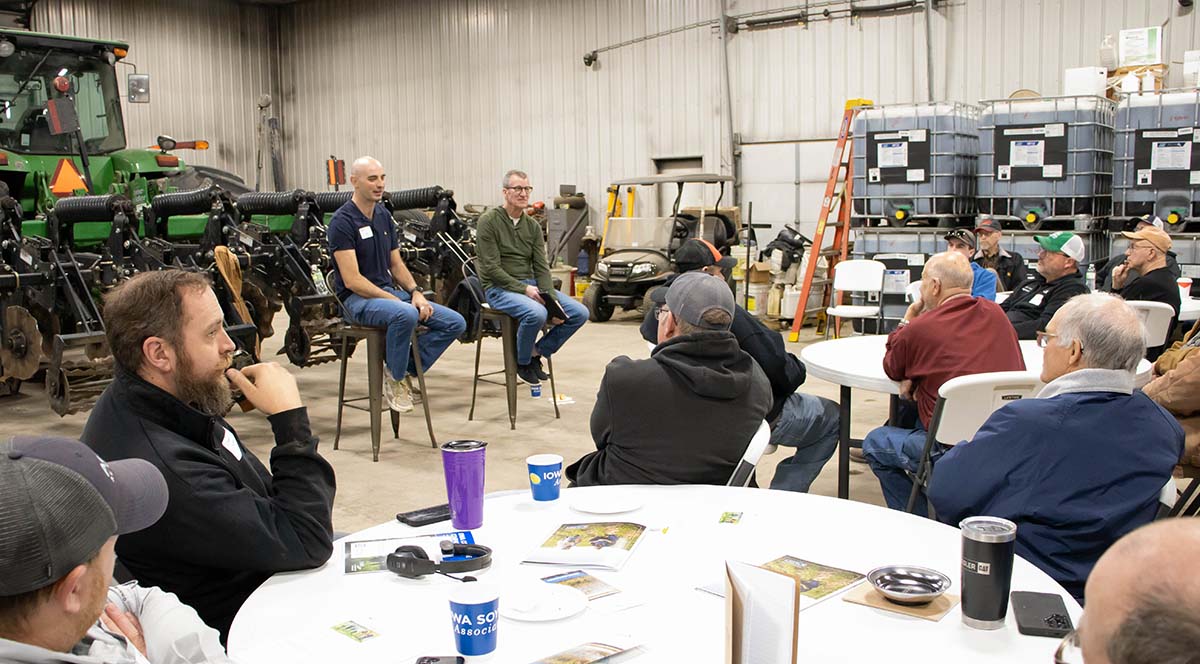
At this Shop Talk, that experience came from ISA district 1 director Paul Kassel of Spencer and host for the morning, Sioux Rapids farmer Will Jones, who led discussion and answered questions throughout the session.
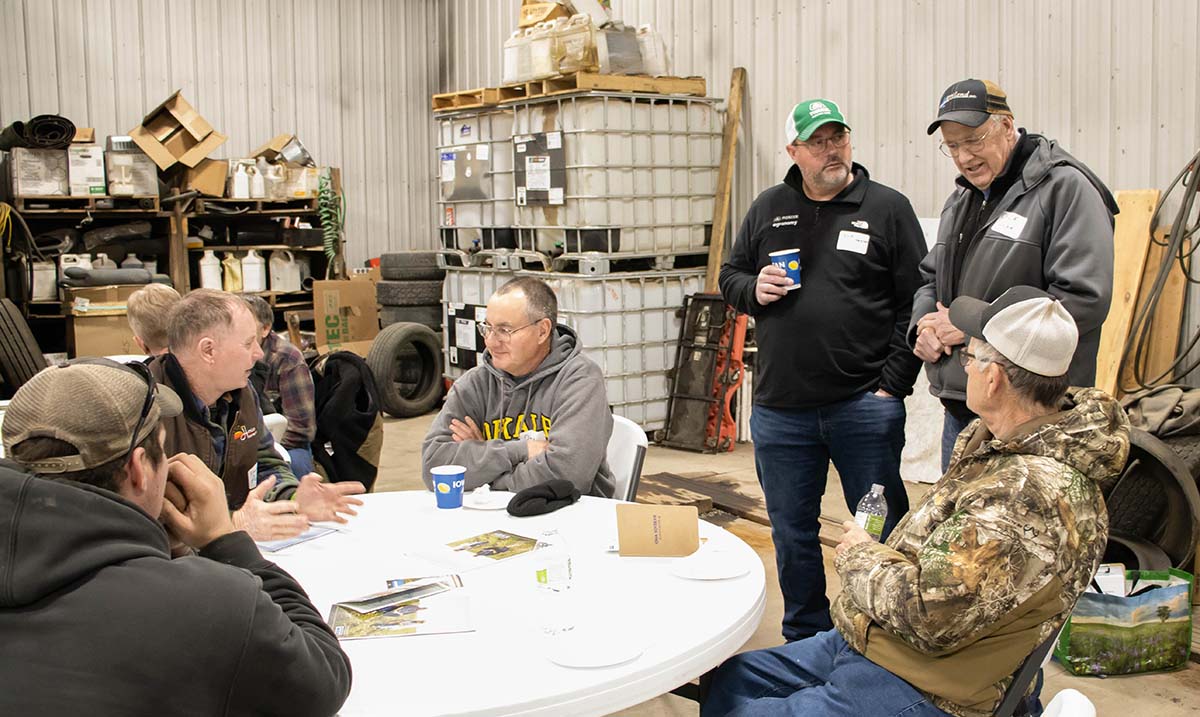
That discussion didn’t stop there. Farmers carried ideas into smaller groups, asking questions and talking through how it could work on their own farms.
Practical experience
Jones shared insights from his diversified operation, which includes corn, soybeans and livestock across roughly 3,000 acres. Building on years of no-till soybeans and strip-till corn, he has expanded into cover crops, forage production and targeted nutrient placement.
“We have cover crops going in front of 100% of our corn acres,” Jones says. “We strip-till corn and no-till soybeans.”
He seeds rye ahead of soybeans but prefers camelina ahead of corn to avoid nitrogen tie-up, noting strong results with that system. He also uses a 2x2 setup on his planter to place nutrients more efficiently.
He also discussed trade-offs with using cover crops for forage, including a year when harvesting rye for feed affected soybean performance due to moisture conditions.
“A lot of it comes down to Mother Nature,” Jones says. “She helps make some of those decisions for you.”
For Jones, hosting the event meant keeping conversations simple and honest.
“I really appreciate this kind of atmosphere where farmers can get together and visit,” he says. “Nobody was selling anything. We were just here talking about what’s worked and what we’ve tried.”
Keep it simple
Kassel brought a similar message, focusing on practical, straightforward approaches to conservation.
“It’s a great way to do it, because you get a lot of farmer-to-farmer conversation,” says Kassel. “When we can talk openly and share ideas, it helps farmers feel more comfortable making changes.”
After Kassel’s presentation, he visited with fellow farmers. Much of the discussion he says centered on nitrogen management and tools like the N-Fact calculator.
“We talked about people’s comfort level using tools like N-Fact to figure their own rates for ammonia this spring,” Kassel says.
Cover crops were another key topic, with Kassel emphasizing how simple the practice can be to implement.
“In my case, it’s pretty easy,” he says. “I make a phone call for aerial application in the fall, and then it’s just a matter of coming back with herbicide after planting. It’s really pretty straightforward.”
That simplicity carries through his entire operation.
“I try to keep things simple,” Kassel says. “My planter isn’t anything fancy, and modern equipment adapts pretty easily. It doesn’t have to be complicated.”
His motivation includes reducing erosion, improving soil health and addressing water quality concerns, but he didn’t adopt everything at once.
“I didn’t jump in 100 percent right away,” he says. “There was some concern at first, but my experience has been very positive.”
Over time, he says, the system has proven both manageable and effective.
“It’s been very easy to do and fit into the operation,” Kassel says. “From an agronomic standpoint, I haven’t seen any negative impact on yields.”
Learning both ways
For Chuck White, a farmer from Spencer and former ISA district 1 director, that exchange of ideas is what makes Shop Talks valuable.
“The Shop Talks are an excellent way to get farmers together,” White says. “It’s a good way to educate farmers and get them sitting one-on-one with each other to find out what we’re doing to improve our farms.”
White has used cover crops for more than a decade and no-till practices for more than 20 years. Those systems, he says, help manage rising costs.
“The cost of production isn’t going anywhere but up, and crop prices are down,” White says. “So you’ve got to cut somewhere.”
At the same time, he says no one has all the answers.
“We all think we’re doing it the right way on our own farms,” White says. “But I’m always looking at how to do it better.”
That mindset, he adds, is critical.
“You can’t be afraid of change,” White says. “You’ve got to keep looking for ways to improve, save money and become more profitable.”
Real conversations
Throughout the event, that willingness to share showed up in both large group discussion and smaller conversations.
Farmers dug into topics like strip-till, seeding rates and alternative cover crops, while also connecting directly with speakers to follow up on ideas. Several attendees said those conversations helped build confidence to try new practices.
For Hanson, that access to other farmers may be the biggest takeaway.
“One of the biggest benefits is having someone you can call and ask questions,” he says. “And they’re willing to share, which is really helpful.”
While cover crops were a central topic, he said the broader value was seeing how different approaches can fit different operations.
“We had someone who’s been doing it a long time and someone just getting started,” Hanson says. “That gives you a chance to hear about different challenges and what might work for you.”
Written by Kriss Nelson.
Back