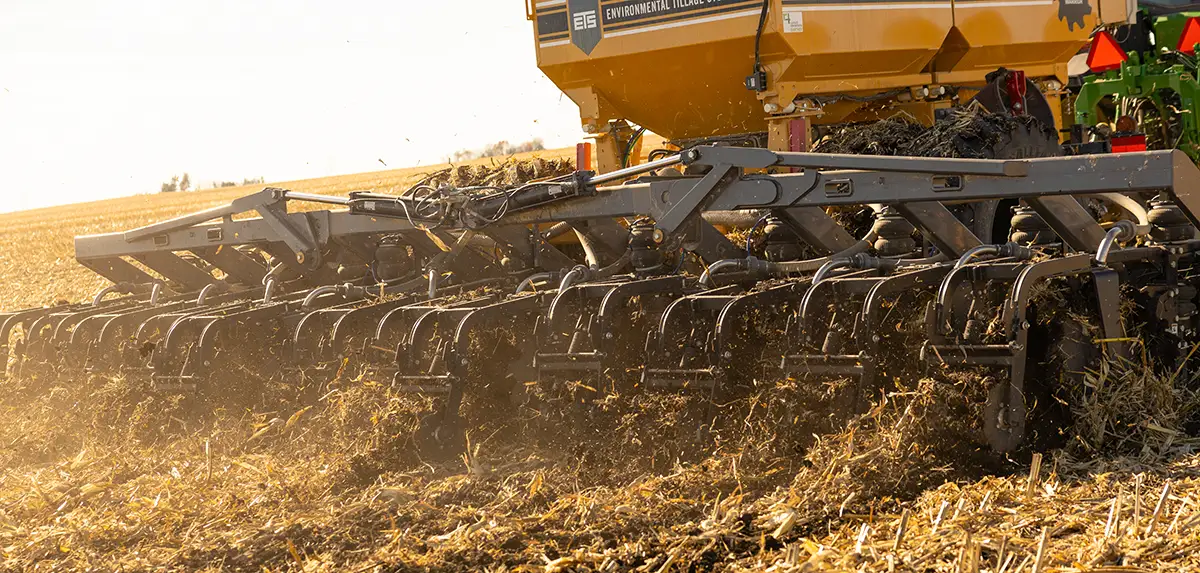
(Photo: Iowa Soybean Association / Joclyn Kuboushek)
Purpose over pass: Balancing costs and compaction in fall tillage
October 15, 2026 | Kriss Nelson
Wet harvest conditions have left ruts and compacted soils in some Iowa fields, raising questions about how to address the damage without unnecessary tillage.
With diesel prices hovering around $6 per gallon, Iowa Soybean Association Research Agronomist Shane Beck encourages farmers to consider both the economic costs and long-term soil health before making another tillage pass.
“Make sure you have a purpose with your tillage this fall,” Beck says.
Unnecessary trips across a field add expenses and disturb soil, but significant ruts and compaction may warrant targeted tillage when conditions are suitable.
Putting costs in perspective
Fuel accounts for a relatively small portion of the total expense of a tillage pass, says Matt Carroll, Ph.D., ISA science and analytics lead.
He references August 2025 estimates from the Department of Agricultural and Consumer Economics at the University of Illinois at Urbana-Champaign, Machinery Cost Estimates: Field Operations, which put the cost of a chisel plow pass at approximately $19.15 per acre.
Using the chisel plow strictly as a cost comparison, Carroll says the operation uses an estimated 0.7 gallon of diesel per acre. At $3 per gallon, that's $2.10 in fuel costs. At $6 per gallon, fuel costs increase to $4.20 per acre, an additional $2.10.
For operations making multiple tillage passes, Carroll estimates the combined increase in fuel costs could be around $3 to $4 per acre.
Other expenses, including equipment ownership, depreciation, labor and overhead, make up much of the total cost of tillage.
“There are a lot of reasons to maybe skip a tillage pass, but I don't think that fuel use itself would be the reason not to,” Carroll says.
Beyond fuel and equipment costs, reducing unnecessary tillage can help protect soil structure, reduce erosion and preserve the benefits of long-term conservation practices.
Carroll encourages farmers to consider the actual cost of a tillage pass and whether it provides enough agronomic benefit to justify the expense.
Consider the crop
Carroll says farmers may have opportunities to reduce tillage expenses without sacrificing yield, particularly ahead of soybeans.
Across multiple data sources, he says soybean yields generally show little significant difference between tilled and no-till systems.
For farmers who routinely till ahead of soybeans, that raises an opportunity to reconsider whether a pass is necessary, potentially reducing expenses while protecting soil structure.
Tillage ahead of corn presents a different situation.
“Tillage in front of corn is a little bit more of a mixed bag. I think it's more regional,” Carroll says.
Some research indicates corn may respond favorably to a degree of tillage, depending on field conditions and location.
Those differences make it important to consider the crop and the expected return before deciding whether to eliminate a pass.
Addressing compaction
This fall's wet conditions add another factor to consider.
Beck says some areas of Iowa experienced wet conditions throughout much of the growing season, with field traffic creating ruts and compaction even before harvest.
As farmers work to get crops out of saturated fields, they may cause additional damage.
Beck says significant ruts and compaction may warrant intervention, but farmers should first evaluate where the damage occurred and whether tillage is necessary across the entire field.
“Maybe we don't work a whole field. We work just the end rows to help minimize some costs there,” Beck says.
Where tillage is necessary, limiting passes to damaged headlands or other high-traffic areas may help minimize soil disturbance and reduce fuel and equipment expenses.
Carroll agrees that unusually wet conditions change the economics.
His general tillage cost comparisons assume normal field conditions. Compaction from harvesting wet fields may justify a pass that otherwise wouldn't provide enough benefit to warrant the expense.
No-till considerations
For farmers who have practiced no-till for decades, wet-weather damage presents another management decision: how to address significant compaction while preserving the benefits of reduced soil disturbance.
Beck says cover crops can help address some compaction, although severely damaged areas may require additional intervention.
Where mechanical tillage is warranted, he suggests considering less aggressive equipment, such as an in-line ripper, to loosen compacted soil while limiting surface disturbance.
That approach may allow farmers to address specific problem areas without abandoning their established conservation practices.
“Once you have compaction, it's going to affect you for years to come,” Beck says.
Leaving significant ruts and compaction unaddressed could create challenges for future crops, including preparing a suitable seedbed next spring.
However, Beck cautions against abandoning management practices that have consistently worked.
If tillage has provided a return on a farm, including incorporating manure or fertilizer, higher diesel prices alone may not justify eliminating it.
He says farmers should consider whether a practice's benefits still outweigh its costs, rather than making broad changes based on fuel prices.
Weed pressure
Beyond compaction, Beck encourages farmers to evaluate areas where excessive moisture caused crops to drown out during the growing season.
Those areas may have developed substantial weed growth, leaving additional residue to manage before spring planting.
Beck says farmers should consider whether that residue could interfere with spring fieldwork before deciding if additional management is necessary. Where tillage is already warranted, a pass may also help break down weed residue.
Timing matters
Although addressing ruts and compaction may be necessary, Beck cautions against working ground before conditions are suitable.
Making a tillage pass on saturated soils can create additional compaction and damage soil structure, potentially making conditions worse.
With harvest running behind normal in some areas and weather continuing to limit fieldwork, farmers may have fewer opportunities to address compaction this fall. If soil remains wet, waiting until spring may be the better option.
“Don't do tillage on wet ground just to do tillage,” Beck says. “You're causing more of a problem than waiting for it to dry out, even if it's waiting until spring to do it.”
Written by Kriss Nelson.
Back